



Search News
Industry Portal
Popular Tags
How to Evaluate a SIL4 Signalling Equipment Exporter for Safety Compliance and Project Risk
Author
Time
Click Count
How to Evaluate a SIL4 Signalling Equipment Exporter for Safety Compliance and Project Risk
A weak evaluation usually starts with the wrong question. Many buyers ask whether a supplier “has SIL4.” In railway signalling, that is too blunt to be useful. SIL4 is not a brand attribute and not a blanket quality label for an exporter. It is a safety integrity level defined under the CENELEC railway safety framework, commonly associated with EN 50126, EN 50128, and EN 50129, and it applies to specific safety-related functions, products, subsystems, and the way evidence is built around them. When assessing a SIL4 signalling equipment exporter, the real task is to determine whether the exporter can prove that its delivered scope, engineering process, documentation chain, and project execution remain compliant in the target application, not merely that a certificate exists somewhere in the company archive.
That distinction matters because signalling export is exposed to two risks at the same time. One is obvious: operational safety. The other is less visible but often more expensive: project failure caused by incomplete compliance evidence, interface mismatches, approval delays, cybersecurity gaps, spare parts constraints, or an inability to support configuration control over the system lifecycle. A technically polished product can still become a commercial and contractual problem if the exporter cannot carry the evidence burden required by the operator, assessor, EPC contractor, or national approval body.
A credible evaluation starts by narrowing the object under review. Are you buying an interlocking, axle counter, point machine controller, onboard ATP element, zone controller, wayside signalling logic, data communication unit, or a package that includes integration engineering? The compliance basis is different in each case. A component with a valid safety case in one architecture does not automatically transfer its acceptance to another architecture, especially where local operating rules, fallback modes, telecom dependencies, or maintainability assumptions have changed. This is one of the most common misunderstandings in export procurement: people treat SIL4 as portable in the same way they would treat a material grade or a voltage rating. It is not.
What should be examined before the certificate itself
Before reading any certificate, look at the exporter’s scope discipline. A serious supplier can identify exactly which function is safety-related, which standards were applied, what assumptions were made in the safety case, what the operating environment was, and where the compliance boundary ends. If the exporter describes everything as “SIL4 certified” without separating hardware, software, application data, and system integration responsibilities, that is a warning sign. In signalling, unclear scope usually turns into change-order disputes or assessor objections later.
The next issue is independence of assessment. Technical evaluators should not only ask for a certificate number; they should ask what was assessed, by whom, under which edition of the standard, and whether the assessment covered product design only or also application conditions, validation, and safety management processes. Independent Safety Assessment, where required by the project or jurisdiction, is not a paperwork ornament. It is part of the trust structure around the system. If the exporter cannot explain how its evidence package interacts with ISA, NoBo, DeBo, AsBo, or equivalent local assurance mechanisms where relevant, the project team will probably end up doing that work themselves under time pressure.
Version control deserves the same level of scrutiny. Railway signalling approval is highly sensitive to software baselines, application data versions, firmware revisions, and field modification history. An exporter may have a compliant product family but weak configuration governance across export lots, subcontracted manufacturing, or localization variants. That weakness is easy to miss during tender review because it does not show up in brochures. It appears during FAT, site testing, and incident investigation. Ask how the exporter manages released versions, change requests, obsolescence, regression testing, and traceability from hazard log to delivered configuration.
Evidence that carries more weight than marketing claims
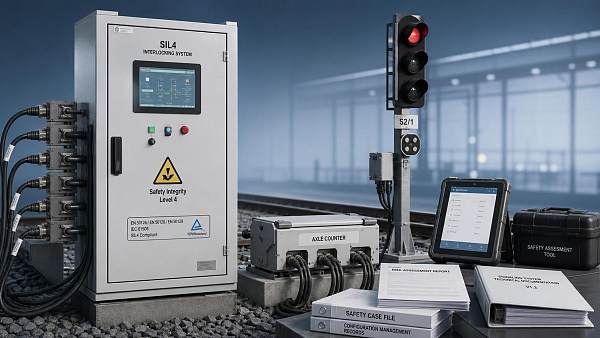
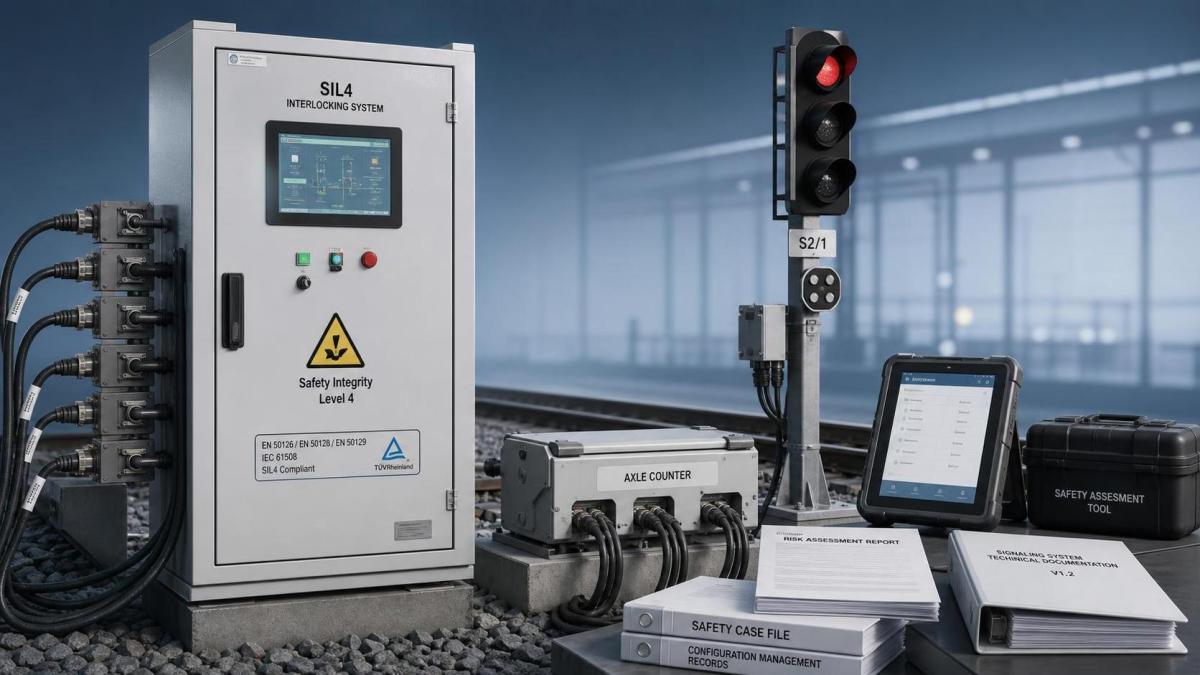
In practice, technical evaluators usually get better insight from the structure of the safety evidence than from the headline certification. A mature exporter should be able to present, at least under NDA where necessary, a coherent documentation set: safety plan, hazard analysis approach, requirements traceability method, verification and validation records, test strategy, software development assurance records where applicable, and the top-level logic of the safety case. No one expects unrestricted disclosure of proprietary design details in early procurement, but a supplier that cannot show how the evidence is assembled is asking the buyer to accept blind risk.
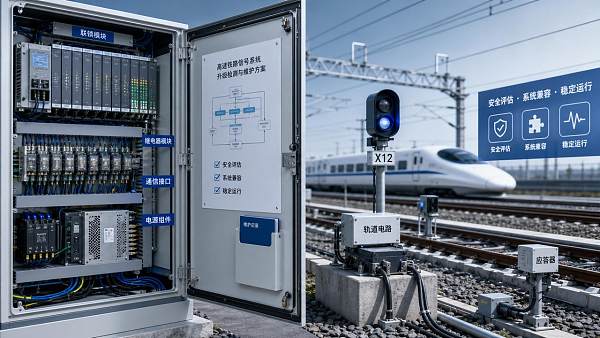
There is also a practical difference between exporters that manufacture a product and exporters that can support a railway project. The latter understand RAMS allocation, interface registers, installation constraints, EMC implications, environmental qualification, and migration planning from legacy signalling. They can discuss not only nominal safety performance but degraded modes, maintenance bypasses, diagnostic coverage, and restoration procedures after failure. These topics rarely sit at the center of sales meetings, yet they determine whether the delivered system behaves acceptably in service and whether the operator can live with it for twenty or thirty years.
A useful way to screen exporters is to separate four evidence layers:
This framework is useful because railway projects fail less often on the narrow question of whether a lab-tested product exists, and more often on the wider question of whether the exporter can preserve compliance through engineering change, localization, and handover.
The exporter’s integration capability is part of safety
A signalling exporter should never be assessed in isolation from its system interfaces. SIL4 functions do not live alone; they depend on power quality, telecom architecture, train detection logic, point actuation behavior, HMI philosophy, operational rules, and sometimes cybersecurity zoning. An exporter that is strong in product design but weak in interface management can transfer major risk to the integrator or operator. Technical evaluators should therefore ask for prior experience with third-party interlocking interfaces, communication protocols, time synchronization, diagnostic systems, and migration into brownfield environments.
This is especially relevant in international projects, where the exporter may be entering a network with different fail-safe design conventions, maintenance competencies, language requirements, or authority approval habits. The challenge is not just whether the equipment can be made to work. It is whether the exporter can produce defensible engineering evidence in the format and pace the project needs. Some suppliers have good products but weak export documentation discipline. Others can support mature approval workflows but rely heavily on custom engineering that expands validation risk. Neither issue is visible if evaluation is reduced to price and headline certification.
Common errors in exporter assessment
One recurring error is treating factory acceptance testing as proof of safety compliance. FAT is important, but it does not replace the structured evidence required by safety standards, nor does it prove that site conditions, application data, and integration assumptions are valid. Another error is overvaluing reference lists without understanding project comparability. A supplier’s previous deliveries may have been successful in metros, but your project may involve heavy haul, mixed traffic, CBTC migration, or national rule overlays that change the assurance burden significantly.
There is also a tendency to assume that a multinational exporter is automatically lower risk than a regional specialist. Sometimes that is true, especially where lifecycle support and assessor coordination are complex. But large exporters can also introduce risk through rigid product platforms, long change-control cycles, or limited flexibility for local adaptation. The right conclusion comes from alignment between the exporter’s safety evidence model and the project’s approval model, not from company size alone.
Cybersecurity now sits close to this discussion as well. In modern signalling, safety and security are not identical, but they increasingly interact. Remote diagnostics, IP-based communications, centralized maintenance access, and software update mechanisms all affect system exposure. A technical evaluator does not need to collapse security into the SIL argument, but should verify whether the exporter has a disciplined approach to secure development, access control, patch handling, and architecture segregation, especially when the delivered equipment is network-connected.
A defensible evaluation method
The most defensible procurement approach is to score an exporter across compliance credibility, engineering maturity, execution reliability, and lifecycle resilience. That means checking whether the certification basis is relevant, whether the safety case assumptions match the intended use, whether configuration control is robust, whether integration responsibilities are explicit, and whether the exporter can sustain technical support after commissioning. For many projects, the difference between an acceptable supplier and a risky one is not the certificate on day one; it is the exporter’s ability to keep every approved assumption intact as the project moves through design freeze, manufacturing, testing, installation, and service.
In other words, evaluating a SIL4 signalling equipment exporter is really an exercise in evidence discipline. The exporter should be able to show where the safety claim begins, what standards support it, which interfaces can invalidate it, and how changes are controlled over time. If that chain is clear, the buyer can make a reasoned decision. If it is vague, the risk is already present, even before the first shipment leaves the factory.
For organizations working across rail and wider transport technology intelligence, this way of reading suppliers matters beyond a single tender. It reflects a broader truth of high-consequence systems: compliance is never just a document status. It is the ability to translate demanding technical standards into repeatable delivery, under real project constraints, without losing control of safety assumptions along the way.
Recommended News
 Sep 24, 2026When should rail operators upgrade to CBTC-based railway automation systems?Railway automation systems: learn when CBTC upgrades deliver capacity, resilience and safer operations—and how to plan a phased, low-risk migration.
 Sep 12, 2026How automatic train control reduces the risk of signal overrunsAutomatic train control reduces signal overrun risk with continuous speed supervision, braking curves, fail-safe responses, and stronger rail safety assurance.
 Sep 02, 2026How to choose train control equipment for signaling reliabilityTrain control equipment for signaling: learn how to assess safety, reliability, interfaces, cybersecurity, and lifecycle support for resilient railway operations.
 Aug 17, 2026When does upgrading railway signaling systems improve line capacity?Railway signaling systems improve line capacity when headways, junction recovery, and service stability become the real bottlenecks. Learn the signs and best upgrade path.
 Aug 04, 2026What Drives Railway Signal Control Systems Pricing in New Rail Projects?Railway signal control systems pricing depends on scope, SIL4 safety, interfaces, testing, and lifecycle support. Learn the real cost drivers to compare bids and avoid overruns.
 Aug 02, 2026How to Evaluate Train Control Systems for Mainline Capacity and SafetyTrain control systems for mainline demand more than feature comparisons. Learn how to assess capacity, safety, interoperability, degraded modes, and migration before you shortlist.
 Jul 31, 2026How to Evaluate a SIL4 Signalling Equipment Exporter for Safety Compliance and Project RiskSIL4 signalling equipment exporter evaluation starts with evidence, not claims. Learn how to verify safety compliance, project risk, integration capability, and lifecycle support.
 Jul 10, 2026SIL4 Signalling Systems: Key Safety Functions and Integration RisksSIL4 signalling systems explained: explore key safety functions, integration risks, and practical evaluation criteria to verify real-world railway reliability.
 Jul 08, 2026Automatic Train Control Fail Safe: Core Design Checks That MatterAutomatic train control fail safe explained: learn the core design checks for braking priority, fault detection, communication integrity, and safer rail system performance.
 Jul 06, 2026Train Control Equipment ETCS: Key Functions, Levels, and Deployment DifferencesTrain control equipment ETCS explained: explore key functions, ETCS levels, deployment differences, and evaluation risks to support smarter rail upgrade and procurement decisions.
 Jun 28, 2026Rail Signalling North America: Standards and Upgrade Priorities in 2026Rail signalling North America in 2026: explore key standards, cyber risks, and upgrade priorities shaping safer, smarter, higher-capacity rail networks.
 Jun 25, 2026How to Compare Railway Control Systems for Safer Network UpgradesRailway control systems comparison made practical: learn how to assess safety, migration risk, interoperability, and supplier capability for smarter, safer network upgrades.
 Jun 24, 2026Railway Automation Systems Standards in 2026: What Is Changing?Railway automation systems in 2026 face stricter standards in safety, cybersecurity, interoperability, and compliance. Discover what is changing and how projects can stay competitive.
 Jun 22, 2026Rail Signalling Basics: Common Failure Points and Safety Upgrade PrioritiesRail signalling basics explained: discover common failure points, risk-based safety upgrade priorities, and practical steps to improve reliability, compliance, and network performance.
 Jun 20, 2026LTE-M Rail Transit: Where It Fits Better Than Legacy WirelessLTE-M rail transit explained: discover where it outperforms legacy wireless in rail monitoring, low-power devices, and scalable telemetry for smarter, cost-efficient operations.
 Jun 16, 2026LTE-M Rail Transit: What to Check Before DeploymentLTE-M rail transit deployment starts with the right checks. Learn how to evaluate coverage, latency, handovers, cybersecurity, and system integration before rollout.
 Jun 15, 2026How to Evaluate Railway Control Components for Safer Signaling UpgradesRailway control components shape signaling safety, uptime, and integration success. Learn how to evaluate compatibility, SIL, resilience, and lifecycle fit before your next upgrade.
 Jun 12, 2026Railway Automation Systems: Key Standards and Performance ChecksRailway automation systems explained through key standards, SIL checks, interoperability, diagnostics, and lifecycle risks—discover how to compare solutions with confidence.
 Jun 10, 2026Railway Control Components: What Matters Most in System SelectionRailway control components selection affects safety, interoperability, and lifecycle cost. Discover the key criteria for choosing resilient rail systems with confidence.
 Jun 08, 2026Rail Signalling vs CBTC: What Matters for Network UpgradesRail signalling vs CBTC: learn what matters for network upgrades, from capacity and interoperability to automation, lifecycle cost, and safer long-term performance.
 Jun 03, 2026LTE-M Rail Transit: When It Fits Signaling, Monitoring, and Field OperationsLTE-M rail transit can strengthen signaling support, asset monitoring, and field operations—learn where it fits, what to test, and how GTOT helps reduce deployment risk.
 Jun 01, 2026Railway Signal Control Systems: CBTC or Interlocking?Railway signal control systems are evolving fast. Compare CBTC and interlocking to assess safety, capacity, cybersecurity, and lifecycle value for smarter rail upgrades.
 May 31, 2026Railway Safety Technology: When CBTC Adds Real ValueRailway safety technology gains real value with CBTC when it improves headway, SIL4 safety, resilience, and lifecycle performance across complex rail scenarios.
 May 23, 2026LTE-M Rail Transit: Where It Fits Best in 2026LTE-M rail transit in 2026: discover where it fits best for low-power monitoring, asset visibility, and cost-efficient rail digitalization across stations, depots, and trackside systems.