



Search News
Industry Portal
Popular Tags
When does upgrading railway signaling systems improve line capacity?
Author
Time
Click Count
It usually starts with a timetable problem that no longer behaves like a timetable problem. Trains are scheduled tightly, dispatchers are constantly adjusting around small delays, platform occupation runs longer than planned, and the team keeps hearing the same explanation: the line needs more capacity. But after a few review cycles, it becomes clear that adding track is not the immediate bottleneck. The network is being limited by the way trains are separated, routed, and recovered after disruption. In that moment, the question shifts from civil expansion to control logic.
Many teams reach this point during resignaling studies, automation planning, or corridor upgrades where traffic has grown faster than the original operating concept. A line may still look acceptable on paper, yet in daily operation the margin between trains is too dependent on ideal conditions. Small variations in dwell time, approach speed, route setting, or recovery handling begin to consume the available headway. That is often when upgrading railway signaling systems starts to improve line capacity in a practical, measurable sense.
When the track is not the first constraint anymore
A common mistake is to treat capacity as a simple count of tracks and platforms. In reality, many lines lose throughput because the signaling design assumes larger protection distances, slower route release, or more manual intervention than current demand can tolerate. If train service frequency increases but the control system still behaves as if long fixed margins are the safest default, the infrastructure may be underused even before any physical limit is reached.
This becomes visible in a few recurring situations. One is when planned headways look reasonable in simulation, but actual operations require larger gaps to stay stable. Another is when junctions become sensitive to minor timetable drift because overlapping movements cannot be authorized efficiently. A third is when a line introduces higher-performance rolling stock, yet braking curves, movement authority logic, or interlocking behavior still reflect older assumptions. In those cases, the signaling layer is not just a safety function; it has become a capacity governor.
That does not mean every busy route needs immediate modernization. Some bottlenecks are still better solved by revising stopping patterns, turnback procedures, dispatching rules, or maintenance windows. The issue is knowing when signaling is the dominant limiter rather than one contributor among many.
The signs that a signaling upgrade is likely to matter
If you are evaluating whether an upgrade is justified, the most useful approach is not to start with technology names. Start with operating symptoms.
One symptom is persistent headway compression failure. The timetable may call for close train spacing, but real operations repeatedly need extra separation to avoid knock-on delay. Another is route-setting latency at stations or junctions where train movements should be fluid but are held by release sequences that do not match current traffic intensity. There is also the familiar pattern of “good peak hours on good days” followed by sharp deterioration whenever dwell times vary, a crossing movement slips, or a recovery turn has to be improvised.
In mixed-traffic environments, the threshold often appears sooner. Passenger, freight, express, and stopping services create uneven braking, acceleration, and occupancy patterns. Legacy logic may maintain safety correctly but leave too little flexibility to absorb those differences. On metro-style lines, the problem may present as unstable service regularity rather than visible route conflicts. Trains can technically run often, but not consistently enough to deliver the intended throughput.
When those conditions repeat, capacity is no longer only a civil or rolling-stock issue. It becomes an issue of train separation philosophy, control responsiveness, and recovery resilience.
Where teams often misjudge the decision
One of the most common misjudgments is assuming that any signaling upgrade automatically increases capacity. It does not. Replacing old equipment with newer equipment that preserves the same operational logic may improve reliability and maintainability without meaningfully changing throughput. That can still be a valid project, but it should not be presented internally as a capacity intervention unless the new design actually reduces practical separation constraints or improves conflict handling.
Another weak assumption is to focus only on theoretical minimum headway. Capacity on a working railway depends just as much on variation management as on nominal spacing. A system that can authorize trains closer together in perfect conditions may still disappoint if it handles degraded modes poorly, requires cumbersome fallback procedures, or lacks enough operational visibility for dispatchers.
A third mistake is leaving future operating concepts out of the decision. If the corridor is moving toward higher automation, denser service, or more integrated traffic management, the value of upgrading railway signaling systems may come from enabling a different control architecture rather than just shaving seconds off current operation. In that case, the project should be judged on staged capability, not only today’s bottleneck.
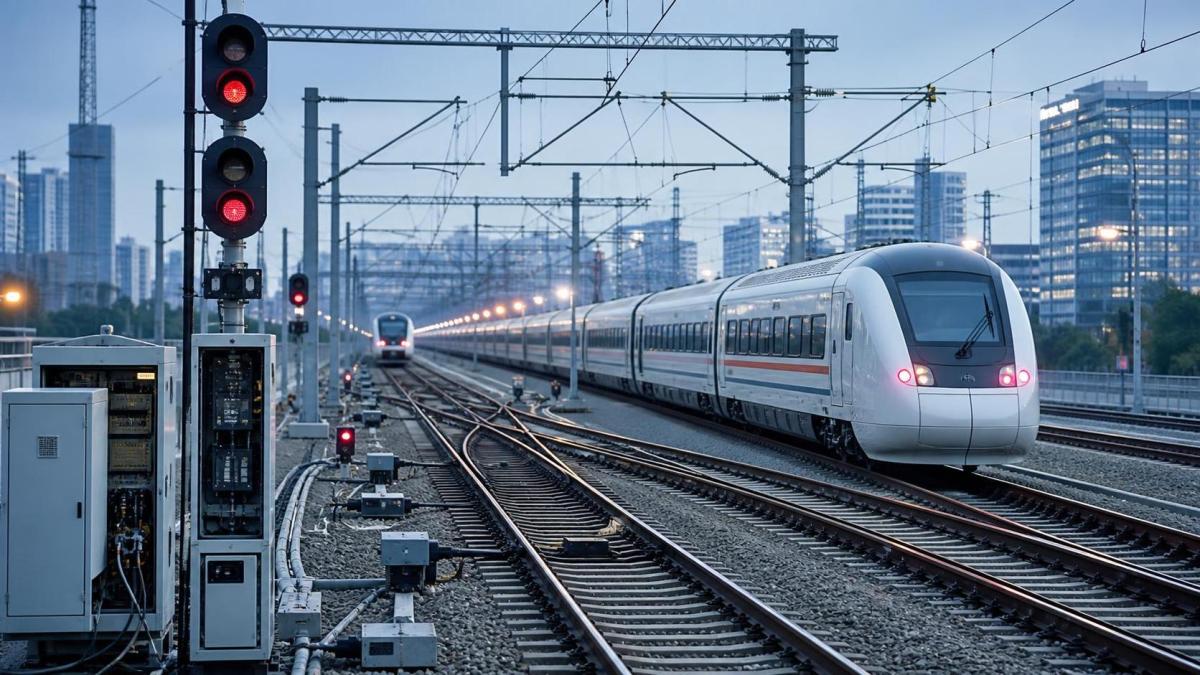
Comparing upgrade paths without getting lost in terminology
Once the need is real, the next challenge is choosing the right level of change. This is where projects often get stuck between “do the minimum” and “replace everything.” A more useful comparison is to ask which upgrade path changes the operating envelope enough to justify cost, possession time, integration risk, and training effort.
For some corridors, interlocking renewal is the practical first step. If the existing system has become difficult to maintain, slow to reconfigure, or constrained in route logic, renewing the interlocking may support better junction handling, cleaner interfaces, and easier future expansion. By itself, however, it may not produce a major capacity gain unless route release behavior, conflict management, or operational flexibility materially improves.
On lines where fixed-block spacing is the dominant limitation, moving toward a more advanced train control approach can matter more. The benefit is not simply “newer technology.” The real value comes from better alignment between train position knowledge, protection margins, and actual traffic needs. Whether that leads to shorter headways depends on braking assumptions, fleet compatibility, station dwell behavior, communication robustness, and the discipline of the operating plan.
Automatic train operation can also change the discussion, especially where line performance suffers from inconsistent driving patterns. More uniform acceleration, braking, and stopping can support tighter and more repeatable service. But automation should not be viewed as a shortcut around weak infrastructure logic. If the underlying signaling architecture still imposes broad constraints, automation alone will not unlock the expected line capacity.
Some projects gain more from integrated traffic management than from a pure field-system upgrade. If dispatchers lack predictive conflict visibility or rerouting support, the line may lose capacity during perturbation even if nominal signaling performance is adequate. In those cases, modernization should be assessed as a combined control-and-operations change rather than as a standalone hardware replacement.
A more reliable way to decide whether the timing is right
When teams ask, “When should we upgrade?” the answer is usually found in the gap between planned service and recoverable service. If the network can only meet target frequency under narrow operating conditions, the upgrade conversation is already late. Capacity that disappears whenever real-world variation appears is not durable capacity.
A practical decision process usually begins with five lines of inquiry.
First, examine where delays amplify rather than merely occur. If minor lateness repeatedly spreads through close-following trains, junction sequences, or terminal approaches, signaling constraints may be reducing the line’s ability to absorb variation.
Second, compare theoretical and usable headway. A timetable might suggest the route can support a certain service level, but if operators routinely add buffer to stay stable, the usable capacity is lower than the designed capacity. That gap is often where modernization value hides.
Third, review route release and conflict points in detail. Busy station throats, flat junctions, and turnbacks can erase the gains of long open sections if movement authority or route locking is too rigid for current service patterns.
Fourth, look at the fleet and braking model. Higher-performance rolling stock does not automatically create more line capacity if the control system cannot take advantage of its characteristics within the safety case.
Fifth, consider the next operating phase, not only the present one. If service growth, automation, or network integration is already planned, an upgrade that only restores maintainability may solve today’s pain while forcing another intervention later.
These questions do not replace formal engineering studies, but they help determine whether the case for upgrading railway signaling systems is operationally mature or still speculative.
What usually belongs in the solution path
For many engineering teams, the most productive path is not a single technology decision but a staged program. The first stage clarifies the real constraint through timetable analysis, control logic review, and bottleneck mapping. The second defines which subsystem changes actually alter throughput: interlocking behavior, train detection granularity, movement authority principles, onboard compatibility, supervisory control, or automation support. The third tests the concept against degraded operation, maintenance access, and migration constraints.
This is also where specialist intelligence becomes useful. Work around rail control components, signaling architecture, traction interaction, and operational evolution should be stitched together rather than evaluated in isolation. If braking behavior, power collection stability, train performance, and signaling margins are reviewed separately, capacity assumptions can become too optimistic. A better approach is to connect those technical layers early, especially on dense or high-speed lines where one subsystem’s limitation reshapes the value of another.
In practice, that means resisting the urge to frame modernization as “install new signaling and capacity will follow.” Instead, define the operational problem in concrete terms: headway instability, junction rigidity, poor perturbation recovery, or inability to support automation. Then choose the upgrade scope that addresses that exact problem.
Situations where upgrading may not be the first move
It is worth saying plainly that signaling is not always the first lever to pull. If station dwell management is erratic, turnaround procedures are weak, maintenance possessions are poorly structured, or rolling-stock availability is driving irregular service, a major control-system project may not deliver the expected relief. The same is true where line capacity is primarily consumed by platforming constraints, terminal geometry, or service pattern design.
In those cases, modernization can still be sensible for safety, obsolescence, or lifecycle reasons, but its role should be described honestly. A project goes more smoothly when everyone involved understands whether the upgrade is meant to increase throughput, improve resilience, prepare automation, reduce maintenance burden, or some combination of those goals.
What to keep in view during project definition
Once the decision leans toward upgrading railway signaling systems, the hard part becomes scope discipline. Capacity-focused projects often drift because too many objectives are attached at once. Try to keep three questions visible throughout definition and procurement: which operational constraint must change, how that change will be verified in service conditions rather than ideal conditions, and what migration path preserves safe operation without creating long periods of reduced availability.
That sounds obvious, but it is where many otherwise capable projects lose clarity. A capacity upgrade is only successful if it changes daily operating behavior, not just the asset register. If the proposed design supports closer train running on paper but introduces cumbersome cutover phases, difficult maintenance transitions, or complicated degraded modes, the short-term burden may offset the intended gain.
The best timing is usually when the line is showing repeatable signs that control logic, separation method, or route handling has become the limiting layer, and when the upgrade can be aligned with a credible future operating plan. Not every busy railway needs immediate resignaling. But when the timetable depends too heavily on perfect execution, when recovery is fragile, and when the infrastructure has more physical potential than the control system can safely release, that is often the point where modernization stops being optional and starts being the practical path to more usable capacity.
Recommended News
 Sep 24, 2026When should rail operators upgrade to CBTC-based railway automation systems?Railway automation systems: learn when CBTC upgrades deliver capacity, resilience and safer operations—and how to plan a phased, low-risk migration.
 Sep 12, 2026How automatic train control reduces the risk of signal overrunsAutomatic train control reduces signal overrun risk with continuous speed supervision, braking curves, fail-safe responses, and stronger rail safety assurance.
 Sep 02, 2026How to choose train control equipment for signaling reliabilityTrain control equipment for signaling: learn how to assess safety, reliability, interfaces, cybersecurity, and lifecycle support for resilient railway operations.
 Aug 17, 2026When does upgrading railway signaling systems improve line capacity?Railway signaling systems improve line capacity when headways, junction recovery, and service stability become the real bottlenecks. Learn the signs and best upgrade path.
 Aug 04, 2026What Drives Railway Signal Control Systems Pricing in New Rail Projects?Railway signal control systems pricing depends on scope, SIL4 safety, interfaces, testing, and lifecycle support. Learn the real cost drivers to compare bids and avoid overruns.
 Aug 02, 2026How to Evaluate Train Control Systems for Mainline Capacity and SafetyTrain control systems for mainline demand more than feature comparisons. Learn how to assess capacity, safety, interoperability, degraded modes, and migration before you shortlist.
 Jul 31, 2026How to Evaluate a SIL4 Signalling Equipment Exporter for Safety Compliance and Project RiskSIL4 signalling equipment exporter evaluation starts with evidence, not claims. Learn how to verify safety compliance, project risk, integration capability, and lifecycle support.
 Jul 10, 2026SIL4 Signalling Systems: Key Safety Functions and Integration RisksSIL4 signalling systems explained: explore key safety functions, integration risks, and practical evaluation criteria to verify real-world railway reliability.
 Jul 08, 2026Automatic Train Control Fail Safe: Core Design Checks That MatterAutomatic train control fail safe explained: learn the core design checks for braking priority, fault detection, communication integrity, and safer rail system performance.
 Jul 06, 2026Train Control Equipment ETCS: Key Functions, Levels, and Deployment DifferencesTrain control equipment ETCS explained: explore key functions, ETCS levels, deployment differences, and evaluation risks to support smarter rail upgrade and procurement decisions.
 Jun 28, 2026Rail Signalling North America: Standards and Upgrade Priorities in 2026Rail signalling North America in 2026: explore key standards, cyber risks, and upgrade priorities shaping safer, smarter, higher-capacity rail networks.
 Jun 25, 2026How to Compare Railway Control Systems for Safer Network UpgradesRailway control systems comparison made practical: learn how to assess safety, migration risk, interoperability, and supplier capability for smarter, safer network upgrades.
 Jun 24, 2026Railway Automation Systems Standards in 2026: What Is Changing?Railway automation systems in 2026 face stricter standards in safety, cybersecurity, interoperability, and compliance. Discover what is changing and how projects can stay competitive.
 Jun 22, 2026Rail Signalling Basics: Common Failure Points and Safety Upgrade PrioritiesRail signalling basics explained: discover common failure points, risk-based safety upgrade priorities, and practical steps to improve reliability, compliance, and network performance.
 Jun 20, 2026LTE-M Rail Transit: Where It Fits Better Than Legacy WirelessLTE-M rail transit explained: discover where it outperforms legacy wireless in rail monitoring, low-power devices, and scalable telemetry for smarter, cost-efficient operations.
 Jun 16, 2026LTE-M Rail Transit: What to Check Before DeploymentLTE-M rail transit deployment starts with the right checks. Learn how to evaluate coverage, latency, handovers, cybersecurity, and system integration before rollout.
 Jun 15, 2026How to Evaluate Railway Control Components for Safer Signaling UpgradesRailway control components shape signaling safety, uptime, and integration success. Learn how to evaluate compatibility, SIL, resilience, and lifecycle fit before your next upgrade.
 Jun 12, 2026Railway Automation Systems: Key Standards and Performance ChecksRailway automation systems explained through key standards, SIL checks, interoperability, diagnostics, and lifecycle risks—discover how to compare solutions with confidence.
 Jun 10, 2026Railway Control Components: What Matters Most in System SelectionRailway control components selection affects safety, interoperability, and lifecycle cost. Discover the key criteria for choosing resilient rail systems with confidence.
 Jun 08, 2026Rail Signalling vs CBTC: What Matters for Network UpgradesRail signalling vs CBTC: learn what matters for network upgrades, from capacity and interoperability to automation, lifecycle cost, and safer long-term performance.
 Jun 03, 2026LTE-M Rail Transit: When It Fits Signaling, Monitoring, and Field OperationsLTE-M rail transit can strengthen signaling support, asset monitoring, and field operations—learn where it fits, what to test, and how GTOT helps reduce deployment risk.
 Jun 01, 2026Railway Signal Control Systems: CBTC or Interlocking?Railway signal control systems are evolving fast. Compare CBTC and interlocking to assess safety, capacity, cybersecurity, and lifecycle value for smarter rail upgrades.
 May 31, 2026Railway Safety Technology: When CBTC Adds Real ValueRailway safety technology gains real value with CBTC when it improves headway, SIL4 safety, resilience, and lifecycle performance across complex rail scenarios.
 May 23, 2026LTE-M Rail Transit: Where It Fits Best in 2026LTE-M rail transit in 2026: discover where it fits best for low-power monitoring, asset visibility, and cost-efficient rail digitalization across stations, depots, and trackside systems.