



Search News
Industry Portal
Popular Tags
How automatic train control reduces the risk of signal overruns
Author
Time
Click Count
How Automatic Train Control Reduces the Risk of Signal Overruns
A signal overrun is rarely caused by one dramatic failure. More often, it develops through a chain of smaller weaknesses: a driver receives restrictive information late, a braking estimate is too optimistic, rail adhesion changes after rain, a temporary speed restriction is not handled as expected, or a control-room instruction reaches the train under pressure. In a dense rail network, that chain can close very quickly.
Automatic train control is designed to break the chain before a train passes the limit of its movement authority. It does not merely “warn the driver.” A properly engineered system continuously compares where the train is, how fast it is travelling, the route it is permitted to occupy, and the distance needed to stop safely. When the operating situation moves outside the safe envelope, the system can apply braking independently of human reaction.
For rail quality and safety teams, this distinction matters. The value of automatic train control is not simply automation. Its real safety contribution is the disciplined conversion of signalling rules, braking assumptions, rolling-stock characteristics, and communication status into enforceable limits on the train.
A signal overrun is a movement-authority problem, not just a driver problem
A signal overrun, often discussed alongside a signal passed at danger (SPAD), occurs when a train goes beyond the point at which it is authorized to proceed. Depending on the railway and signalling architecture, that point may be a lineside signal, the end of a route, the end of a movement authority transmitted by radio, a virtual block marker, or a buffer-stop protection boundary.
The operational consequences vary. On an open main line, an overrun can threaten separation from a preceding train or conflict with a crossing movement. In a terminal, depot, or metro turnback area, the immediate concern may be collision with a stationary train, fouling a junction, or entering a work zone. The same basic risk exists in every case: the train has exceeded the area protected by the interlocking and traffic-management logic.
Traditional signalling reduces this exposure by presenting movement instructions to the driver and by locking routes through the interlocking. That remains fundamental. Yet conventional visual signalling relies on correct perception, correct interpretation, timely braking, and continued driver alertness. These are reasonable expectations, but they are not sufficient as the sole protective layer in high-speed, high-frequency, or degraded operating conditions.
Automatic train control adds supervision between the signalling decision and the physical movement of the train. In practice, the safety-critical portion is usually described as automatic train protection (ATP). Automatic train operation (ATO) may control routine acceleration, coasting, and station stopping, while automatic train supervision (ATS) supports regulation and timetable management. Those functions are often integrated, but they should not be confused: a railway can have driverless-style operating features without weakening the independent authority of ATP to enforce a safe stop.
The protection principle: calculate the stopping boundary continuously
The core mechanism behind automatic train control is a supervised braking curve. The onboard system receives, or derives, a movement authority and associated route data. It also needs reliable train-location information, speed measurement, train length, relevant speed limits, and braking-performance inputs. It then determines whether the train can still stop before the end of its authority.
That calculation is not a simple distance-to-signal check. A train at 80 km/h and a train at 160 km/h may face the same stop point, but their required braking distances are fundamentally different. Gradient matters. So does the confirmed braking capability of the formation, the response time of the brake system, wheel-slide protection performance, wheel-rail conditions, and any safety margin required by the railway’s design rules.
A well-configured ATP function normally establishes several thresholds rather than waiting for one final emergency point. The system may issue an advance warning, enforce a service-brake intervention threshold, and retain an emergency-brake threshold as the final protection barrier. The exact naming and logic vary by system, but the operational idea is consistent: do not leave the decision to brake until there is no recovery margin left.
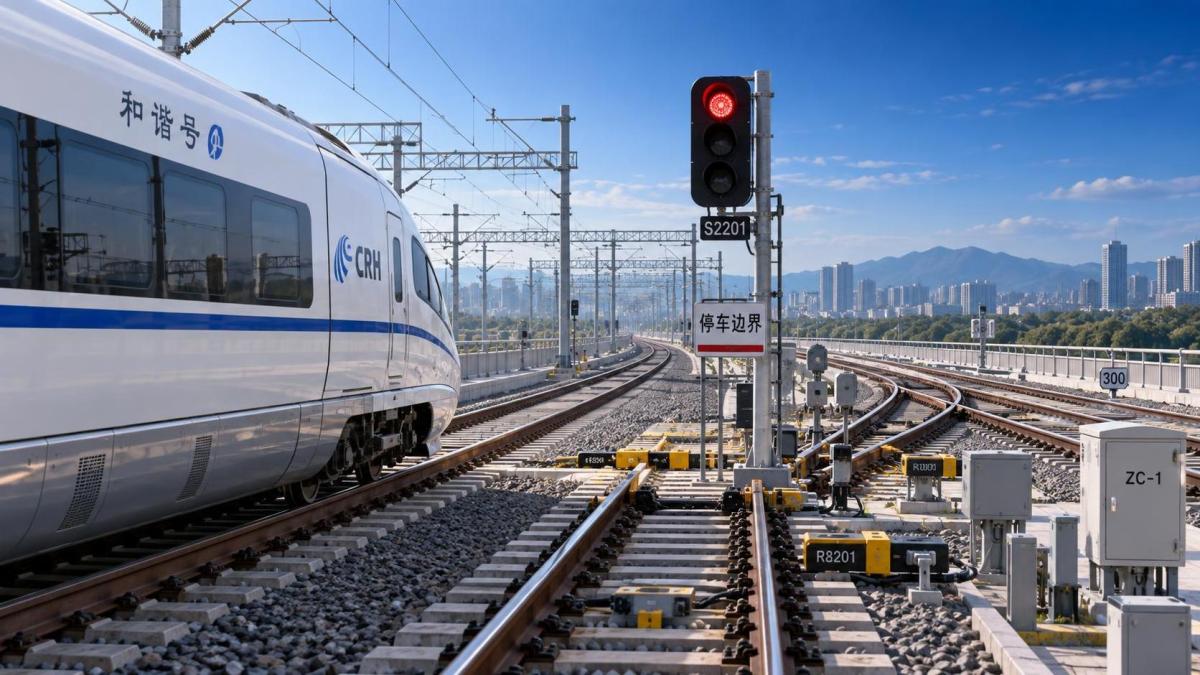
This is why automatic train control is particularly effective against late braking. A driver may see a restrictive aspect but judge the approach incorrectly, be distracted by a radio call, or assume that adhesion is better than it is. The onboard protection system does not make that judgment emotionally or under time pressure. If speed exceeds the permitted curve, it intervenes.
Movement authority must be trustworthy from end to end
The braking curve is only as credible as the movement authority behind it. In a fixed-block railway, the authority may be tied to signal aspects, track-circuit occupancy, axle-counter information, route locking, and balise or trackside transmission. In ETCS-based operation, authority and route data can be conveyed through balises and, depending on the level and design, radio communications. In communications-based train control (CBTC), the system can use continuous bidirectional data exchange and train-borne position reporting to support close headways.
The technology differs, but the safety question is the same: can the train be allowed to proceed only when the infrastructure has proved that the route ahead is safe and available? An interlocking must prevent conflicting routes from being released. Detection systems must correctly establish occupancy or train integrity according to the architecture in use. The onboard controller must interpret restrictions correctly. A weak interface anywhere in that chain can undermine the apparent sophistication of the protection system.
For this reason, quality assurance should not inspect ATP as a standalone onboard product. Signal overrun protection is a system property. It spans interlocking data, wayside equipment, telecoms, onboard software, brake interfaces, odometry, driver-machine interface design, maintenance procedures, and change control.
Why location confidence and braking performance deserve closer scrutiny
Two issues are often underestimated in routine discussions: train position uncertainty and actual braking performance. Both directly affect whether automatic train control can protect the endpoint of authority with adequate margin.
Train location is not always a perfect point on a map. Wheel rotation sensors can be affected by wheel wear, slip, slide, or calibration drift. Trackside reference points, such as balises, can correct accumulated odometry error, but their placement, readability, and encoded data require disciplined inspection. In a radio-based system, the position report must also be treated as a safety input rather than merely an operational data message.
The conservative engineering response is to account for uncertainty in the safe direction. If the system cannot determine the front of the train with the required confidence, it should reduce permitted movement, impose a restrictive mode, or require a defined recovery procedure. Allowing normal-speed operation on the basis of ambiguous localization is precisely the kind of hidden weakness that can later appear as an overrun event.
Braking is equally practical. A braking-rate value entered in a design file may be valid when equipment is new and conditions are controlled; operations take place in a messier world. Brake pad condition, disc temperature, pneumatic response, load state, wheel condition, gradients, and low adhesion all influence stopping behaviour. Composite brake materials, for example, should be assessed for their actual thermal and friction characteristics within the vehicle’s approved braking model, not only for nominal material compliance.
This is where rail control and rolling-stock assurance meet. A signal system may calculate a correct curve using incorrect vehicle assumptions. Conversely, a healthy braking system cannot compensate for a protection system configured with a route-gradient profile or speed restriction that is wrong. The boundary between signalling and traction-and-brake engineering may be organizational, but it is not physical.
Fail-safe behaviour matters most when normal operation is lost
The strongest test of automatic train control is not a clean demonstration run. It is what happens when data is missing, equipment disagrees, a train reverses unexpectedly, a communication session drops, or a temporary restriction is introduced shortly before service begins.
A fail-safe railway design does not assume that every failure produces a convenient warning. It defines a safe response for credible fault conditions. If communication with the movement-authority source is lost, the train may be permitted to continue only under a limited authority, at restricted speed, or not at all, depending on the architecture and operating rule. If a speed sensor becomes unreliable, the system should not silently continue to enforce normal limits using invalid information. If the onboard and wayside datasets do not match, the discrepancy requires controlled handling rather than operator improvisation.
Safety integrity requirements are commonly addressed through railway RAMS and safety-assurance processes, including standards such as IEC 62278 and related signalling-system standards where applicable. However, citing a standard is not evidence that the risk has been controlled. The practical evidence lies in hazard analysis, traceable requirements, verification records, independent assessment where required, configuration baselines, test coverage, and evidence that degraded modes were tested under realistic operating assumptions.
The uncomfortable role of temporary conditions
Permanent route data is usually reviewed repeatedly. Temporary conditions are more vulnerable. Engineering works, possession limits, platform changes, speed restrictions, special operating notices, and partial equipment isolation can all alter the protection context. A temporary speed restriction that is correctly issued in the control room but absent from the onboard dataset is not a paperwork defect; it can change the available braking margin.
Safety managers should therefore examine the full lifecycle of temporary data: authorization, entry, independent check, transmission, activation time, train acknowledgment where relevant, expiry, removal, and audit trail. The difficult question is not whether a process exists. It is whether the process still works at night, during disruption, and when multiple teams are making changes at once.
What quality teams should verify beyond a functional test
A successful demonstration that a train brakes for a red signal is necessary but far from sufficient. The assurance focus should include how the system behaves across its operating envelope. The following checks tend to expose issues that are missed by basic functional testing:
- Trace every enforced speed and stop target back to an approved signalling, civil-engineering, and operating-data source.
- Verify gradient profiles, route distances, train-length assumptions, and speed restrictions after every controlled configuration change.
- Test braking-curve intervention with representative vehicle conditions, including credible low-adhesion and degraded-brake scenarios where the project safety case requires them.
- Review odometry reset, position-reference detection, loss-of-communication, and mode-transition behaviour instead of treating those states as exceptional footnotes.
- Confirm that event logs capture the authority, permitted speed, actual speed, brake demand, driver acknowledgement, and relevant system mode in a form suitable for investigation.
- Assess human-machine interface messages for clarity. An intervention that is technically correct but poorly communicated can create secondary operational risk during recovery.
The event recorder deserves particular attention. After an overrun or near miss, investigators need to establish whether the train received the correct authority, whether the target was calculated correctly, when warning thresholds were crossed, and whether the commanded brake response occurred. Without synchronized, protected, and interpretable logs, the organization may identify a symptom but fail to correct the underlying control weakness.
Automation does not remove operational discipline
There is a common but risky assumption that a protected railway can tolerate weaker driver competence or less rigorous control-room practice. In reality, automatic train control changes the nature of human work. Drivers must understand intervention modes and recovery rules. Signallers and controllers must understand what authority has actually been issued. Maintenance teams must recognize that seemingly minor equipment substitutions, software updates, or sensor changes may affect a safety function.
Automation also creates a temptation to judge performance only by the number of emergency brake interventions. That metric can be misleading. A reduction may reflect safer driving, but it may also indicate altered thresholds, incomplete logging, unavailable protection, or changes in traffic patterns. Quality reviews should combine intervention records with system availability, fault reports, maintenance findings, configuration-change history, and observations from degraded operation.
For organizations studying railway control components alongside high-speed traction and braking technologies, the useful perspective is a connected one. Stable current collection, reliable traction response, braking capability, and signalling supervision all meet at the same operational moment: the train must obey its movement authority under real conditions, not ideal ones. This systems view is central to the technical intelligence work followed across the land-and-sea transport sector by Global Transit & Ocean Tech.
The practical safety test
Automatic train control reduces signal-overrun risk because it turns a safety instruction into an enforceable physical limit. It continuously supervises speed against the distance available, applies braking before the safe stopping boundary is lost, and defaults toward restriction when essential information cannot be trusted.
But the protection is only as strong as its inputs, interfaces, maintenance, and operating rules. The most useful question for a safety review is not “Does the system have ATP?” It is: “Can we demonstrate that this train, with this braking condition, on this route, using this approved dataset, will stop within its authority when a person, component, or communication link does not behave as planned?”
If that question cannot be answered with traceable evidence, the railway has automation—but not yet the level of assurance that signal-overrun protection demands.
Recommended News
 Sep 24, 2026When should rail operators upgrade to CBTC-based railway automation systems?Railway automation systems: learn when CBTC upgrades deliver capacity, resilience and safer operations—and how to plan a phased, low-risk migration.
 Sep 12, 2026How automatic train control reduces the risk of signal overrunsAutomatic train control reduces signal overrun risk with continuous speed supervision, braking curves, fail-safe responses, and stronger rail safety assurance.
 Sep 02, 2026How to choose train control equipment for signaling reliabilityTrain control equipment for signaling: learn how to assess safety, reliability, interfaces, cybersecurity, and lifecycle support for resilient railway operations.
 Aug 17, 2026When does upgrading railway signaling systems improve line capacity?Railway signaling systems improve line capacity when headways, junction recovery, and service stability become the real bottlenecks. Learn the signs and best upgrade path.
 Aug 04, 2026What Drives Railway Signal Control Systems Pricing in New Rail Projects?Railway signal control systems pricing depends on scope, SIL4 safety, interfaces, testing, and lifecycle support. Learn the real cost drivers to compare bids and avoid overruns.
 Aug 02, 2026How to Evaluate Train Control Systems for Mainline Capacity and SafetyTrain control systems for mainline demand more than feature comparisons. Learn how to assess capacity, safety, interoperability, degraded modes, and migration before you shortlist.
 Jul 31, 2026How to Evaluate a SIL4 Signalling Equipment Exporter for Safety Compliance and Project RiskSIL4 signalling equipment exporter evaluation starts with evidence, not claims. Learn how to verify safety compliance, project risk, integration capability, and lifecycle support.
 Jul 10, 2026SIL4 Signalling Systems: Key Safety Functions and Integration RisksSIL4 signalling systems explained: explore key safety functions, integration risks, and practical evaluation criteria to verify real-world railway reliability.
 Jul 08, 2026Automatic Train Control Fail Safe: Core Design Checks That MatterAutomatic train control fail safe explained: learn the core design checks for braking priority, fault detection, communication integrity, and safer rail system performance.
 Jul 06, 2026Train Control Equipment ETCS: Key Functions, Levels, and Deployment DifferencesTrain control equipment ETCS explained: explore key functions, ETCS levels, deployment differences, and evaluation risks to support smarter rail upgrade and procurement decisions.
 Jun 28, 2026Rail Signalling North America: Standards and Upgrade Priorities in 2026Rail signalling North America in 2026: explore key standards, cyber risks, and upgrade priorities shaping safer, smarter, higher-capacity rail networks.
 Jun 25, 2026How to Compare Railway Control Systems for Safer Network UpgradesRailway control systems comparison made practical: learn how to assess safety, migration risk, interoperability, and supplier capability for smarter, safer network upgrades.
 Jun 24, 2026Railway Automation Systems Standards in 2026: What Is Changing?Railway automation systems in 2026 face stricter standards in safety, cybersecurity, interoperability, and compliance. Discover what is changing and how projects can stay competitive.
 Jun 22, 2026Rail Signalling Basics: Common Failure Points and Safety Upgrade PrioritiesRail signalling basics explained: discover common failure points, risk-based safety upgrade priorities, and practical steps to improve reliability, compliance, and network performance.
 Jun 20, 2026LTE-M Rail Transit: Where It Fits Better Than Legacy WirelessLTE-M rail transit explained: discover where it outperforms legacy wireless in rail monitoring, low-power devices, and scalable telemetry for smarter, cost-efficient operations.
 Jun 16, 2026LTE-M Rail Transit: What to Check Before DeploymentLTE-M rail transit deployment starts with the right checks. Learn how to evaluate coverage, latency, handovers, cybersecurity, and system integration before rollout.
 Jun 15, 2026How to Evaluate Railway Control Components for Safer Signaling UpgradesRailway control components shape signaling safety, uptime, and integration success. Learn how to evaluate compatibility, SIL, resilience, and lifecycle fit before your next upgrade.
 Jun 12, 2026Railway Automation Systems: Key Standards and Performance ChecksRailway automation systems explained through key standards, SIL checks, interoperability, diagnostics, and lifecycle risks—discover how to compare solutions with confidence.
 Jun 10, 2026Railway Control Components: What Matters Most in System SelectionRailway control components selection affects safety, interoperability, and lifecycle cost. Discover the key criteria for choosing resilient rail systems with confidence.
 Jun 08, 2026Rail Signalling vs CBTC: What Matters for Network UpgradesRail signalling vs CBTC: learn what matters for network upgrades, from capacity and interoperability to automation, lifecycle cost, and safer long-term performance.
 Jun 03, 2026LTE-M Rail Transit: When It Fits Signaling, Monitoring, and Field OperationsLTE-M rail transit can strengthen signaling support, asset monitoring, and field operations—learn where it fits, what to test, and how GTOT helps reduce deployment risk.
 Jun 01, 2026Railway Signal Control Systems: CBTC or Interlocking?Railway signal control systems are evolving fast. Compare CBTC and interlocking to assess safety, capacity, cybersecurity, and lifecycle value for smarter rail upgrades.
 May 31, 2026Railway Safety Technology: When CBTC Adds Real ValueRailway safety technology gains real value with CBTC when it improves headway, SIL4 safety, resilience, and lifecycle performance across complex rail scenarios.
 May 23, 2026LTE-M Rail Transit: Where It Fits Best in 2026LTE-M rail transit in 2026: discover where it fits best for low-power monitoring, asset visibility, and cost-efficient rail digitalization across stations, depots, and trackside systems.