



Search News
Industry Portal
Popular Tags
Rail Signalling North America: Standards and Upgrade Priorities in 2026
Author
Time
Click Count
In 2026, rail signalling North America is no longer defined by simple compliance upgrades. The market is moving toward selective modernization, where every investment must answer safety, interoperability, cyber resilience, and capacity pressure at the same time.
That shift matters across freight corridors, commuter networks, metro extensions, and cross-border routes. It also matters beyond rail alone, because signalling reliability affects terminal throughput, port connections, energy logistics, and the wider transport chain.
For a platform such as GTOT, which tracks critical rail control systems alongside broader land-sea infrastructure intelligence, the issue is not whether signalling will be upgraded. The issue is which upgrades create measurable value over the next asset cycle.
What rail signalling North America means in 2026
At its core, rail signalling North America refers to the systems that separate train movements, enforce route authority, protect work zones, and support dispatching decisions across mixed traffic environments.
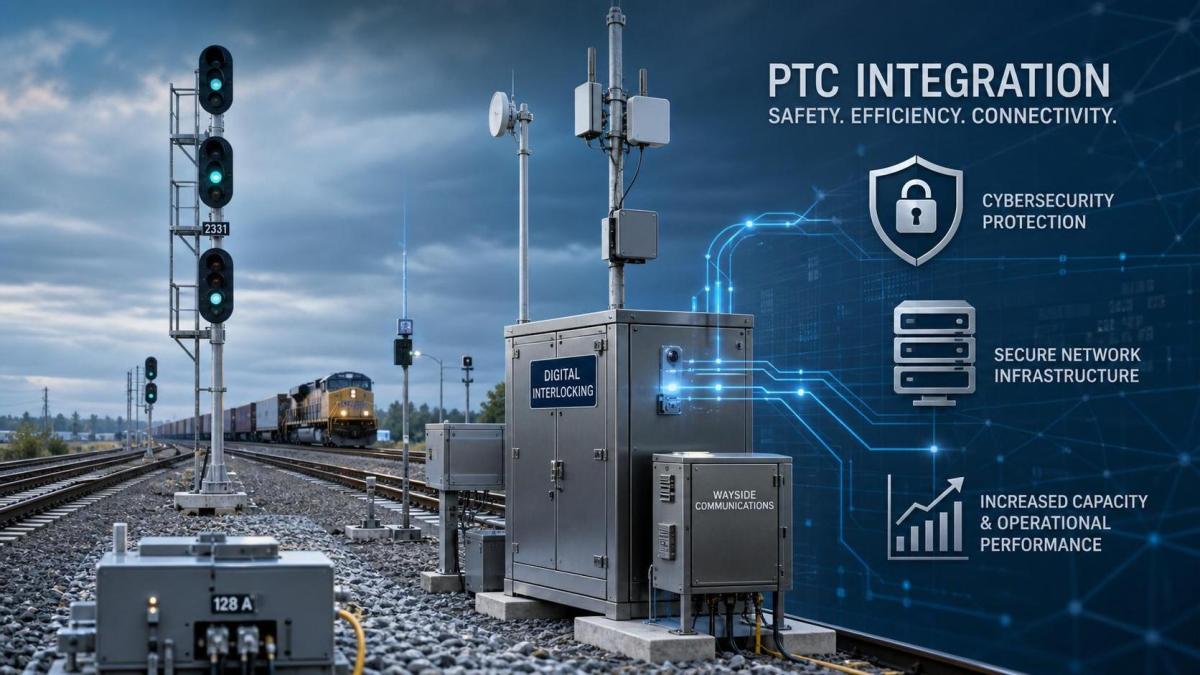
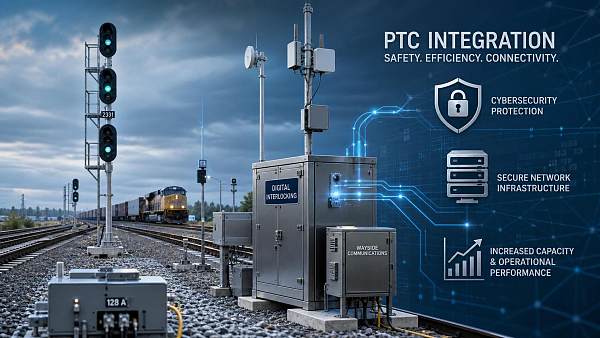
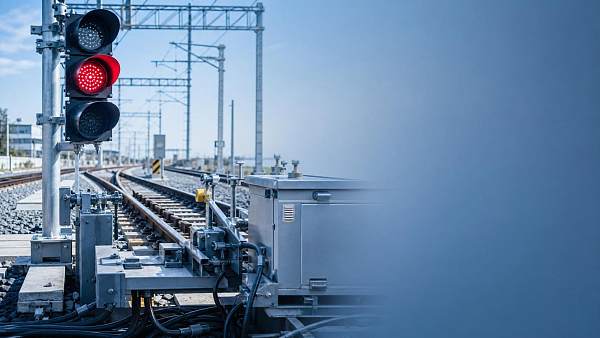
In practical terms, this includes interlockings, wayside signals, train detection, control centers, communication links, onboard interfaces, and the growing integration layer between legacy signalling and PTC.
North America adds a specific complexity. Freight dominance, long routes, dark territory conversions, commuter overlays, and uneven asset age create a different upgrade logic than highly standardized high-speed networks elsewhere.
As a result, technical review in 2026 depends less on headline technology and more on fit. A strong signalling solution must work within existing operational rules, maintenance capabilities, and capital constraints.
The standards picture is broad, not singular
One reason rail signalling North America remains challenging is that compliance sits across several layers. Federal rules, industry standards, safety integrity expectations, and operator-specific practices all shape the final system architecture.
FRA requirements remain central for many projects. APTA guidance matters in passenger settings. AREMA standards continue to influence design choices, documentation practices, and component acceptance pathways.
Safety evaluation increasingly draws on international methods as well. SIL thinking, fault tolerance analysis, and software assurance frameworks now appear more often in North American procurement and validation language.
That does not mean a direct copy of European signalling models. It means buyers are becoming more disciplined about proving hazard control, lifecycle traceability, and interface accountability.
The most useful reading of standards in 2026 is therefore operational. A compliant design is only the starting point. The stronger question is whether the design remains testable, maintainable, and expandable after commissioning.
Where standards pressure is increasing
- Cybersecurity controls for control centers, field devices, and remote maintenance access.
- Configuration management for software-driven interlockings and onboard interfaces.
- Data logging quality for incident investigation and predictive maintenance.
- Human-machine interface consistency in dispatch and maintenance environments.
- Evidence that mixed fleets can operate safely during phased migration.
Why upgrade priorities are changing
Earlier programs often focused on replacing visibly obsolete equipment. In 2026, rail signalling North America is being assessed through a wider performance lens, because the hidden costs of fragmentation are now harder to ignore.
PTC implementation solved important enforcement gaps, but it also exposed integration burdens. Many networks now operate with overlapping control layers, aging relay logic, uneven diagnostics, and vendor-specific maintenance dependencies.
At the same time, traffic patterns are shifting. Intermodal terminals, port rail links, energy corridors, and passenger recovery plans all demand better throughput without reducing safety margins.
This is where GTOT’s wider transport perspective becomes useful. Signalling is not isolated infrastructure. It influences dwell time, equipment utilization, yard fluidity, and the reliability of inland links that support maritime and industrial supply chains.
In other words, the upgrade conversation is moving from “What must be replaced?” to “What removes operational friction over fifteen to twenty years?”
The upgrade areas drawing the most attention
Not every network needs the same modernization package. Still, several upgrade themes are appearing repeatedly across rail signalling North America in 2026.
These priorities are not equal everywhere. A dense passenger corridor may value headway improvements first. A freight-heavy route may focus on resilience, maintainability, and fewer service disruptions during weather events.
How to read value beyond compliance
A signalling project can pass formal review and still deliver weak long-term results. That gap usually appears when decision-making focuses too narrowly on initial capital cost or nominal feature lists.
A more useful framework looks at lifecycle performance. Rail signalling North America often operates in long renewal cycles, with difficult field access and mixed ownership models. That makes maintainability a strategic variable, not a secondary one.
Three questions usually expose real value:
- Can the system simplify future extensions without a full redesign?
- Does it reduce diagnostic uncertainty during service-impacting failures?
- Will spare parts, software support, and engineering knowledge remain available at scale?
This is especially relevant where signalling connects to electrification, braking performance, train control software, and port-facing logistics. GTOT’s cross-domain intelligence model reflects that reality: transport assets perform best when subsystems are judged as part of one operating chain.
Typical scenarios shaping decisions
Several recurring scenarios explain why rail signalling North America needs nuanced upgrade priorities rather than one universal roadmap.
Legacy interlocking replacement
Relay rooms with growing failure rates often trigger modernization. The main issue is not only replacement speed. It is preserving operational continuity while transferring route logic into a digital environment with verified fail-safe behavior.
Cross-border and multi-operator corridors
Interoperability becomes harder when dispatching rules, communication layers, and maintenance organizations differ. Interface governance matters as much as hardware performance.
Passenger capacity expansion
When additional frequency is needed, signalling must support shorter headways without creating brittle operating margins. This often requires better detection quality, faster route setting, and clearer degraded mode procedures.
Freight corridors linked to ports and terminals
In these cases, signalling quality affects more than train movement. It can shape berth schedules, inland container flows, and the reliability of maritime-facing supply chain timing.
Practical checks before committing to an upgrade path
A disciplined review process helps separate attractive concepts from durable solutions. In 2026, rail signalling North America projects deserve close attention in the following areas.
- Asset baseline: identify which failures come from age, which from architecture, and which from maintenance process weakness.
- Interface map: document every connection among interlocking, PTC, dispatch, telecom, onboard equipment, and diagnostic platforms.
- Migration plan: test how old and new systems will coexist during staged commissioning.
- Cyber posture: review remote access, patch governance, and recovery procedures after abnormal events.
- Support model: confirm training depth, spare strategy, software escrow terms, and long-horizon vendor support.
- Performance evidence: ask for operating data from similar climates, traffic densities, and rule environments.
These checks create a more realistic comparison than headline promises. They also reduce the chance of solving one bottleneck while introducing another.
Where the next round of judgment should focus
The most credible decisions in rail signalling North America will come from linking standards review with operating outcomes. Safety remains non-negotiable, but safety cases now need to coexist with cyber discipline, maintainability, and capacity logic.
That is why 2026 is less about buying the newest signalling layer and more about building a reliable modernization sequence. Some networks will start with train detection. Others will gain more from interlocking renewal or cleaner PTC integration.
The next useful step is to build a corridor-by-corridor upgrade matrix. Rank assets by operational criticality, interface risk, obsolescence exposure, and lifecycle burden. Then compare that picture with traffic growth, resilience targets, and available engineering support.
For organizations tracking broader transport performance, this approach also aligns signalling decisions with terminal access, industrial logistics, and long-range infrastructure planning. That is where sharper technical judgment turns into durable network value.
Recommended News
 Sep 24, 2026When should rail operators upgrade to CBTC-based railway automation systems?Railway automation systems: learn when CBTC upgrades deliver capacity, resilience and safer operations—and how to plan a phased, low-risk migration.
 Sep 12, 2026How automatic train control reduces the risk of signal overrunsAutomatic train control reduces signal overrun risk with continuous speed supervision, braking curves, fail-safe responses, and stronger rail safety assurance.
 Sep 02, 2026How to choose train control equipment for signaling reliabilityTrain control equipment for signaling: learn how to assess safety, reliability, interfaces, cybersecurity, and lifecycle support for resilient railway operations.
 Aug 17, 2026When does upgrading railway signaling systems improve line capacity?Railway signaling systems improve line capacity when headways, junction recovery, and service stability become the real bottlenecks. Learn the signs and best upgrade path.
 Aug 04, 2026What Drives Railway Signal Control Systems Pricing in New Rail Projects?Railway signal control systems pricing depends on scope, SIL4 safety, interfaces, testing, and lifecycle support. Learn the real cost drivers to compare bids and avoid overruns.
 Aug 02, 2026How to Evaluate Train Control Systems for Mainline Capacity and SafetyTrain control systems for mainline demand more than feature comparisons. Learn how to assess capacity, safety, interoperability, degraded modes, and migration before you shortlist.
 Jul 31, 2026How to Evaluate a SIL4 Signalling Equipment Exporter for Safety Compliance and Project RiskSIL4 signalling equipment exporter evaluation starts with evidence, not claims. Learn how to verify safety compliance, project risk, integration capability, and lifecycle support.
 Jul 10, 2026SIL4 Signalling Systems: Key Safety Functions and Integration RisksSIL4 signalling systems explained: explore key safety functions, integration risks, and practical evaluation criteria to verify real-world railway reliability.
 Jul 08, 2026Automatic Train Control Fail Safe: Core Design Checks That MatterAutomatic train control fail safe explained: learn the core design checks for braking priority, fault detection, communication integrity, and safer rail system performance.
 Jul 06, 2026Train Control Equipment ETCS: Key Functions, Levels, and Deployment DifferencesTrain control equipment ETCS explained: explore key functions, ETCS levels, deployment differences, and evaluation risks to support smarter rail upgrade and procurement decisions.
 Jun 28, 2026Rail Signalling North America: Standards and Upgrade Priorities in 2026Rail signalling North America in 2026: explore key standards, cyber risks, and upgrade priorities shaping safer, smarter, higher-capacity rail networks.
 Jun 25, 2026How to Compare Railway Control Systems for Safer Network UpgradesRailway control systems comparison made practical: learn how to assess safety, migration risk, interoperability, and supplier capability for smarter, safer network upgrades.
 Jun 24, 2026Railway Automation Systems Standards in 2026: What Is Changing?Railway automation systems in 2026 face stricter standards in safety, cybersecurity, interoperability, and compliance. Discover what is changing and how projects can stay competitive.
 Jun 22, 2026Rail Signalling Basics: Common Failure Points and Safety Upgrade PrioritiesRail signalling basics explained: discover common failure points, risk-based safety upgrade priorities, and practical steps to improve reliability, compliance, and network performance.
 Jun 20, 2026LTE-M Rail Transit: Where It Fits Better Than Legacy WirelessLTE-M rail transit explained: discover where it outperforms legacy wireless in rail monitoring, low-power devices, and scalable telemetry for smarter, cost-efficient operations.
 Jun 16, 2026LTE-M Rail Transit: What to Check Before DeploymentLTE-M rail transit deployment starts with the right checks. Learn how to evaluate coverage, latency, handovers, cybersecurity, and system integration before rollout.
 Jun 15, 2026How to Evaluate Railway Control Components for Safer Signaling UpgradesRailway control components shape signaling safety, uptime, and integration success. Learn how to evaluate compatibility, SIL, resilience, and lifecycle fit before your next upgrade.
 Jun 12, 2026Railway Automation Systems: Key Standards and Performance ChecksRailway automation systems explained through key standards, SIL checks, interoperability, diagnostics, and lifecycle risks—discover how to compare solutions with confidence.
 Jun 10, 2026Railway Control Components: What Matters Most in System SelectionRailway control components selection affects safety, interoperability, and lifecycle cost. Discover the key criteria for choosing resilient rail systems with confidence.
 Jun 08, 2026Rail Signalling vs CBTC: What Matters for Network UpgradesRail signalling vs CBTC: learn what matters for network upgrades, from capacity and interoperability to automation, lifecycle cost, and safer long-term performance.
 Jun 03, 2026LTE-M Rail Transit: When It Fits Signaling, Monitoring, and Field OperationsLTE-M rail transit can strengthen signaling support, asset monitoring, and field operations—learn where it fits, what to test, and how GTOT helps reduce deployment risk.
 Jun 01, 2026Railway Signal Control Systems: CBTC or Interlocking?Railway signal control systems are evolving fast. Compare CBTC and interlocking to assess safety, capacity, cybersecurity, and lifecycle value for smarter rail upgrades.
 May 31, 2026Railway Safety Technology: When CBTC Adds Real ValueRailway safety technology gains real value with CBTC when it improves headway, SIL4 safety, resilience, and lifecycle performance across complex rail scenarios.
 May 23, 2026LTE-M Rail Transit: Where It Fits Best in 2026LTE-M rail transit in 2026: discover where it fits best for low-power monitoring, asset visibility, and cost-efficient rail digitalization across stations, depots, and trackside systems.