Search News
Industry Portal
Popular Tags
Diagnosing Marine Propulsion System Performance Loss From Operating Data
Author
Time
Click Count
A vessel rarely announces propulsion trouble with one dramatic alarm. More often, the warning arrives as a slightly higher daily fuel figure, a shaft that needs more torque to hold the same speed, a small exhaust-temperature spread that keeps widening, or vibration that the crew begins to treat as “normal.” For aftermarket maintenance teams, these small departures are often the most useful evidence.
Diagnosing marine propulsion system performance loss from operating data is not just a matter of finding a number outside a limit. It means comparing today’s behavior with the vessel’s own healthy baseline, separating hull and weather effects from machinery faults, and tracing the pattern back through the propeller, shaftline, engine, controls, and supporting systems. Done well, this process turns routine log data into a practical maintenance decision tool before lost efficiency becomes lost availability.
Start with the operating condition, not the fault list
A common diagnostic mistake is to open a fault checklist as soon as fuel consumption rises. That can lead to unnecessary injector work, turbocharger inspections, or gearbox interventions when the real cause is a fouled hull, stronger current, altered draft, or a vessel operating outside its normal loading profile.
Before interpreting any performance trend, establish what the vessel was being asked to do. The most useful reference set includes vessel speed through water where available, shaft rpm, engine load or brake power, fuel flow, draft and trim, sea state, wind direction, water temperature, displacement, and propulsion configuration. For controllable-pitch propellers, pitch command and actual pitch feedback are essential. For diesel-electric vessels, include generator loading, motor current, converter status, and power-management events.
The question is not simply, “Is fuel consumption high?” A more revealing question is: “At the same draft, comparable sea condition, and similar speed, is the vessel now consuming more fuel or requiring more power than it did during a known healthy period?”
That distinction protects the maintenance team from chasing normal operational variation. It also creates a fair basis for discussing findings with operators, chartering teams, and shore-based technical management.
Build a baseline that technicians can actually use
The best baseline is usually not a manufacturer’s curve in isolation. Shop-test data remains valuable, but a vessel accumulates its own reality: hull condition, propeller wear, intake resistance, fuel quality, route profile, and control-system behavior all influence in-service results.
Create a reference period after dry docking, propeller cleaning, major overhaul, or another confirmed healthy event. Group data by practical operating bands rather than comparing every voyage point against every other point. A maintenance team may use bands such as a defined rpm range, fixed pitch range, displacement range, and sea-state category. The objective is repeatability, not mathematical perfection.
For each band, track a small set of trendable indicators:
- Fuel consumption per nautical mile and, where reliable power data exists, specific fuel consumption.
- Speed versus shaft power, or speed versus fuel flow when direct power measurement is unavailable.
- Shaft rpm, torque, and power demand at comparable vessel speed.
- Exhaust gas temperature before and after the turbocharger, including cylinder-to-cylinder spread.
- Scavenge-air pressure and temperature, charge-air cooler differential pressure, and turbocharger speed if instrumented.
- Lube-oil pressure, bearing temperatures, stern-tube parameters, and shaftline vibration.
- For CPP systems, commanded pitch, actual pitch, hydraulic pressure, and response time.
A single data point can be misleading. A steady shift across several comparable operating periods is much more persuasive. Maintenance decisions should be based on direction, rate of change, and correlation between signals.
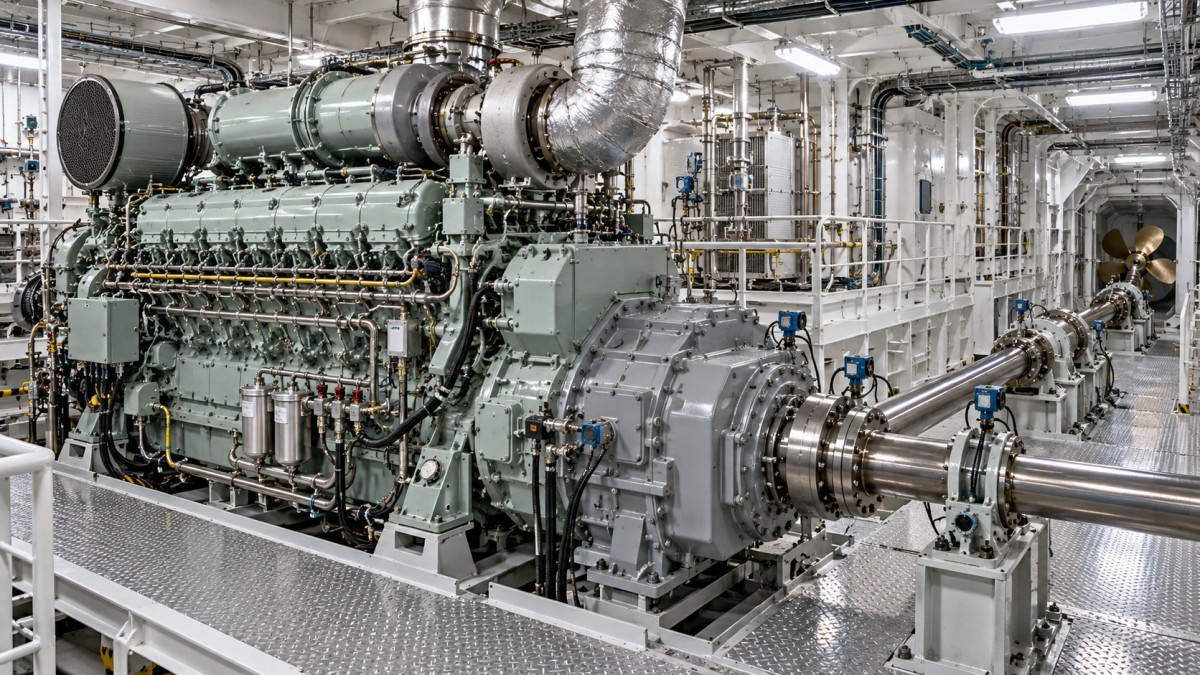
Read the pattern: where is the lost performance likely originating?
Propulsion performance loss generally falls into three interacting areas: increased resistance at the vessel or propeller, reduced power produced by the prime mover, or losses and control problems between the engine and the propulsor. The data signature can help narrow the field.
When the vessel needs more power for the same speed
If shaft power or fuel flow rises while achievable speed falls under comparable conditions, begin by considering external resistance. Hull fouling, propeller fouling, damaged blades, rope entanglement, poor trim, and appendage damage can all shift the speed-power relationship.
A useful clue is the relationship between rpm and power. A fouled hull may require more power across much of the operating range, while propeller damage can introduce stronger vibration, uneven loading, cavitation symptoms, or a change in the relationship between rpm and vessel speed. Do not assume a clean-looking propeller is a healthy propeller; minor leading-edge damage, surface roughness, and pitch distortion can still have operational consequences.
Review dry-dock history, underwater inspection records, route exposure, and the timing of the trend. A gradual decline after months in warm, biologically active waters points in a different direction from an abrupt step change after debris contact or grounding.
When fuel use rises but delivered power does not
If the engine burns more fuel without a corresponding increase in shaft power, investigate combustion, air supply, fuel delivery, and measurement reliability. Rising exhaust temperatures across all cylinders may suggest restricted air supply, fouled charge-air cooling, turbocharger degradation, or changes in fuel properties. One cylinder running persistently hotter or colder than its peers can point toward injector condition, fuel pump timing, exhaust-valve sealing, compression loss, or sensor error.
Temperature spread matters as much as absolute temperature. A slowly widening spread often gives the team time to plan inspection work. A rapid excursion, especially when paired with smoke, unstable load response, abnormal scavenge conditions, or high exhaust backpressure, deserves a more immediate response.
Do not diagnose from exhaust temperature alone. Cross-check fuel rack position or injection command, scavenge pressure, turbocharger behavior, charge-air cooler differential pressure, and cylinder-pressure data where available. In a modern propulsion plant, the strongest diagnosis is usually formed by several modest clues that agree with one another.
When rpm is stable but the ship feels “heavy”
Stable rpm does not prove that the propulsion train is healthy. On fixed-pitch systems, the governor may hold rpm while fuel demand climbs to overcome increased resistance. On controllable-pitch systems, operators may preserve engine rpm while changing blade pitch, which can conceal the source of the problem unless pitch feedback is examined alongside fuel index and speed.
For CPP vessels, compare commanded pitch with actual pitch and hydraulic-system behavior. Delayed pitch response, inconsistent feedback, pressure instability, or a persistent command-versus-actual offset may indicate actuator, servo, valve, linkage, or sensor issues. Mechanical blade problems can produce similar symptoms, so control data should guide inspection rather than replace it.
When vibration rises with no obvious engine alarm
Vibration often tells the story that average performance values cannot. A rise at shaft rotational frequency may indicate alignment changes, shafting issues, or propeller imbalance. Blade-pass-frequency changes can be associated with propeller condition, wake interaction, cavitation, or bearing clearance concerns. Gearbox-related frequencies may point toward gear mesh or bearing problems.
Trend vibration by operating point. A reading taken during acceleration, maneuvering, or heavy weather should not be treated as equivalent to a stable cruise reading. When possible, compare port and starboard machinery on twin-screw vessels; the healthy side can provide a particularly useful real-world reference.
A practical diagnostic sequence for the maintenance team
When performance loss is suspected, the pressure to name a cause quickly can be intense. A structured sequence reduces the chance of replacing sound components while the real issue remains in service.
- Validate the data. Check timestamps, sensor calibration status, missing values, unit consistency, and whether fuel-flow totals agree with bunker and tank records over a meaningful period. A drifting sensor can imitate a machinery problem.
- Normalize the operating context. Compare like with like: draft, trim, route segment, speed target, weather exposure, and propulsion mode. Flag data collected during maneuvering, shallow-water operation, heavy sea states, or transient loading.
- Identify the first deviation. Determine whether the earliest change was in speed-power behavior, combustion indicators, vibration, temperatures, pitch response, or lubrication parameters. The first changing signal is often closer to the cause than the latest alarm.
- Separate resistance from machinery output. If engine health indicators remain stable while power demand rises, inspect hull and propeller condition first. If delivered power falls at similar fuel input, focus on engine, air, fuel, and transmission losses.
- Inspect the highest-probability path. Use data to prioritize accessible checks: filters, coolers, intake paths, fuel condition, oil analysis, sensor connections, control feedback, and visual shaftline or gearbox inspection.
- Confirm after intervention. Repeat the same comparison after cleaning, adjustment, repair, or component replacement. A repair should restore a measurable relationship, not merely clear an alarm.
Signals that should not be averaged away
Some logbook practices unintentionally hide emerging faults. Daily averages are useful for fleet reporting, but they can smooth over short events that matter greatly to diagnosis. Preserve raw or high-resolution trend data around load changes, alarms, pitch commands, clutch engagement, and transitions between propulsion modes.
Pay particular attention to repeated short-duration events: a temporary drop in lube-oil pressure during a certain rpm band, recurring pitch lag during cold starts, exhaust-temperature spikes following a specific fuel transfer, or vibration that appears only at a narrow shaft speed. These patterns may not affect daily averages, yet they often reveal the conditions needed to reproduce the fault.
Likewise, do not dismiss crew observations because they are qualitative. A report that the vessel “takes longer to answer the throttle,” “sounds harsher at 70 percent load,” or “has lost the clean feel of its normal cruise” can be useful when matched to time-stamped operating data. Experienced crew often notice a change before it becomes visible in dashboards.
Common traps in marine propulsion system performance analysis
Comparing speed over ground instead of speed through water. Current can make a healthy plant look weak or hide a real decline. Use speed through water whenever the sensor quality supports it, and interpret GPS-based speed with current data in mind.
Assuming a clean engine means a clean propulsion system. Good combustion data does not eliminate propeller, hull, shaft, gearbox, or CPP-control issues. A propulsion train performs as a system, and losses can migrate between disciplines.
Changing several variables at once. If filters are changed, injectors adjusted, software updated, and pitch calibration performed in the same maintenance window, the team may never know what corrected the condition. Record each intervention and its timing.
Treating OEM limits as the only trigger. A value can remain within an allowable limit while the vessel’s efficiency is already deteriorating. Trend deviation from the vessel baseline alongside absolute operating limits.
Turning operating data into an actionable work order
The final output of diagnosis should not be a vague note that “performance is reduced.” It should translate evidence into a focused action: inspect charge-air cooler fouling; verify cylinder sensor calibration; schedule underwater propeller inspection; sample gearbox oil and review vibration spectrum; test CPP feedback and hydraulic response under controlled conditions.
A strong work order states the affected operating band, the observed deviation, supporting parameters, likely causes, safety implications, and the data needed to verify the result. This improves communication between shipboard engineers, service technicians, OEM support teams, and shore management. It also builds a better historical record for the next event.
For complex fleets, an intelligence-led approach can connect onboard trends with dry-dock findings, component service history, fuel changes, and route conditions. This is where disciplined data practice becomes more than reporting. It becomes a way to protect asset value, reduce avoidable fuel loss, and plan maintenance around evidence rather than urgency.
The goal is earlier certainty, not perfect prediction
No operating-data model can eliminate the need for inspection, sea trial judgment, or experienced engineering review. Marine environments are too variable, and propulsion systems are too interconnected, for a single indicator to provide every answer. But operating data can sharply reduce uncertainty.
When technicians compare like-for-like conditions, watch for linked trends, and test hypotheses in a logical order, marine propulsion system performance loss becomes easier to isolate. The result is not only a better chance of restoring speed and efficiency. It is a calmer, more defensible maintenance process—one that catches deterioration while there is still time to choose the right intervention.
Recommended News
 Oct 15, 2026What Should You Do if an LNG Carrier Propulsion System Fails at Sea?What should I do if an LNG carrier propulsion system fails at sea? Explore urgent actions for navigation, BOG control, safe recovery, and towage planning.
 Oct 20, 2026Marine Propulsion Solutions Compared: Retrofit Constraints, Efficiency, and CAPEXMarine propulsion solution comparison: assess retrofit constraints, duty-cycle efficiency, and true CAPEX to choose a vessel upgrade that controls risk and boosts lifetime value.
 Oct 19, 2026Diagnosing Marine Propulsion System Performance Loss From Operating DataMarine propulsion system performance insights: learn how operating data reveals fuel, power, vibration, and control issues for faster, evidence-based maintenance decisions.
 Oct 18, 2026Ship Propulsion Solution Selection for Variable Routes and Fuel AvailabilityShip propulsion solution selection made practical: compare fuel availability, route variability, lifecycle cost, and resilient options for smarter fleet decisions.
 Oct 17, 2026Which Marine Decarbonization Solution Fits Your Vessel Age, Fuel, and Route?Marine solutions for decarbonization tailored to vessel age, fuel options, and routes. Explore practical retrofit paths, efficiency upgrades, and future-ready strategies.
 Oct 12, 2026Which Marine Propulsion System Is Easier to Maintain?Which marine propulsion system is easier to maintain? Compare direct-drive diesel, CPP, diesel-electric, LNG, and hybrid options for smarter fleet decisions.
 Aug 28, 2026How to select a marine propulsion system for tankers by operating profileMarine propulsion system for tankers: learn how to align propulsion, fuel strategy, propeller performance, redundancy, and lifecycle costs with real operating profiles.
 Jul 15, 2026Class Approved Dual-Fuel Marine Propulsion: Key Certification Points to CheckClass approved dual-fuel marine propulsion explained: learn the key certification points, hidden compliance gaps, and practical checks to improve safety, approval readiness, and supplier selection.
 Jul 10, 2026Dual Fuel Propulsion IMO Compliance: What to Check Before SpecificationDual fuel propulsion IMO compliance starts before spec freeze. Learn the key checks on emissions, IGF safety, class approval, and lifecycle risk to avoid costly redesigns.
 Jul 04, 2026LNG Vessel Retrofit: Key Risks Before Final Scope ApprovalLNG vessel retrofit risks often emerge before final scope approval. Learn how to assess interfaces, yard limits, compliance, and lifecycle value to avoid delays and costly rework.
 Jun 21, 2026How Dual-Fuel Propulsion Cuts LNG Carrier Fuel Risk and EmissionsLNG carriers dual-fuel propulsion cuts fuel risk and emissions by using boil-off gas and liquid fuels flexibly. Learn how it boosts efficiency, compliance, and voyage resilience.
 Jun 18, 2026Dual-Fuel Propulsion: What to Check Before Choosing a SystemDual-fuel propulsion buyers should check fuel strategy, emissions, control logic, safety, and lifecycle cost before choosing a system. Learn what drives real vessel performance.
 Jun 16, 2026Decarbonization Solutions for Maritime Logistics: Which Options Deliver Real ROI?Decarbonization solutions for maritime logistics: discover which upgrades, digital tools, and fuel strategies deliver real ROI, lower risk, and measurable savings for fleets.
 Jun 14, 2026Decarbonization Solutions for Maritime Logistics ComparedDecarbonization solutions for maritime logistics compared: explore LNG, retrofits, AI routing, and smart vessel strategies to cut emissions, control costs, and protect shipping reliability.
 Jun 12, 2026LNG Carriers Dual-Fuel Propulsion: Cost, Compliance, and PaybackLNG carriers dual-fuel propulsion explained: compare cost, compliance impact, and payback to see how fuel flexibility can protect vessel value and charter competitiveness.
![]() Jun 09, 2026Dual-Fuel Propulsion: Cost, Compliance, and Retrofit Trade-OffsDual-fuel propulsion explained: compare cost, compliance, and retrofit trade-offs for vessels, with practical insights on LNG flexibility, asset value, and smarter procurement decisions.
 Jun 08, 2026Dual-Fuel Propulsion: Cost, Range, and Emissions Trade-Offs in 2026Dual-fuel propulsion in 2026: compare cost, range, and emissions trade-offs for ships and transport assets. Learn where flexibility pays off and what to verify before investing.
 Jun 07, 2026Marine Propulsion Systems: Key Efficiency Trade-Offs for New Vessel ProjectsMarine propulsion systems for new vessel projects: compare fuel efficiency, emissions, lifecycle cost, and control trade-offs to choose a smarter, future-ready vessel solution.
 Jun 02, 20262026 LNG Carriers Technology Advancements Reshaping Fleet PlanningLNG carriers technology advancements are redefining 2026 fleet planning with smarter containment, dual-fuel propulsion, AI routing, and compliance-ready performance.
 Jun 01, 2026Marine Propulsion Systems: Cost Risks Before RetrofitMarine propulsion systems retrofits can hide fuel, downtime, compliance, and maintenance costs. Learn how to quantify risks before approval and protect fleet ROI.
 May 31, 2026International Shipbuilding Trends Shaping Dual-Fuel FleetsInternational shipbuilding is shifting toward dual-fuel fleets, reshaping fuel flexibility, asset value, compliance strategy, and maritime competitiveness.
 May 25, 2026LNG Carriers: Choosing Dual-Fuel Propulsion for Lower LossesLNG carriers for global energy transport benefit from dual-fuel propulsion with lower cargo losses, stronger compliance, and better fuel flexibility—see what buyers should evaluate now.
 May 24, 2026Marine Propulsion Technology: Dual-fuel Performance Trade-offsMarine propulsion technology explained: compare dual-fuel efficiency, emissions, methane slip, load profile, and lifecycle risk to choose smarter vessel propulsion strategies.
![]() May 23, 2026Marine Propulsion Systems: Cost vs Fuel EfficiencyMarine propulsion systems decisions should balance cost, fuel efficiency, and compliance. Compare scenario-based options for container ships, LNG carriers, and hybrid routes.