



Search News
Industry Portal
Popular Tags
What Determines Safe Cryogenic Containment Design in LNG Storage?
Author
Time
Click Count
Meta Title: What Determines Safe Cryogenic Containment Design in LNG Storage?
When people assess LNG storage safety, they often start with insulation. That is necessary, but it is not the deciding factor by itself. Safe cryogenic containment design depends on how the whole system behaves at about -163°C: the metal contracts, some materials become brittle, internal pressure shifts with boil-off gas, and the tank structure has to tolerate motion, fatigue, and abnormal events without losing containment. For a technical evaluator, the real question is not “Is the tank cold enough?” It is “Will this containment system stay stable, inspectable, and code-compliant over its full operating life?”
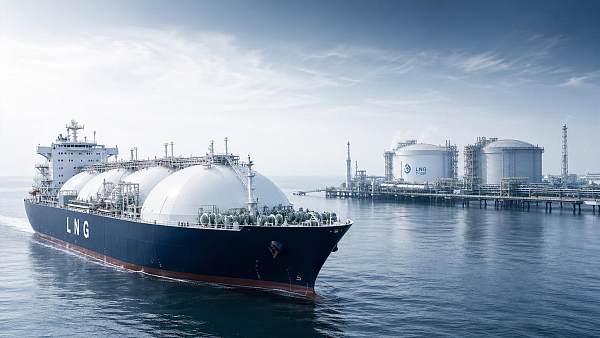
That is where many reviews become shallow. A design can look robust on a datasheet and still carry risk if the material selection, support details, secondary barrier concept, and gas handling philosophy do not match the service profile. LNG carriers, land-based tanks, and bunkering systems share the same thermodynamic challenge, but the evaluation logic is not identical. Marine motion, sloshing, and space constraints create a different design burden than a fixed onshore tank.
Safe cryogenic containment design is a system decision, not a thickness decision
If you need a short answer, here it is: safe cryogenic containment design is determined by the interaction of low-temperature material performance, thermal stress control, structural load paths, leak prevention, boil-off gas management, and compliance with recognized design codes. Weakness in any one of those areas can undermine the rest.
That sounds obvious, yet in practice many people overweight one variable. Some focus on insulation heat leak. Others focus only on maximum allowable working pressure. In LNG service, both matter, but neither tells you enough about actual containment reliability.
The better way to evaluate a design is to ask five practical questions:
- Will the primary barrier keep its toughness and ductility at LNG temperature?
- Can the structure absorb contraction, expansion, and repeated thermal cycling without crack initiation?
- Does the system manage static and dynamic loads, including sloshing or transportation-induced acceleration where relevant?
- Is leakage controlled through secondary containment, detection, and drainage logic?
- Is the design basis aligned with the applicable code, class rule, and operating envelope?
That is the backbone of a serious technical review.
Material behavior at -163°C is where many risks begin
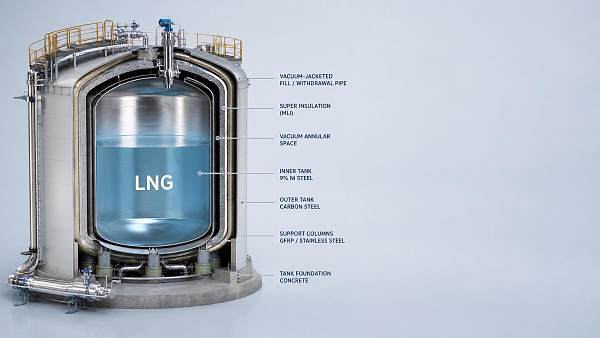
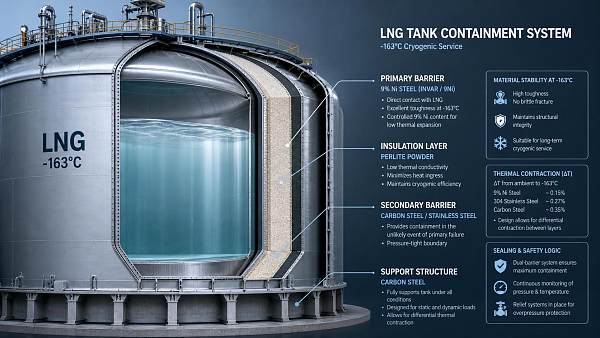
At ambient temperature, a material may perform well and still be a poor choice for LNG containment. Cryogenic service changes the failure mode. Toughness, notch sensitivity, weld performance, and differential contraction become central. This is why LNG tanks do not simply use “strong steel.” They use materials selected for low-temperature integrity, such as 9% nickel steel, austenitic stainless steel, aluminum alloys, or specialized membrane barrier materials, depending on the containment concept.
A common misunderstanding is to treat yield strength as the main screening metric. In cryogenic containment, fracture toughness is often the more important concern. A strong material that becomes brittle under low-temperature stress concentration is not safer. Evaluators should pay close attention to impact test data, weld procedure qualification, heat-affected zone performance, and the compatibility between primary barrier material and supporting structure.
Another point that gets missed: joints are often the real weak link. Parent metal data may look excellent, but containment systems fail at transitions, corners, weld details, penetrations, and support interfaces. If the design review stays at the material grade level and never reaches the detail level, it is incomplete.
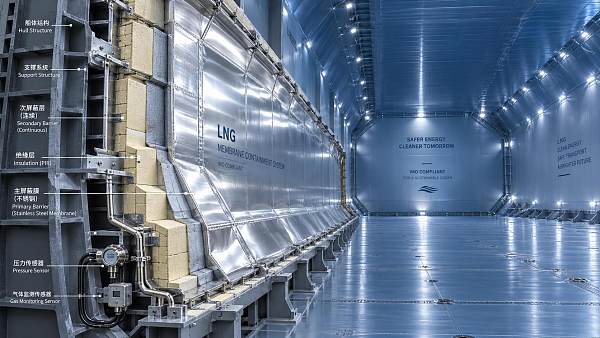
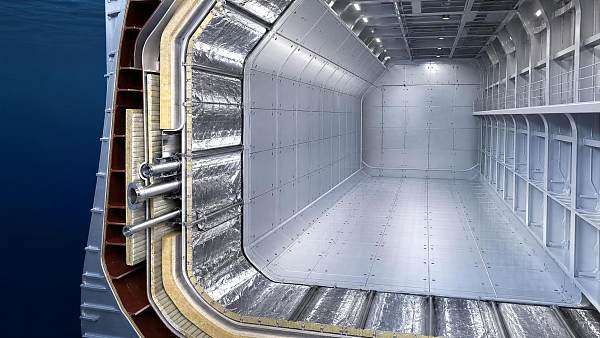
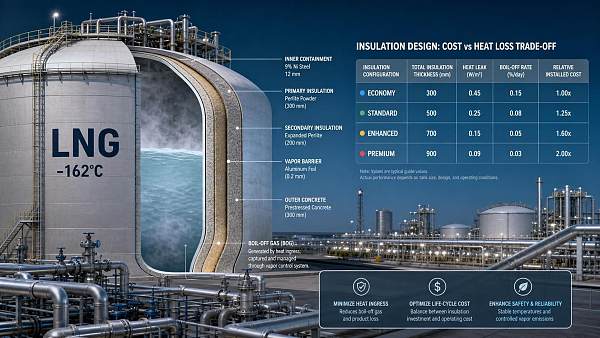
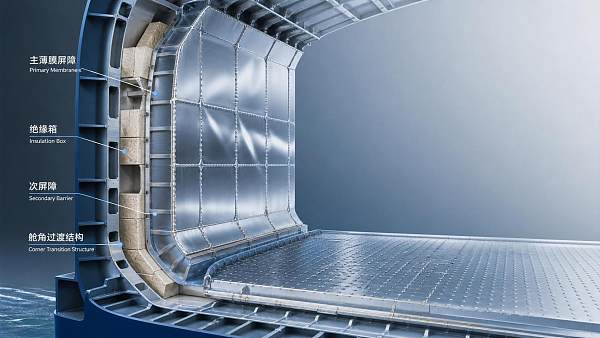
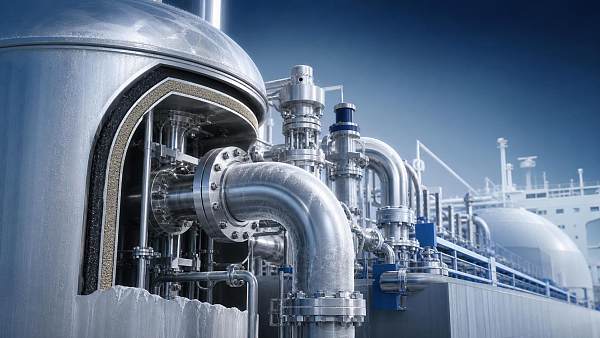
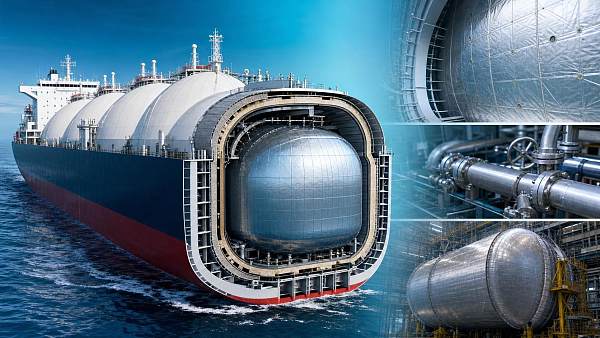
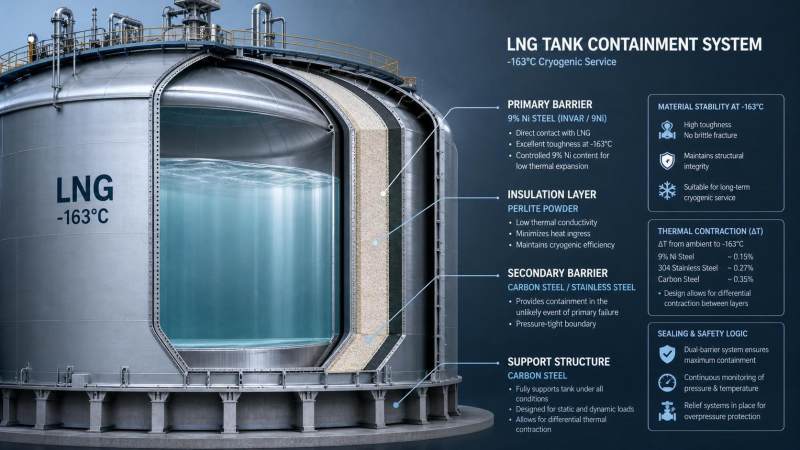
[图片占位符1:LNG storage containment section showing primary barrier, insulation layer, and secondary barrier with stress concentration points marked, alt="cryogenic containment design details in LNG storage tank cross-section"]
Thermal contraction has to be designed in, not corrected later
LNG containment systems move. They are supposed to. As temperature drops from ambient to cryogenic conditions, components contract at different rates. If the design does not allow controlled movement, stress builds up in places that are hard to inspect and easy to underestimate.
This is why support systems, anchor points, sliding arrangements, corner protection, and expansion allowances deserve more attention than they usually get in early-stage evaluation. Thermal contraction is not a commissioning detail. It is a first-order design input.
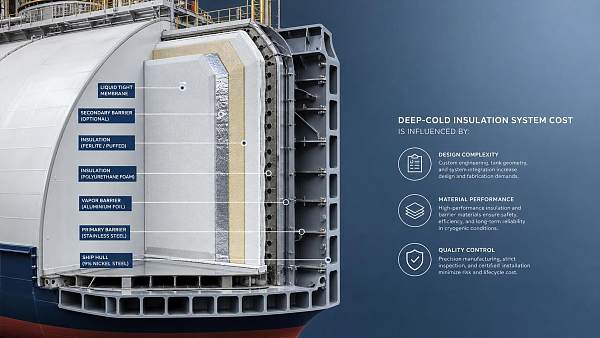
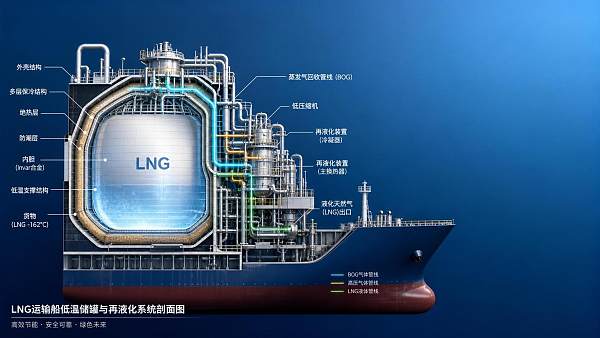
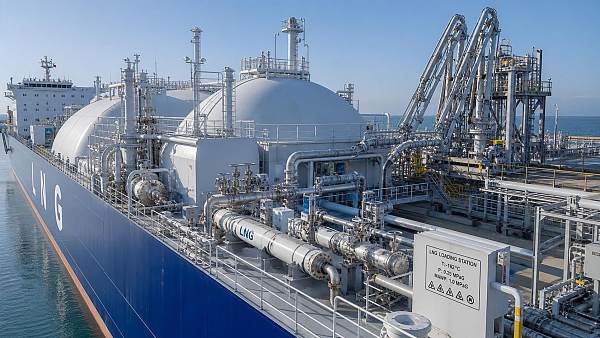
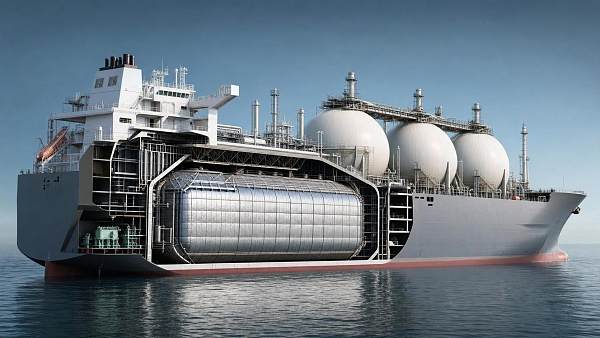
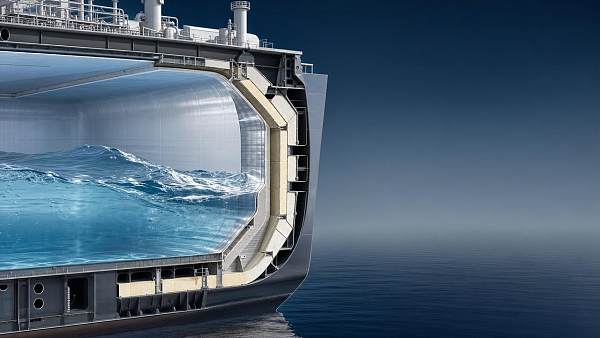
For membrane systems in LNG carriers, the issue becomes even more sensitive because the barrier is thin and relies on a carefully engineered relationship between membrane, insulation boxes, and hull structure. For independent tanks, the movement logic differs, but the same principle applies: restraint where restraint is needed, freedom where thermal movement must occur.
One practical review tip: ask for the designer’s assumptions on cooldown and warm-up cycles, not just steady-state operation. Repeated cycling can expose weakness long before ultimate strength limits are reached.
Structural integrity is not just about internal pressure
Many technical buyers are comfortable evaluating pressure vessels. LNG containment requires a broader lens. Internal pressure matters, but so do hydrostatic loads, ship motion, sloshing impact, support reactions, vibration, fatigue, and accidental load cases such as collision, grounding, overfill, or local insulation damage. The relevant combination depends on whether the asset is offshore, marine transport, terminal storage, or satellite distribution.
For LNG carriers, sloshing deserves special caution. Partial filling conditions can generate dynamic liquid impact loads that are highly localized and difficult to simplify. A containment system that performs well under static analysis may still need additional verification for sloshing-sensitive operations. This is one reason operating restrictions sometimes exist for specific filling levels or voyage profiles.
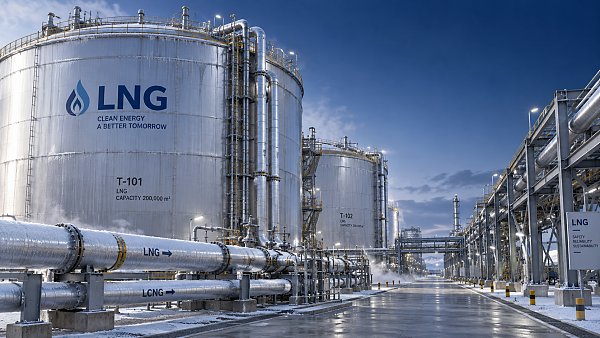
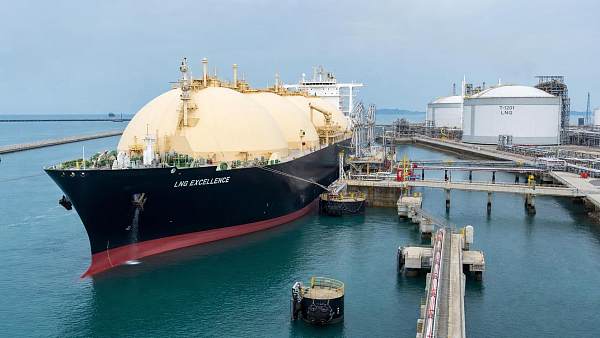
For land-based storage, the structural focus shifts more toward foundation behavior, seismic design where applicable, corner protection, annular space management, and the relationship between inner tank, outer tank, and roof system. Here again, “tank capacity” tells you very little by itself.
If the design package does not clearly define design loads, load combinations, and acceptance criteria, the evaluator is being asked to trust the result without seeing the logic. That is not enough for a high-consequence cryogenic system.
Containment safety depends on what happens after the first leak
No responsible evaluator assumes the primary barrier is infallible. Good cryogenic containment design accounts for abnormal conditions through secondary barriers, insulation space monitoring, leak detection, controlled drainage, pressure relief, and emergency shutdown integration.
This is where design maturity becomes visible. Weak designs often describe prevention well but say much less about consequence control. Strong designs do both.
For example, a very low heat leak figure may look attractive, but if the insulation concept complicates leak detection or makes localized damage harder to identify, the tradeoff needs to be examined. Likewise, a compact arrangement may save space on board a vessel, but if it limits inspection access or makes repair strategy unrealistic, the lifecycle risk rises.
Technical evaluators should also separate “secondary insulation function” from “secondary containment function.” They are related, but not identical. The second barrier must be assessed for its own integrity, exposure duration, and failure consequences under the applicable code framework.
Boil-off gas management is part of containment design, not a separate utility issue
Heat ingress is inevitable. That means boil-off gas is inevitable too. Once you accept that, the design question changes from “Can we avoid boil-off?” to “Can we control it safely under normal and upset conditions?”
Boil-off gas management affects pressure stability, venting philosophy, fuel utilization, relief sizing, and operational flexibility. In marine systems, it also connects directly to propulsion and cargo handling strategy. In terminal or small-scale storage, it influences recondenser logic, send-out consistency, and flare or vent system design where permitted.
A recurring mistake is to treat boil-off gas rate as a simple efficiency metric. It is also a safety metric. If gas handling equipment is undersized, poorly integrated, or dependent on narrow operating assumptions, containment pressure control becomes fragile. That is especially risky during loading, unloading, weather delays, standby periods, or maintenance transitions.
In other words, thermal design and gas management should be reviewed together. Splitting them between separate teams without a common design basis often creates blind spots.
Codes and class rules shape what “safe” actually means
In LNG storage, safety is not judged by engineering intuition alone. It is defined through recognized standards, class rules, and jurisdiction-specific requirements. Depending on the application, the relevant framework may involve IMO IGC Code provisions, classification society rules, API or EN standards, operator specifications, and local regulatory approval. The exact reference set must be confirmed case by case.
That matters because two designs can both claim compliance while working to different assumptions. One may be optimized for an LNG carrier membrane tank under class review. Another may be intended for an onshore full-containment tank with a different hazard basis, inspection regime, and safety margin structure.
For technical evaluation, the right question is not simply “Is it compliant?” It is “Compliant with what design basis, for what service, and with what limitations?” If those boundaries are vague, the compliance claim has limited value.
This is also where intelligence sources such as GTOT can be useful in a narrow, non-promotional sense. For teams tracking LNG carrier containment trends, membrane stress analysis topics, and evolving marine equipment practice, sector intelligence helps evaluators compare design claims against broader industry direction. It does not replace code review, but it can sharpen the questions worth asking.
What experienced evaluators usually check first
People newer to LNG assessment often start with brochure-level parameters: tank type, capacity, insulation thickness, daily boil-off rate. Those are relevant, but experienced reviewers usually move quickly to a smaller set of harder questions:
- What is the failure mode the designer is most worried about?
- Where are the highest thermal gradients and stress concentrations?
- How are welds qualified and inspected at critical locations?
- What happens during partial-load operation, cooldown, and emergency shutdown?
- What inspection access remains after installation?
- What assumptions become invalid if the operating profile changes?
Those questions tend to reveal whether the design is robust or merely adequate under ideal conditions.
Another useful distinction is between designs that are technically impressive and designs that are operationally forgiving. The second group is often safer in real service. LNG systems live through weather, schedule pressure, maintenance deferrals, crew variability, and aging. A containment concept that depends on perfect execution every day may still be a weak long-term choice.
Where evaluations often go wrong
Three mistakes show up repeatedly.
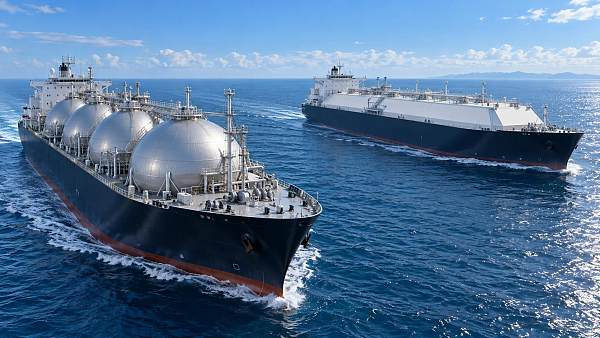
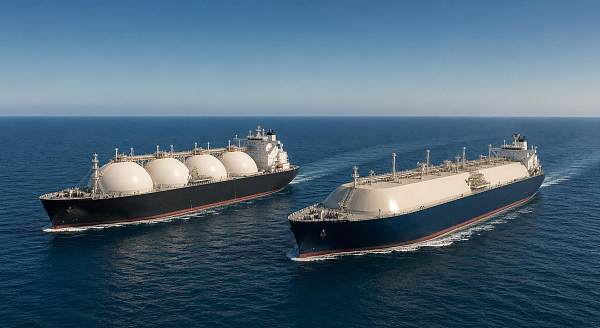
First, treating all LNG containment concepts as interchangeable. Membrane tanks, Moss-type tanks, Type C tanks, and onshore full-containment systems solve different problems. Comparing them without reference to operating context leads to bad decisions.
Second, reviewing capital efficiency without enough lifecycle thinking. A lower initial cost can disappear quickly if inspection, repair, gas handling losses, or operational restrictions are worse than expected.
Third, assuming the safety case is proven by precedent alone. “This design has been used before” is useful background, not a complete assessment. Service route, filling pattern, maintenance philosophy, and regulatory environment may be different this time.
That is why safe cryogenic containment design should be judged as a combination of material science, structural engineering, thermal management, operational realism, and code discipline. Remove any one of those, and the evaluation becomes fragile.
FAQ
Is insulation thickness the main factor in LNG containment safety?
No. It affects heat ingress and boil-off, but safety also depends on low-temperature material toughness, structural load management, secondary containment, and code-compliant pressure control.
Why are welds such a critical issue in cryogenic service?
Because low temperature can amplify brittleness and stress concentration effects. A qualified base material is not enough if weld procedures and heat-affected zones are not validated for cryogenic duty.
Does a lower boil-off rate always mean a better design?
Not automatically. A lower boil-off rate can be beneficial, but not if it comes with poorer inspectability, more difficult leak detection, or tighter operating constraints.
Are marine and onshore LNG containment evaluations basically the same?
No. They share cryogenic principles, but marine systems must handle motion, sloshing, and class-specific design cases that do not apply in the same way to fixed onshore tanks.
图片占位符清单
图片占位符1:建议放在“Material behavior at -163°C is where many risks begin”段落之后;内容为LNG储罐或船用围护系统剖面,标出主屏障、绝热层、次屏障及应力集中区域;alt="cryogenic containment design details in LNG storage tank cross-section"
内链锚文本建议
- Membrane containment systems in LNG carriers:建议链接到船舶围护系统解析页面
- How boil-off gas management affects LNG safety:建议链接到BOG处理专题页
- Material selection for -163°C LNG service:建议链接到低温材料技术文章
- LNG carrier classification and safety standards:建议链接到规范标准汇总页
- Sloshing load risks in marine LNG storage:建议链接到船载动态载荷分析页面
外部权威来源建议
- 国际海事组织相关规范页面或行业规范资料
- 船级社官方技术规则与LNG围护系统指南
- 低温材料与LNG储罐设计相关的学术机构或工程标准文档
For anyone making a real selection or approval decision, the next step is straightforward: request the design basis, load assumptions, material qualification records, weld procedure documentation, boil-off gas handling philosophy, and applicable code matrix in one package. That is usually enough to tell whether the proposed cryogenic containment design is engineered for dependable service or only presented well on paper.
Recommended News
 Sep 28, 2026When is nickel steel containment needed for cryogenic storage?Nickel steel containment is essential when cryogenic tanks face brittle-fracture risk. Discover how temperature, loads, and tank design guide the right choice.
 Sep 11, 2026How membrane containment systems demonstrate compliance with IMO standardsMembrane containment systems IMO standards: discover how LNG carriers prove compliance through verified barriers, testing, monitoring, and traceable records.
 Sep 10, 2026How membrane and Moss containment systems differ for LNG carriersLNG cargo containment for carriers: compare membrane and Moss systems for capacity, BOG, safety, sloshing, lifecycle cost, and operational flexibility.
 Sep 03, 2026What drives membrane containment systems cost in LNG projects?Membrane containment systems cost depends on tank design, materials, labor, QA, and boil-off performance. Discover how to control LNG project risk and lifecycle costs.
 Aug 11, 2026How Vacuum Insulated Cryogenic Engineering Reduces Boil-Off and Heat LeakVacuum insulated cryogenic engineering cuts boil-off and heat leak by optimizing vacuum spaces, MLI, supports, and penetrations—discover what really improves LNG thermal performance.
 Aug 09, 2026What Determines Safe Cryogenic Containment Design in LNG Storage?Cryogenic containment design in LNG storage depends on materials, thermal stress, leak control, and BOG management. Discover what truly defines safe, code-compliant performance.
 Jul 29, 2026How to Evaluate a Cryogenic Tank Handling System for LNG Transfer SafetyCryogenic tank handling system evaluation for LNG transfer safety: learn how to assess pressure control, insulation, ESD response, and operational reliability before choosing a safer system.
 Jul 24, 2026Deep-Cryogenic Insulation Systems Cost: What Drives Total Project Spend?Deep-cryogenic insulation systems cost depends on design, materials, installation, QA, and boil-off performance. Learn what drives total project spend and compare bids with confidence.
 Jul 21, 2026LNG Carriers Class Approval: Key Rules and Compliance RisksLNG carriers class approval explained: key rules, major compliance risks, and practical steps to prevent delays, protect vessel readiness, and improve charter confidence.
 Jul 15, 2026Low Boil Off Insulation System Performance: What Reduces LNG Losses MostLow boil off insulation system performance explained: discover what cuts LNG losses most through smarter containment, installation quality, and BOG management.
 Jul 13, 2026Deep Cryogenic Insulation for LNG Tanks: Cost vs Heat LossDeep cryogenic insulation for LNG tanks impacts more than upfront cost. Learn how lower heat loss cuts BOG, improves efficiency, and strengthens lifecycle value.
 Jul 13, 2026Low Loss Cryogenic Handling: Key Factors for Safer TransferLow loss cryogenic handling starts with thermal control, pressure balance, and clean transfer. Learn the key factors that reduce boil-off, protect product integrity, and improve safer LNG and industrial operations.
 Jul 12, 2026LNG Vessel Fuel Storage: Main Safety Risks and FixesLNG vessel fuel storage safety starts with early risk detection. Learn the main hazards, warning signs, and practical fixes to reduce leaks, pressure instability, and onboard failures.
 Jul 09, 2026Membrane Cargo Tank vs Moss Type: Which Fits Modern LNG FleetsMembrane cargo tank vs Moss type: compare LNG fleet capacity, boil-off strategy, maintenance, and asset value to choose the best-fit design for modern shipping returns.
 Jul 08, 2026Membrane Containment Systems: Key Failure Risks in LNG Tank DesignMembrane containment systems are central to LNG tank safety. Explore key failure risks, from insulation degradation to sloshing and secondary barrier issues, and learn what to check early.
 Jul 06, 2026How to Compare a Cryogenic Shipping Systems Manufacturer for Long-Haul LNG ProjectsCryogenic shipping systems manufacturer selection can make or break long-haul LNG projects. Compare boil-off control, compliance, engineering support, and lifecycle value.
 Jul 02, 2026Cryogenic Shipping Safety: Common Failure Risks and FixesCryogenic shipping safety starts with finding hidden failure risks early. Learn the main causes, practical fixes, and audit gaps that help protect LNG cargo, cut incidents, and improve control.
 Jul 02, 2026LNG Carriers Dimensions Explained for Terminal PlanningLNG carriers dimensions explained for smarter terminal planning. Learn how vessel size affects berth design, draft limits, mooring, and future fleet compatibility.
 Jun 30, 2026LNG Carrier Containment Technology Explained: Membrane vs Moss SystemsLNG carrier containment technology explained clearly: compare membrane vs Moss systems, key trade-offs, cargo efficiency, sloshing risk, and what drives smarter LNG vessel decisions.
 Jun 30, 2026Vacuum Deep Cryogenic Insulation: Key Failure Risks and How to Prevent ThemVacuum deep cryogenic insulation failure can raise boil-off, safety, and compliance risks. Learn key warning signs, root causes, and practical prevention steps to protect LNG operations.
 Jun 28, 2026Deep-Cryogenic Insulation Cost: What Drives Budget Changes in LNG ProjectsDeep-cryogenic insulation cost in LNG projects depends on materials, containment design, labor, compliance, and shipyard execution. Learn what drives budget changes and how to control risk.
 Jun 25, 2026Cryogenic Shipping Solutions: Key Risks, Costs, and Containment ChoicesCryogenic shipping solutions: compare key risks, lifecycle costs, and membrane vs. Moss containment to avoid hidden losses and choose safer, more efficient LNG transport.
 Jun 15, 2026Cryogenic Engineering Basics: Key Design Factors for Containment SafetyCryogenic engineering basics explained: discover the key design factors behind safer LNG and low-temperature containment, from materials and thermal stress to boil-off control and monitoring.
 Jun 11, 2026Membrane Containment Systems: Key Failure Risks and Design ChecksMembrane containment systems demand rigorous design checks. Explore key failure risks, from sloshing stress to insulation aging, and learn how to improve LNG vessel safety and compliance.