Search News
Industry Portal
Popular Tags
How Should You Compare Cryogenic Engineering Test Data from Suppliers?

Author
Time
Click Count
How do I compare cryogenic engineering test data from suppliers? In LNG carrier projects and other extreme-temperature applications, the answer is rarely found in a single conductivity value, a tensile-strength chart, or a polished test certificate. At temperatures approaching the LNG range of approximately −163°C, small differences in specimen preparation, test method, weld condition, sensor placement, or heat-leak calculation can change the engineering meaning of a result.
For procurement teams, naval architects, EPC contractors, and technical evaluators, the real task is to determine whether supplier data represents the equipment that will actually be delivered and whether that equipment will remain dependable through cool-down, loading cycles, sloshing-related motion, vibration, pressure variation, and long-term service. A disciplined comparison process turns a stack of apparently similar reports into an evidence-based decision.
Start by comparing the test basis—not the headline result
A supplier may state that an insulation panel, valve assembly, membrane-related material, pipe support, or cryogenic component “passed at −196°C.” That statement is incomplete without context. Was the test performed continuously at that temperature, or was the specimen briefly exposed? Was the result measured in a laboratory fixture that differs substantially from installation conditions? Was the item new, aged, welded, mechanically loaded, or subjected to thermal cycling before the test?
Before placing values side by side, request a one-page test-basis summary for every data set. It should identify the sample, test conditions, governing method, instrumentation, acceptance criterion, and deviation history. If one supplier provides only a marketing datasheet while another supplies a traceable laboratory report, they are not offering comparable evidence—even if the numbers look close.
A useful rule is simple: compare like with like, then evaluate what remains unlike. A lower heat-leak figure obtained under a milder temperature gradient is not automatically better than a higher figure measured under a more severe and representative duty cycle.
Build a common comparison sheet before judging performance
Engineering teams often lose time because each supplier organizes documentation differently. One report emphasizes material properties, another focuses on system-level testing, and a third includes only compliance statements. Normalize the information in a comparison sheet with shared fields. This makes missing evidence visible early, before commercial negotiations make it awkward to ask difficult questions.
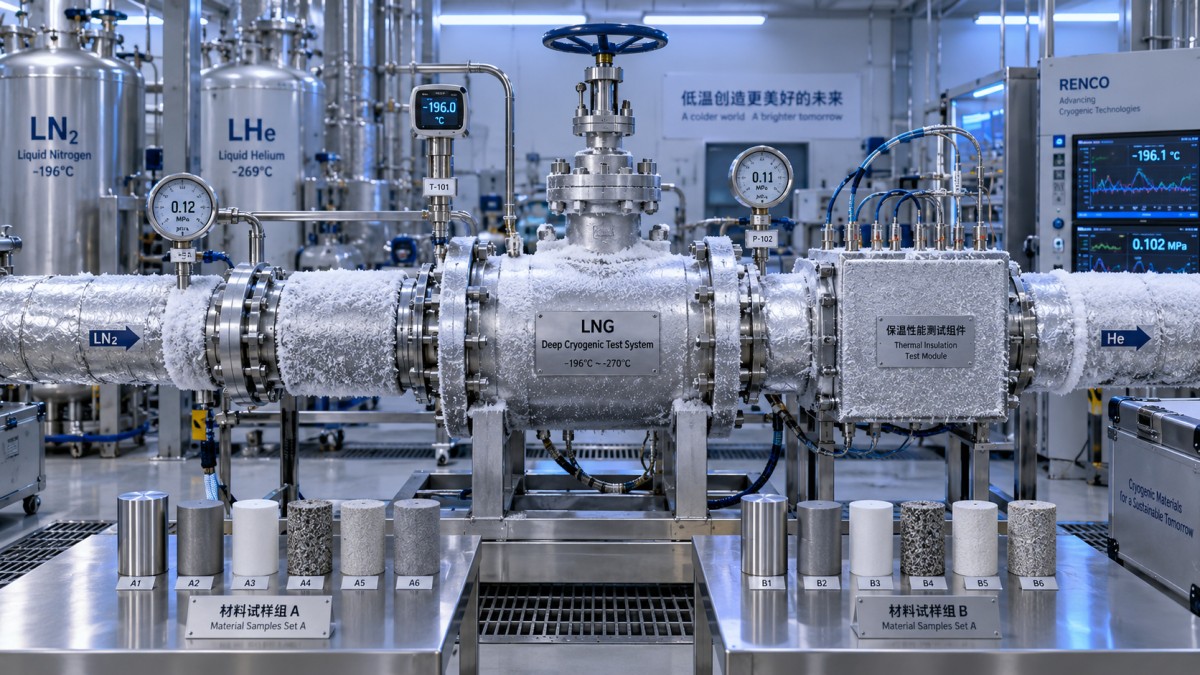
For large LNG containment, piping, or cargo-handling packages, this sheet should also identify whether the result relates to a coupon, a subassembly, a full-scale mock-up, or an installed system. Coupon testing is valuable for material qualification; it is not a substitute for evidence that joints, supports, interfaces, and manufacturing tolerances behave properly together.
Read thermal data with an engineer’s caution
Thermal performance is often the first figure buyers compare, particularly for insulation systems and cryogenic transfer equipment. Yet thermal conductivity, overall heat-transfer coefficient, boil-off contribution, and heat ingress are not interchangeable metrics. Each requires its own context.
When reviewing insulation data, ask whether the reported thermal conductivity was measured at mean temperature, at the cold-face temperature, or across a stated temperature gradient. Confirm moisture condition and density, because both can influence results. If a material is used under compression, check whether the stated value reflects that installed density and load. A laboratory sample held dry and unloaded may not represent an insulation layer that is constrained between structural surfaces.
For system-level heat-leak results, examine the boundary conditions. Were ambient temperature, airflow, surface emissivity, vacuum condition where relevant, and support conduction accounted for? Was the result measured after steady state was achieved? In a cryogenic test, a number recorded before temperatures stabilize may be more optimistic than the product’s true long-duration behavior.
Do not automatically reject a supplier whose data appears less dramatic. A transparent report that explains uncertainty, test limitations, and correction factors is frequently more useful than an unusually attractive figure with no method description.
Mechanical properties must be assessed at the service temperature
At ambient temperature, several metals, polymers, composites, adhesives, and sealing materials may appear robust. Their behavior can shift markedly when cooled. Ductility may fall, stiffness may rise, differential contraction can create interface stress, and a material that performed well in a static test may crack after repeated temperature transitions.
For metallic components, review yield strength, tensile strength, elongation, impact toughness, fracture behavior where required, and weld-zone performance at the specified cryogenic temperature. A parent-material certificate alone is not enough if the final item contains welds, heat-affected zones, formed regions, or dissimilar material joints. In an LNG carrier environment, those details can be more critical than the base material’s nominal grade.
For non-metallic materials, look beyond tensile strength. Check dimensional stability, compression set, permeability, adhesive bond retention, flammability requirements where applicable, and compatibility with expected exposure conditions. Ask whether testing included thermal cycling. A seal that survives a single immersion-style exposure may still lose sealing force after many cool-down and warm-up events.
Traceability is part of the performance claim
One of the most practical answers to “How should you compare cryogenic engineering test data from suppliers?” is to treat traceability as a technical requirement, not a paperwork exercise. The report should allow a reviewer to connect the tested specimen to raw material records, manufacturing controls, inspection records, and the proposed production configuration.
Ask direct questions:
- Was the tested sample manufactured using the same process intended for serial supply?
- Does the report identify the production batch or material heat?
- Were any repairs, substitutions, or process deviations present?
- Can the supplier provide a control plan for ongoing production verification?
- Is there a clear distinction between type-test evidence and routine production test evidence?
This distinction matters. A successful type test demonstrates that a design can meet a requirement under defined conditions. It does not prove that every delivered unit will perform identically. For critical equipment, procurement documents should define what production testing, inspection, sampling, and release documentation are required after design qualification.
Check standards, but do not stop at the standard number
References to ASTM, ISO, EN, ASME, IEC, classification-society rules, or IMO-related requirements can strengthen a submission—but only when they are relevant and current. A supplier may cite a recognized standard without explaining which edition was used, which clauses apply, or whether the test setup departed from the method.
Review the full citation and ask for the test laboratory’s procedure. Where a project is governed by class requirements or LNG carrier design rules, align the supplier’s evidence with the applicable project specification and approval pathway. A material test that is valid for an onshore cryogenic application may not fully address marine vibration, ship motion, containment-system integration, or class documentation requirements.
It is also wise to separate three concepts that are often blurred together: compliance with a test method, compliance with a product standard, and acceptance by the project authority. They are related, but they are not identical.
Pay close attention to uncertainty, repeatability, and margins
Cryogenic testing is demanding. Instrument accuracy changes with temperature, gradients can be difficult to control, and sample-to-sample variation can be meaningful. A responsible report should state measurement uncertainty or provide enough information for the reviewer to understand it.
When two suppliers differ by only a small amount, determine whether the difference exceeds the uncertainty of the test method. If Supplier A reports a marginally better thermal value but offers one test result with no repeat data, while Supplier B provides multiple consistent runs with documented calibration, Supplier B may present the lower technical risk.
Margins deserve equal attention. Compare not only the measured result with the minimum project requirement, but also the distance between them. A component that barely passes under ideal test conditions can leave little room for manufacturing variation, installation tolerance, aging, or unexpected operating severity. The right margin depends on the consequence of failure, inspectability in service, repair access, and the project’s safety philosophy.
A practical review sequence for supplier evaluations
For high-value transport assets, data review works best as a staged process rather than a single pass/fail screen. Begin with document completeness. Then confirm configuration equivalence, validate the test method, assess environmental and mechanical representativeness, and finally judge the result against the required margin.
- Define the operating envelope. State minimum temperature, pressure, cycling frequency, motion, load cases, exposure environment, and design life.
- Set a common evidence request. Give every supplier the same document list and data fields.
- Screen for comparability. Flag results obtained under non-equivalent conditions rather than forcing a misleading numerical ranking.
- Review interfaces. Examine welds, supports, seals, transitions, fasteners, and installation-dependent elements.
- Assess production confidence. Review traceability, quality controls, routine test plans, and change-management procedures.
- Record assumptions and open points. A decision log protects the project when data must later be revisited during design review or commissioning.
For complex LNG shipping systems, this review should involve more than purchasing. Materials engineers, cryogenic specialists, quality personnel, class-facing teams, and installation stakeholders may each notice a different risk hidden in the same report.
Common mistakes that create false confidence
The most frequent mistake is selecting the best-looking number without comparing test conditions. Another is accepting a generic certificate that does not identify the exact supplied configuration. Teams may also overlook the fact that a test sample was prepared by a different manufacturing route than production units.
There is a quieter risk as well: treating a successful laboratory test as proof of system reliability. In real vessels and cryogenic infrastructure, the most vulnerable location may be a joint, a penetration, a support, a sensor connection, or an interface between materials with different contraction rates. Those areas should be explicitly addressed in the supplier’s validation package.
Frequently asked questions
What is the single most important item to request from a supplier?
Request the complete test report, not only a certificate or summary table. The full report reveals specimen identity, setup, temperatures, loading conditions, instrumentation, deviations, and acceptance criteria. Without those details, meaningful comparison is limited.
Should we require testing at −196°C if the system operates near LNG temperature?
Not automatically. Testing at a lower temperature can be useful for material screening or demonstrating a broader operating envelope, but it does not replace testing that represents the actual duty cycle. The appropriate temperature, loading, duration, and cycling profile should follow the project specification and component function.
Is third-party laboratory data always better than supplier laboratory data?
Independent testing can add confidence, especially for critical qualifications or disputed performance claims. However, the quality of the method, traceability, laboratory competence, and relevance of the test setup matter more than the laboratory label alone. Supplier testing can be highly valuable when it is controlled, documented, and auditable.
How should we handle incomplete data?
Do not fill technical gaps with assumptions. Classify missing items by risk, request clarification, and define whether additional testing, a design review, or a contractual hold point is necessary. An incomplete submission may still be considered, but it should not be ranked as equivalent to a fully substantiated one.
Make the comparison support the life of the asset
The strongest cryogenic supplier evaluation is not a contest for the lowest conductivity figure or highest strength value. It is a structured judgment about evidence, relevance, and repeatability. For LNG carriers and other assets operating at the edge of thermal and mechanical limits, trustworthy data is data that can be traced, explained, reproduced, and connected to the real conditions the equipment will face.
That approach helps project teams make decisions with fewer blind spots: not merely choosing a component that performs well in a report, but selecting a solution whose test evidence remains credible from design review through construction, commissioning, and years of operation at sea.
Recommended News
 Nov 03, 2026How to choose a containment system for cryogenic shipping in EuropeCryogenic shipping Europe: compare membrane and independent tanks, boil-off management, regulations and lifecycle costs to choose the right containment system.
 Nov 02, 2026How insulated piping reduces heat gain in cryogenic shippingExplore cryogenic shipping solutions piping and discover how insulation, thermal bridge control and installation quality reduce heat gain in LNG transfer lines.
 Oct 16, 2026Is Membrane Containment Suitable for LNG Vessels in Rough Seas?Is membrane containment suitable for LNG vessels operating in rough seas? Explore sloshing risks, operating limits, and proven safety controls for confident LNG voyage planning.
 Oct 13, 2026How Should You Compare Cryogenic Engineering Test Data from Suppliers?How do I compare cryogenic engineering test data from suppliers? Discover a practical guide to evaluating LNG thermal performance, traceability, standards, and risk.
 Sep 28, 2026When is nickel steel containment needed for cryogenic storage?Nickel steel containment is essential when cryogenic tanks face brittle-fracture risk. Discover how temperature, loads, and tank design guide the right choice.
 Sep 11, 2026How membrane containment systems demonstrate compliance with IMO standardsMembrane containment systems IMO standards: discover how LNG carriers prove compliance through verified barriers, testing, monitoring, and traceable records.
 Sep 10, 2026How membrane and Moss containment systems differ for LNG carriersLNG cargo containment for carriers: compare membrane and Moss systems for capacity, BOG, safety, sloshing, lifecycle cost, and operational flexibility.
 Sep 03, 2026What drives membrane containment systems cost in LNG projects?Membrane containment systems cost depends on tank design, materials, labor, QA, and boil-off performance. Discover how to control LNG project risk and lifecycle costs.
 Aug 11, 2026How Vacuum Insulated Cryogenic Engineering Reduces Boil-Off and Heat LeakVacuum insulated cryogenic engineering cuts boil-off and heat leak by optimizing vacuum spaces, MLI, supports, and penetrations—discover what really improves LNG thermal performance.
 Aug 09, 2026What Determines Safe Cryogenic Containment Design in LNG Storage?Cryogenic containment design in LNG storage depends on materials, thermal stress, leak control, and BOG management. Discover what truly defines safe, code-compliant performance.
 Jul 29, 2026How to Evaluate a Cryogenic Tank Handling System for LNG Transfer SafetyCryogenic tank handling system evaluation for LNG transfer safety: learn how to assess pressure control, insulation, ESD response, and operational reliability before choosing a safer system.
 Jul 24, 2026Deep-Cryogenic Insulation Systems Cost: What Drives Total Project Spend?Deep-cryogenic insulation systems cost depends on design, materials, installation, QA, and boil-off performance. Learn what drives total project spend and compare bids with confidence.
 Jul 21, 2026LNG Carriers Class Approval: Key Rules and Compliance RisksLNG carriers class approval explained: key rules, major compliance risks, and practical steps to prevent delays, protect vessel readiness, and improve charter confidence.
 Jul 15, 2026Low Boil Off Insulation System Performance: What Reduces LNG Losses MostLow boil off insulation system performance explained: discover what cuts LNG losses most through smarter containment, installation quality, and BOG management.
 Jul 13, 2026Deep Cryogenic Insulation for LNG Tanks: Cost vs Heat LossDeep cryogenic insulation for LNG tanks impacts more than upfront cost. Learn how lower heat loss cuts BOG, improves efficiency, and strengthens lifecycle value.
 Jul 13, 2026Low Loss Cryogenic Handling: Key Factors for Safer TransferLow loss cryogenic handling starts with thermal control, pressure balance, and clean transfer. Learn the key factors that reduce boil-off, protect product integrity, and improve safer LNG and industrial operations.
 Jul 12, 2026LNG Vessel Fuel Storage: Main Safety Risks and FixesLNG vessel fuel storage safety starts with early risk detection. Learn the main hazards, warning signs, and practical fixes to reduce leaks, pressure instability, and onboard failures.
 Jul 09, 2026Membrane Cargo Tank vs Moss Type: Which Fits Modern LNG FleetsMembrane cargo tank vs Moss type: compare LNG fleet capacity, boil-off strategy, maintenance, and asset value to choose the best-fit design for modern shipping returns.
 Jul 08, 2026Membrane Containment Systems: Key Failure Risks in LNG Tank DesignMembrane containment systems are central to LNG tank safety. Explore key failure risks, from insulation degradation to sloshing and secondary barrier issues, and learn what to check early.
 Jul 06, 2026How to Compare a Cryogenic Shipping Systems Manufacturer for Long-Haul LNG ProjectsCryogenic shipping systems manufacturer selection can make or break long-haul LNG projects. Compare boil-off control, compliance, engineering support, and lifecycle value.
 Jul 02, 2026Cryogenic Shipping Safety: Common Failure Risks and FixesCryogenic shipping safety starts with finding hidden failure risks early. Learn the main causes, practical fixes, and audit gaps that help protect LNG cargo, cut incidents, and improve control.
 Jul 02, 2026LNG Carriers Dimensions Explained for Terminal PlanningLNG carriers dimensions explained for smarter terminal planning. Learn how vessel size affects berth design, draft limits, mooring, and future fleet compatibility.
 Jun 30, 2026LNG Carrier Containment Technology Explained: Membrane vs Moss SystemsLNG carrier containment technology explained clearly: compare membrane vs Moss systems, key trade-offs, cargo efficiency, sloshing risk, and what drives smarter LNG vessel decisions.
 Jun 30, 2026Vacuum Deep Cryogenic Insulation: Key Failure Risks and How to Prevent ThemVacuum deep cryogenic insulation failure can raise boil-off, safety, and compliance risks. Learn key warning signs, root causes, and practical prevention steps to protect LNG operations.