



Search News
Industry Portal
Popular Tags
What rail safety technology best reduces level-crossing risks in Southeast Asia?
Author
Time
Click Count
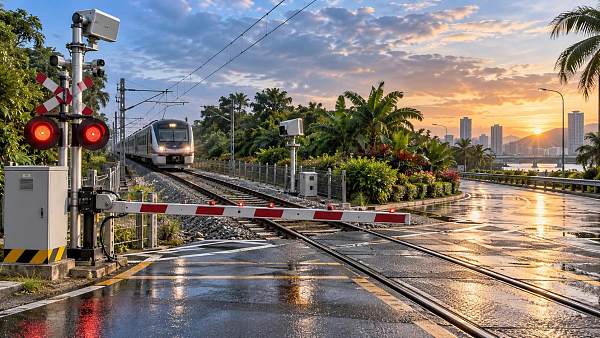
The most effective rail safety technology for reducing level-crossing risks in Southeast Asia is not a single device. It is a coordinated crossing protection system built around fail-safe signalling, automated barriers, reliable obstacle detection, and remote condition monitoring. The right balance depends on the crossing's road traffic, train frequency and speed, visibility, local driving behaviour, power reliability, and maintenance capacity.
A basic flashing-light installation may improve awareness at a quiet rural crossing. It is not an adequate risk-control strategy for a busy urban approach where motorcycles weave through queues, trucks can stop across the tracks, and trains operate on a tight timetable. At higher-risk sites, the system must do more than warn road users. It must detect unsafe conditions, communicate them to rail operations, and ensure that a fault moves the crossing into a safer state.
For rail safety technology Southeast Asia projects, the strongest practical choice is usually an integrated architecture: safety-rated interlocking or signalling logic, full-width barriers where appropriate, train detection, obstacle detection, road-user warning devices, and a control-room monitoring interface. This combination addresses both the predictable risk of a road user ignoring a warning and the less visible risk of equipment degradation between inspections.
Start with the crossing risk, not the equipment catalogue
Level crossings fail in different ways. A pedestrian may enter after lights begin flashing. A motorcyclist may ride around a lowered half-barrier. A truck may become trapped because traffic downstream has stopped. Vegetation, parked vehicles, rain, glare, or an awkward road alignment can reduce sight distance. A system selected without distinguishing these risks often becomes expensive infrastructure that solves the wrong problem.
Before comparing suppliers, classify each site by its actual operating conflict:
- High train frequency or short headways: Warning time must be predictable and correctly integrated with train movement authority. Repeated long closures can also encourage unsafe road-user behaviour.
- Mixed traffic and vulnerable road users: Motorcycles, bicycles, pedestrians, informal crossings, and slow-moving vehicles require physical deterrence and detection strategies that go beyond vehicle-only assumptions.
- Congested urban roads: The primary danger may be a vehicle stopping on the track after entering the crossing. Exit-side traffic conditions matter as much as entry-side warning.
- High-speed or limited-visibility rail corridors: Train crews have little opportunity to compensate for a crossing obstruction. Detection, warning reliability, and operational response become more critical.
- Remote or lightly staffed locations: Equipment must tolerate delayed maintenance response, unstable communications, and power interruptions without silently losing protection.
This classification determines whether the site needs passive protection, active warning, automatic barriers, obstruction detection, or grade separation. It also prevents a common error: treating all crossings along a route as identical because they belong to one construction package.
What each technology actually controls
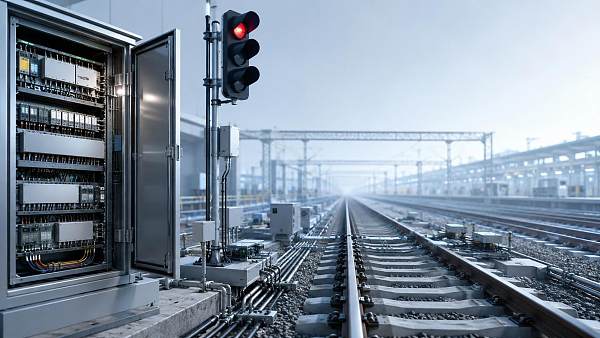
The safety-rated signalling layer is the foundation. It controls the relationship between train detection, warning activation, barrier movement, crossing status, and the information available to rail operations. A safety-integrity design is valuable because a failed component should not create an unnoticed “all clear” condition. In practice, this means the crossing must be designed so that a fault is detected, reported, and handled through a defined safe response.
For major schemes, a SIL4-oriented signalling architecture is often the correct benchmark for the core control function. The point is not to apply a label to every roadside device. The point is to establish a defensible safety case for the functions that can create or release hazardous train-road conflicts. A camera used for operational awareness, for example, may have a different assurance role from the logic that proves a barrier sequence has completed.
Barrier automation is usually necessary, but its form matters
Automatic barriers are frequently the most visible investment at a level crossing, yet they are often selected too simplistically. Half-barriers can discourage entry while leaving an escape path for a vehicle already on the crossing. This can be useful where preventing entrapment is the central concern. But where road users routinely bypass barriers, a half-barrier design may provide too little physical control.
Full-width or four-quadrant barrier arrangements offer stronger closure discipline, particularly at high-risk sites. They also create a more demanding design problem: a vehicle must never be enclosed on the tracks without a reliable means of detection and response. This is why full barrier systems should normally be assessed together with obstacle detection, exit-zone design, and operating rules for abnormal conditions.
Barrier mechanisms also need to suit the local environment. Strong rain, heat, dust, drainage problems, vibration, corrosion, and inconsistent electrical supply can affect field performance. The procurement specification should therefore cover enclosure protection, corrosion resistance, manual release arrangements, battery backup strategy, diagnostic outputs, spare-parts availability, and inspection access. A sophisticated controller cannot compensate for a barrier machine that is difficult to service or frequently out of alignment.
Obstacle detection changes the decision at high-consequence sites
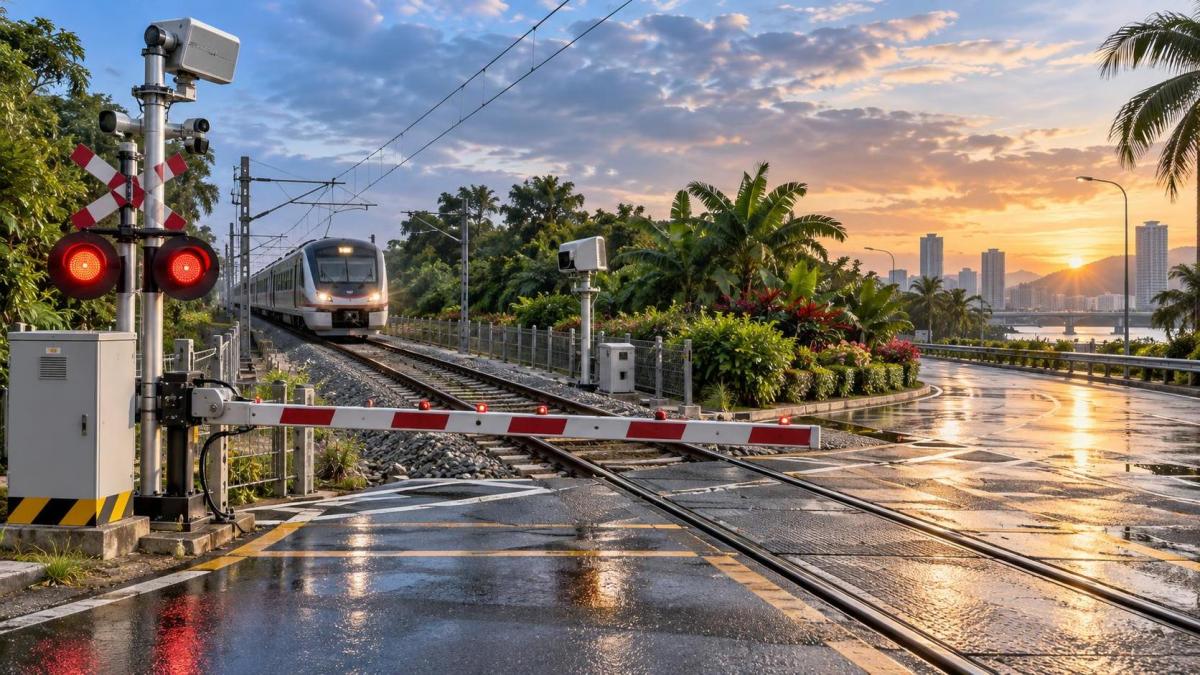
Obstacle detection is the technology that most clearly separates a basic active crossing from a higher-resilience safety system. It helps identify whether the protected area remains occupied when a train is approaching or after barriers have begun to close. Depending on the site, the solution may use radar, lidar, video analytics, or a combination of detection methods.
No detection method is universally superior. Radar can be useful in rain, darkness, and dusty conditions, but its detection zone must be engineered around road geometry and adjacent traffic. Lidar can provide detailed spatial coverage, although performance and maintenance requirements must be considered in harsh outdoor conditions. Video analytics can support classification and incident review, but cameras require clear sightlines, cleaning, lighting design, stable communications, and careful management of shadows, headlight glare, and weather.
The better procurement question is not “Which sensor is best?” It is: what must be detected, across which area, under which conditions, and what action follows a detection? A sensor that detects a stopped truck but only sends an alarm after the train has passed the braking decision point has limited safety value. Detection must be linked to a credible operational response, such as holding the train movement, applying a restrictive route condition, notifying the driver, or escalating to the control centre according to the railway’s operating concept.
False alarms need equal attention. An obstacle detector that generates frequent nuisance events may lead operators to normalize alarms or bypass the system. The design should define how the system distinguishes the crossing area from adjacent lanes, how it handles slow-moving traffic, how it recovers after an event, and how field personnel validate alignment after road resurfacing or civil works.
Integrate the crossing with rail operations, not just roadside equipment
A level crossing is not an isolated roadside installation. Its safety performance depends on the train detection method, approach timing, interlocking interface, communications path, and control-room procedures. Weak integration creates ambiguity: the barriers may appear operational locally while the railway has no reliable indication of their status, or a detected obstruction may reach the controller without a defined train-control response.
For new railways and major renewals, specify the crossing as a complete operational function. The system design should state:
- how approaching trains activate the warning sequence;
- how warning time is maintained across different train speeds and stopping patterns;
- which crossing states are proved to the signalling system;
- what happens when a barrier, detector, power supply, or communications link fails;
- how an obstruction alarm affects train movements;
- who can place the crossing into a degraded mode and under what conditions;
- how all events are time-stamped for investigation and maintenance.
This is particularly relevant where a network combines new metro, intercity, freight, and legacy rail assets. Equipment that functions correctly within its own cabinet may still cause operational risk if interfaces, terminology, alarm priorities, and degraded-mode rules differ across systems.
Remote condition monitoring delivers lifecycle value
Remote monitoring is not a substitute for barriers or safe signalling logic, but it can materially reduce the time that faults remain hidden. A monitored crossing can report power status, battery condition, barrier position, controller faults, communications loss, door access, repeated obstruction alarms, and abnormal operating sequences. That information helps maintenance teams move from calendar-based inspection alone toward intervention based on actual condition.
It also gives programme teams evidence for future investment. A crossing with repeated barrier strikes, prolonged closures, obstruction detections, or warning-device faults may require road redesign, public-realm controls, changed operating logic, or eventual grade separation. Without reliable event data, these decisions are often driven by anecdote rather than a clear risk pattern.
Communication resilience should be designed into this layer. A remote dashboard is useful only when loss of connectivity is itself visible and when the local crossing remains protected during a network outage. Critical safety functions should not depend on a cloud connection or a single backhaul path. The local controller must continue to execute its safe logic even when remote supervision is unavailable.
When grade separation is the better answer
There are crossings where improved equipment is no longer the most proportionate control. If road congestion regularly blocks the exit, train traffic is dense, visibility is constrained by permanent geometry, or land use produces continual pedestrian intrusion, grade separation may be the only option that removes the direct rail-road conflict. It has higher civil cost and can create access, drainage, and community impacts, but it should remain on the option list for the highest-risk sites.
The mistake is to frame this as “technology versus civil works.” A sensible programme can use both. Lower-risk crossings may receive upgraded warning and barriers, medium-risk sites may add obstacle detection and network monitoring, and a small number of critical locations may be prioritised for elimination through road or rail separation.
A procurement sequence that avoids expensive gaps
Selection should begin with a site-by-site risk register and an operating concept, then move into technology design. Buying barrier equipment before defining detection coverage, fault response, train-control interfaces, and road geometry usually creates late changes and disputed responsibilities.
- Map the conflict: record train movements, road movements, vulnerable users, queueing patterns, sightlines, nearby junctions, and abnormal access needs.
- Set the required safety function: distinguish warning, deterrence, obstruction detection, operational protection, and maintenance visibility.
- Choose the physical layout: include barrier arrangement, pedestrian routes, escape paths, road markings, drainage, equipment location, and maintainable access.
- Define interfaces before tender: specify the relationship with interlocking, train detection, telecoms, power supply, control centre, and incident logging.
- Evaluate maintainability as a technical requirement: require diagnostics, documentation, test procedures, training, spare-part strategy, and clear ownership of corrective actions.
- Test degraded modes: acceptance should cover failures, loss of communications, power transfer, detector obstruction, manual operation, and recovery after intervention.
Information resources focused on railway signal control systems, such as GTOT’s technical intelligence coverage, can be useful when comparing how safety architecture, detection, communications, and lifecycle support fit together. The decision should still be made at crossing level: the preferred system is the one that closes the identified hazard path and can be maintained consistently throughout its operating life.
The practical choice
For most active level-crossing upgrades in Southeast Asia, the preferred baseline is safety-rated signalling integrated with visible warnings, automated barriers suited to local road-user behaviour, dependable power arrangements, and remote diagnostics. Add obstacle detection when a vehicle or person remaining on the crossing could create a high-consequence event, especially where congestion, speed, poor visibility, or complex traffic makes clearance uncertain.
Do not treat cameras as a low-cost replacement for a protection system, and do not assume barriers alone resolve the risk of trapped or bypassing vehicles. The most durable reduction in level-crossing risk comes from connecting physical protection, fail-safe control logic, detection, road design, and operational response into one system that still behaves predictably when equipment or communications fail.
Recommended News
 Sep 29, 2026What drives traction systems price differences between rail projects?Traction systems price differences explained: compare duty cycles, voltage compatibility, integration, localization, and lifecycle costs for smarter rail procurement.
 Sep 26, 2026What to assess before selecting an electric traction system manufacturerChoose an electric traction system manufacturer with confidence. Explore key criteria for performance, reliability, safety, integration, energy efficiency, and lifecycle support.
 Sep 25, 2026When do full digitalization systems justify the investment?Full digitalization systems: discover when rail and maritime operators can turn connected data into safer operations, higher availability, and measurable ROI.
 Sep 23, 2026What drives automatic train control systems cost on rail projects?Automatic train control systems cost depends on integration, migration, safety testing, communications, and lifecycle support. Explore the key budget drivers for rail projects.
 Sep 21, 2026How to assess an ocean going vessel builder’s delivery riskAssess an ocean going vessel builder’s delivery risk with proven checks for schedules, capacity, design maturity, critical equipment, quality, and project controls.
 Sep 20, 2026What drives rail safety technology costs over a project lifecycle?Rail safety technology cost goes beyond equipment—explore lifecycle drivers from integration and safety assurance to cybersecurity, commissioning, and obsolescence.
 Sep 16, 2026What to verify before choosing an advanced ocean-going vessels supplierAdvanced ocean-going vessels supplier checklist: verify design authority, build quality, digital systems, delivery reliability, and lifecycle support before you buy.
 Sep 15, 2026What rail safety technology best reduces level-crossing risks in Southeast Asia?Rail safety technology Southeast Asia: discover how fail-safe signalling, barriers, obstacle detection and remote monitoring reduce level-crossing risks.
 Sep 14, 2026How exporters can reduce customs delays in global trade logisticsGlobal trade logistics for exporters: reduce customs delays with accurate data, clearance-ready documents, early filing, and proactive exception management.
 Sep 13, 2026When do global transportation network systems reduce delivery delays?Global transportation network systems reduce delivery delays by improving rail-port-vessel coordination, real-time visibility, and proactive decisions across complex land-sea supply chains.
 Sep 09, 2026When should you choose a rail and maritime manufacturer with dual-sector capability?Rail and maritime manufacturer guide: learn when dual-sector capability reduces integration risk, improves lifecycle support, and strengthens rail-to-port operations.
 Sep 08, 2026What to verify before selecting a railway signalling equipment supplierRailway signalling equipment supplier checklist: verify safety evidence, integration, cybersecurity, delivery capability, and lifecycle support before award.
 Sep 07, 2026How to size a traction power transformer for railway load demandTraction power transformer sizing guide: model railway load demand, peak duty, voltage regulation, harmonics, and contingency capacity for reliable service.
 Sep 07, 2026How do customization options for industrial connectors affect lead times?Customization options for industrial connectors can impact lead times, cost, and compliance. Learn how to specify smarter for rail and marine projects.
 Sep 05, 2026What information should an industrial sourcing guide include?Industrial sourcing information procurement guide: evaluate suppliers, compliance, lifecycle costs, interfaces, and lead times for smarter rail and maritime purchasing decisions.
 Sep 01, 2026How to find reliable maritime tender information before biddingMaritime tender information: learn how to verify sources, define bid-ready scopes, check qualifications, and reduce risk before submitting competitive marine bids.
 Aug 30, 2026How to select railway automation equipment for depots with phased upgradesRailway automation equipment for depots: learn how to plan phased upgrades that improve safety, throughput, integration, and lifecycle control.
 Aug 27, 2026How industrial sourcing intelligence pricing data supports budget approvalIndustrial sourcing intelligence pricing data helps teams benchmark scope, assess supplier risk, and build defensible budget approvals for complex rail and maritime assets.
 Aug 26, 2026When does a marine fuel efficiency solution make financial sense in the Middle East?Marine fuel efficiency solution Middle East: learn when retrofit savings, compliance value, and vessel data align to deliver credible ROI and smarter shipping investment decisions.
 Aug 24, 2026When does maritime automation for tankers deliver a real payback?Maritime automation for tankers delivers real payback when it cuts fuel use, reduces cargo risk, and improves uptime. See how owners can time investment for stronger ROI.
 Aug 23, 2026When do maritime logistics systems in the Middle East justify the costMaritime logistics systems Middle East: discover when rising delays, manual coordination, and poor visibility make system investment the smarter move for regional operators.
 Aug 22, 2026What drives vessel navigation system price for commercial fleetsVessel navigation system price depends on integration, compliance, automation, and support—not just hardware. Learn what drives fleet costs and compare quotes with confidence.
 Aug 21, 2026How to assess shipbuilding maritime tenders before biddingShipbuilding maritime tenders require more than price checks. Learn how to assess technical scope, compliance, supply chain, and commercial risk before bidding with confidence.
 Aug 20, 2026When does working with an ocean-going vessels distributor reduce supply risk?Ocean-going vessels distributor: learn when this partner cuts supply risk through stronger compliance, faster response, and better sourcing resilience in complex maritime procurement.