



Search News
Industry Portal
Popular Tags
How exporters can reduce customs delays in global trade logistics
Author
Time
Click Count
A container can be physically ready to leave the warehouse and still lose days at the border because one field in a declaration does not match the commercial invoice, a product description is too vague for classification, or the consignee data was changed after documents were transmitted. The operational impact is immediate: missed vessel cut-offs, terminal storage exposure, disrupted rail handovers, delayed delivery appointments, and difficult conversations with buyers waiting for inventory.
The practical answer is to treat customs clearance as a controlled workflow rather than a final document task. Strong global trade logistics for exporters depends on validating product data before booking, keeping every trade document tied to one source of truth, transmitting information early enough for review, and creating an exception process for shipments that do not clear as expected. Customs delays cannot be eliminated in every lane, but most preventable delays can be reduced through disciplined preparation and faster response.
Start with the shipment data customs will actually review
Export teams often focus on whether all required documents exist. Customs authorities and brokers also assess whether the documents tell the same commercial and physical story. A packing list may show 24 cartons, while the bill of lading instruction shows 22 packages. An invoice may describe “electrical parts,” while the declaration requires a classification that distinguishes between control modules, connectors, sensors, or complete assemblies. These are not minor wording differences when they affect tariff treatment, licensing, valuation, origin, or admissibility.
Before cargo is handed to the carrier, confirm that the following data is aligned across the booking, invoice, packing list, export declaration, transport instruction, and any destination-entry data supplied to the importer or customs broker:
- Seller, buyer, consignee, importer of record, and notify-party names and addresses.
- Product description in plain commercial language, with the technical detail needed to identify the goods.
- Quantity, units of measure, gross weight, net weight, package count, and marks.
- Declared value, currency, payment terms, and the applicable Incoterms rule with named place.
- HS code, country of origin, export-control status, and destination-specific permit requirements.
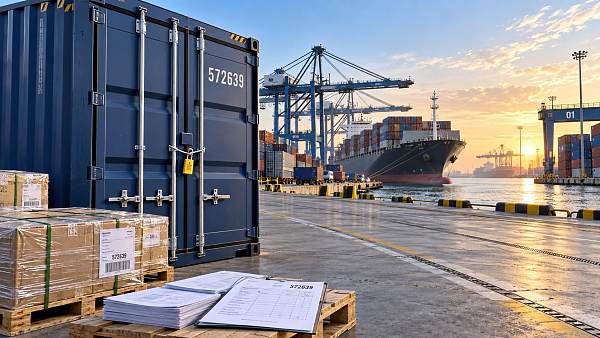
- Container number, seal number, vessel or rail movement details, and booking reference once assigned.
A useful operating rule is to avoid allowing the transport document to become the first place where final shipment facts are assembled. By then, warehouse loading may be complete, the carrier deadline may be close, and a correction can affect customs filing, manifest transmission, and container release at the same time.
Replace vague product descriptions with clearance-ready descriptions
Vague descriptions are a recurring cause of document queries. Terms such as “machine spare parts,” “railway equipment,” “electronics,” or “ship components” may be commercially understandable but rarely give a customs reviewer enough basis to assess classification and controls. The better description is not necessarily long; it is specific enough to identify what the item is, what it does, and, where relevant, what system it is used in.
For example, a description such as “component for train” leaves major questions unanswered. A more usable description might identify the item as an “electromechanical contactor for rail traction power cabinet” or a “pneumatic brake control valve for rail vehicle braking system.” Likewise, “marine equipment” can be improved by describing the functional item, such as a navigation sensor, cryogenic pump component, cargo-valve actuator, or electrical control enclosure. The description should remain truthful and consistent with the invoice, purchase order, technical datasheet, and classification rationale.
Operators should also avoid adding unsupported claims to make cargo sound simpler. Calling a controlled component a “standard spare part” does not remove regulatory obligations. Where an item has dual-use characteristics, contains regulated materials, is designed for a restricted end use, or has technical specifications relevant to export controls, route it for internal compliance review before it reaches the booking stage.
Set a document freeze point before cargo moves
Last-minute document changes create a chain reaction. A revised invoice value can require a new export filing. A changed consignee may require bill of lading amendments and destination-broker updates. A new package count after stuffing can invalidate earlier information. The risk becomes greater when cargo moves through port, rail, and ocean interfaces, because each handover may use the same data in a different operational system.
Create a document freeze point linked to a physical milestone, usually before final loading or container sealing. At that point, the warehouse confirms actual packed quantities and weights, the commercial team confirms the invoicing details, and the compliance or shipping function confirms classification and destination requirements. Changes after the freeze point should not be handled informally by email alone. They should be recorded as controlled amendments with a clear owner and an assessment of which filings, carrier instructions, and parties must be updated.
This approach is particularly important for consolidated cargo. When multiple orders share one container, an error in one line item can delay documentation work for the entire movement. Each shipment file should show which invoice lines are included, how they map to packages or pallets, and whether any item needs special handling, permit evidence, or separate declaration treatment.
Use classification and origin decisions that can be explained later
An HS code should not be selected only because it was used on an old invoice or suggested by a buyer. Products evolve, assemblies may be shipped in different configurations, and destination-country classifications can differ from export-country reporting requirements. Reusing a code without checking the current product description can lead to queries, duty disputes, or requests for supporting information after arrival.
Maintain a product-level classification record for regularly exported goods. It should connect the code to a concise technical description, product composition or function, relevant drawings or specifications, country-of-origin basis, and any known import restrictions. This record does not need to be complicated, but it should let a new operator understand why the code was used rather than copying a number from a prior shipment.
Origin deserves the same attention. “Ship-from country” and “country of origin” are not interchangeable. Goods assembled, tested, repaired, or repacked in one location may still originate elsewhere depending on the applicable rules. Where a preferential tariff claim is involved, ensure that the supporting statement or certificate matches the actual origin analysis. A preference claim that cannot be supported may trigger a hold even when the rest of the documents are accurate.
Build lead time around filing and review, not only sailing dates
A vessel departure date is not a customs deadline. Export declarations, security filings, carrier manifest requirements, controlled-goods approvals, and destination pre-arrival information may all have earlier cut-offs. A shipment can miss its intended movement even if the container arrives at the terminal before the vessel closes, simply because the data was not accepted in time.
For each trade lane, keep an operating calendar that distinguishes physical cut-offs from documentation cut-offs. Include the time required for internal review, broker processing, authority response, carrier acceptance, and correction cycles. Do not assume the normal timing applies during public holidays, port congestion, system outages, route diversions, or schedule changes.
Give brokers and forwarders usable instructions
A broker cannot correct information they have not received, and a freight forwarder cannot reliably coordinate a shipment when the shipper sends partial instructions across separate messages. Provide one complete shipment packet in an agreed format. It should identify the commercial contact, compliance contact, warehouse contact, and escalation contact, along with the filing deadline and the final document version.
Instructions should also state what the broker is authorized to do when a discrepancy appears. For example, can the broker request clarification from the exporter directly? Can they make non-substantive formatting corrections? Must they obtain approval before changing a declared value, classification, origin statement, or consignee? Without these rules, a small query can sit unanswered while several parties assume someone else is handling it.
Where the importer is responsible for destination clearance, confirm the division of responsibility in advance. Exporters may prepare documents accurately yet still face cargo holds if the importer has not arranged duty payment, bond coverage, permits, registrations, or broker appointment. Incoterms allocate certain obligations, but they do not guarantee that operational readiness exists. Ask for a destination-clearance contact and agree on who receives final documents, shipment milestones, and exception notices.
Monitor exceptions by status, not by assumptions
“Shipped” is not a useful final status for customs control. Cargo can be loaded but not released at destination; it can be discharged but held for inspection; it can clear customs but remain unavailable because a carrier release, terminal fee, or delivery order is missing. Operators need milestone visibility that separates transport progress from clearance progress.
Use statuses that make the next action obvious: documents pending, filed, accepted, query raised, examination requested, release granted, carrier release pending, available for pickup, or delivery appointment confirmed. When a status remains unchanged beyond the expected lane timing, investigate before the customer asks. The first question should be factual: what entity currently controls the next release? It may be customs, the carrier, the terminal, the importer, or a broker waiting for a document.
An exception log is more useful when it captures the reason code, shipment stage, affected document, responsible party, and corrective action. Over time, recurring patterns become visible: a particular product line may repeatedly need better descriptions; a warehouse may report weights too late; a destination may require documentation in a specific format; or consignee master data may be outdated.
Prepare for examinations without turning every shipment into a crisis
Some inspections are random, while others result from commodity risk, document inconsistencies, valuation questions, routing concerns, or missing approvals. An examination is not proof that the exporter acted incorrectly. The operational objective is to make information available quickly and keep custody of the shipment clear.
For cargo that is more likely to attract scrutiny, assemble a supporting file before departure. Depending on the goods, this may include technical specifications, photographs, packing diagrams, serial-number lists, certificates, export licences, origin support, safety documentation, and purchase-order references. Ensure that warehouse labels and package marks can be matched to the packing list. A customs officer or appointed inspector should be able to identify the cargo without relying on undocumented verbal explanations.
For containerized goods, retain seal records and loading evidence. If a seal must be broken for examination, make sure the responsible party records the event, replacement seal number where applicable, and any changes needed in onward transport instructions. This is especially important when a container will continue by rail after port release or when sensitive equipment requires controlled handling.
Reduce repeat delays through a short post-shipment review
After a hold, correction, or missed cut-off, avoid recording the event simply as “customs delay.” That label does not show what should change. Identify the first preventable point in the sequence: Was the description insufficient? Was the classification unverified? Did the warehouse report a different weight? Did a broker receive instructions after the filing deadline? Was the importer unprepared to lodge the entry?
Then assign a practical correction to the process. It may be a revised product-data template, a mandatory origin review for a product family, an earlier document freeze, a destination-specific instruction sheet, or a named escalation contact. The aim is not to add approvals to every shipment. It is to place controls where the recurring error actually begins.
Reliable customs performance comes from accurate data, early transmission, and visible ownership at every handover. When those controls are built into the daily shipping routine, exporters spend less time chasing releases and more time managing cargo movement with predictable, defensible information.
Recommended News
 Sep 29, 2026What drives traction systems price differences between rail projects?Traction systems price differences explained: compare duty cycles, voltage compatibility, integration, localization, and lifecycle costs for smarter rail procurement.
 Sep 26, 2026What to assess before selecting an electric traction system manufacturerChoose an electric traction system manufacturer with confidence. Explore key criteria for performance, reliability, safety, integration, energy efficiency, and lifecycle support.
 Sep 25, 2026When do full digitalization systems justify the investment?Full digitalization systems: discover when rail and maritime operators can turn connected data into safer operations, higher availability, and measurable ROI.
 Sep 23, 2026What drives automatic train control systems cost on rail projects?Automatic train control systems cost depends on integration, migration, safety testing, communications, and lifecycle support. Explore the key budget drivers for rail projects.
 Sep 21, 2026How to assess an ocean going vessel builder’s delivery riskAssess an ocean going vessel builder’s delivery risk with proven checks for schedules, capacity, design maturity, critical equipment, quality, and project controls.
 Sep 20, 2026What drives rail safety technology costs over a project lifecycle?Rail safety technology cost goes beyond equipment—explore lifecycle drivers from integration and safety assurance to cybersecurity, commissioning, and obsolescence.
 Sep 16, 2026What to verify before choosing an advanced ocean-going vessels supplierAdvanced ocean-going vessels supplier checklist: verify design authority, build quality, digital systems, delivery reliability, and lifecycle support before you buy.
 Sep 15, 2026What rail safety technology best reduces level-crossing risks in Southeast Asia?Rail safety technology Southeast Asia: discover how fail-safe signalling, barriers, obstacle detection and remote monitoring reduce level-crossing risks.
 Sep 14, 2026How exporters can reduce customs delays in global trade logisticsGlobal trade logistics for exporters: reduce customs delays with accurate data, clearance-ready documents, early filing, and proactive exception management.
 Sep 13, 2026When do global transportation network systems reduce delivery delays?Global transportation network systems reduce delivery delays by improving rail-port-vessel coordination, real-time visibility, and proactive decisions across complex land-sea supply chains.
 Sep 09, 2026When should you choose a rail and maritime manufacturer with dual-sector capability?Rail and maritime manufacturer guide: learn when dual-sector capability reduces integration risk, improves lifecycle support, and strengthens rail-to-port operations.
 Sep 08, 2026What to verify before selecting a railway signalling equipment supplierRailway signalling equipment supplier checklist: verify safety evidence, integration, cybersecurity, delivery capability, and lifecycle support before award.
 Sep 07, 2026How to size a traction power transformer for railway load demandTraction power transformer sizing guide: model railway load demand, peak duty, voltage regulation, harmonics, and contingency capacity for reliable service.
 Sep 07, 2026How do customization options for industrial connectors affect lead times?Customization options for industrial connectors can impact lead times, cost, and compliance. Learn how to specify smarter for rail and marine projects.
 Sep 05, 2026What information should an industrial sourcing guide include?Industrial sourcing information procurement guide: evaluate suppliers, compliance, lifecycle costs, interfaces, and lead times for smarter rail and maritime purchasing decisions.
 Sep 01, 2026How to find reliable maritime tender information before biddingMaritime tender information: learn how to verify sources, define bid-ready scopes, check qualifications, and reduce risk before submitting competitive marine bids.
 Aug 30, 2026How to select railway automation equipment for depots with phased upgradesRailway automation equipment for depots: learn how to plan phased upgrades that improve safety, throughput, integration, and lifecycle control.
 Aug 27, 2026How industrial sourcing intelligence pricing data supports budget approvalIndustrial sourcing intelligence pricing data helps teams benchmark scope, assess supplier risk, and build defensible budget approvals for complex rail and maritime assets.
 Aug 26, 2026When does a marine fuel efficiency solution make financial sense in the Middle East?Marine fuel efficiency solution Middle East: learn when retrofit savings, compliance value, and vessel data align to deliver credible ROI and smarter shipping investment decisions.
 Aug 24, 2026When does maritime automation for tankers deliver a real payback?Maritime automation for tankers delivers real payback when it cuts fuel use, reduces cargo risk, and improves uptime. See how owners can time investment for stronger ROI.
 Aug 23, 2026When do maritime logistics systems in the Middle East justify the costMaritime logistics systems Middle East: discover when rising delays, manual coordination, and poor visibility make system investment the smarter move for regional operators.
 Aug 22, 2026What drives vessel navigation system price for commercial fleetsVessel navigation system price depends on integration, compliance, automation, and support—not just hardware. Learn what drives fleet costs and compare quotes with confidence.
 Aug 21, 2026How to assess shipbuilding maritime tenders before biddingShipbuilding maritime tenders require more than price checks. Learn how to assess technical scope, compliance, supply chain, and commercial risk before bidding with confidence.
 Aug 20, 2026When does working with an ocean-going vessels distributor reduce supply risk?Ocean-going vessels distributor: learn when this partner cuts supply risk through stronger compliance, faster response, and better sourcing resilience in complex maritime procurement.