



Search News
Industry Portal
Popular Tags
When should you choose a rail and maritime manufacturer with dual-sector capability?
Author
Time
Click Count
Choose a rail and maritime manufacturer with dual-sector capability when the project has a real technical, commercial, or operational link between land transport and ocean transport. The strongest case is not simply that rail and shipping appear in the same logistics chain. It is that separate suppliers would create avoidable interfaces in safety assurance, electrical architecture, condition data, documentation, commissioning, or long-term spares support.
A dual-sector source is most valuable where the equipment must perform reliably within two very different operating environments: high-frequency, vibration-intensive rail service and corrosion-prone, motion-affected maritime service. That combination demands more than a broad catalogue. It requires evidence that design control, testing logic, configuration management, and field support are sufficiently mature in both sectors.
Choose dual-sector capability when interfaces carry the project risk
Many transport programs have a handover point where rail assets, terminals, port systems, vessels, and digital control layers must work as one operating chain. The commercial contract may divide these assets into packages, yet the technical consequences of poor alignment remain shared. A delayed alarm, incompatible communications gateway, unclear responsibility for power quality, or inconsistent maintenance record can disrupt the entire route.
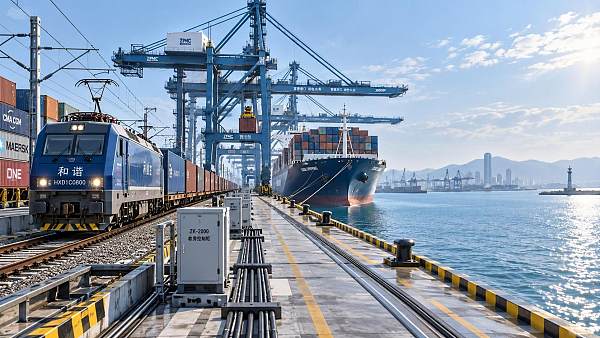
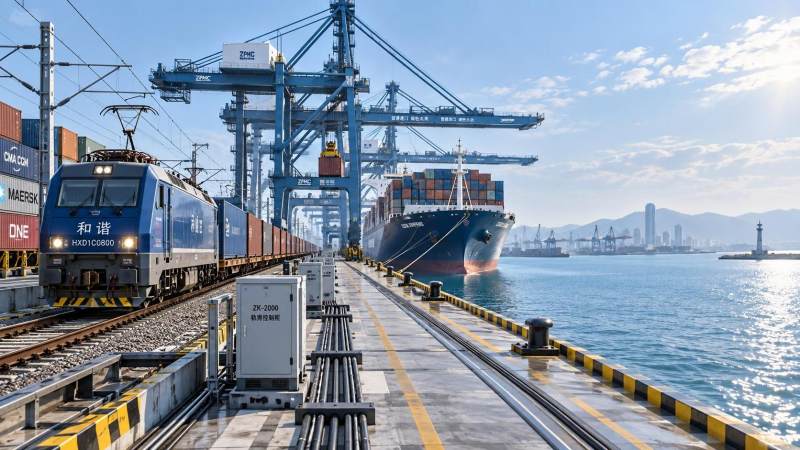
Dual-sector capability becomes justified when the interface is not a simple delivery boundary. Consider a port-connected rail corridor using automated signalling, electrified traction, container-handling coordination, and smart vessel arrival data. Each package has its own engineering discipline, but dispatching decisions and asset availability depend on a common operational picture. A rail-only source may understand interlocking, train detection, traction return current, and braking behaviour in detail. A maritime-only source may understand shipboard automation, navigation data, hull motion, marine electrical segregation, and port call workflows. The value of a dual-sector source lies in resolving the gaps between those disciplines before they become site changes.
That does not require a single entity to manufacture every subsystem. It does require clear ownership of cross-domain requirements. A credible scope might cover interface engineering, coordinated design reviews, common data definitions, failure escalation paths, and evidence showing how a modification in one system affects the other. Without this depth, “dual-sector” can mean little more than two unrelated product lines.
Situations where separate specialists are still the better choice
Dual-sector capability is not automatically the lower-risk option. A highly specialized rail signalling renewal on an existing network may gain little from maritime expertise, particularly where legacy interlocking logic, route-specific operating rules, and local installation constraints dominate the work. The same applies to a vessel retrofit centered on a narrow marine system that has no dependency on terminal, rail, or shore-side operational data.
Separate specialists can also be preferable when the integration boundary is stable and well documented. A container terminal that accepts standardized arrival messages and uses established mechanical transfer equipment may need a robust interface specification rather than a common rail-and-maritime equipment source. In that setting, selecting the strongest specialist for each package and appointing an independent systems integrator can provide better technical depth.
The decision changes when the interface specification is still evolving, responsibilities overlap, or a future expansion will alter operating logic. Choosing solely on the individual performance of each component then creates a hidden dependency: somebody must translate requirements, reconcile test evidence, and control changes across the boundary. If that responsibility is not contractually and technically credible, the apparent benefit of separated packages can disappear during commissioning.
Test the capability behind the claim
A rail and maritime manufacturer should be assessed through its engineering behaviour, not its sector labels. Start with design evidence from comparable environmental and operational conditions. Rail equipment faces repeated vibration, rapid temperature changes, electrical transients, fine dust, and intensive duty cycles. Maritime equipment must tolerate salt-laden air, persistent humidity, vessel motion, restricted access, and long maintenance intervals at sea. A component suited to one environment is not automatically suitable for the other.
For electrical assemblies, ask how enclosure sealing, connector selection, earthing, insulation coordination, condensation control, and cable routing differ between the applications. A cabinet design that performs well in a protected rail equipment room may fail prematurely if it is adapted to a marine location without attention to corrosion paths, drainage, ventilation, and maintenance access. Conversely, a marine-grade enclosure may add weight, space demand, or thermal constraints that make it unsuitable beside rail control equipment.
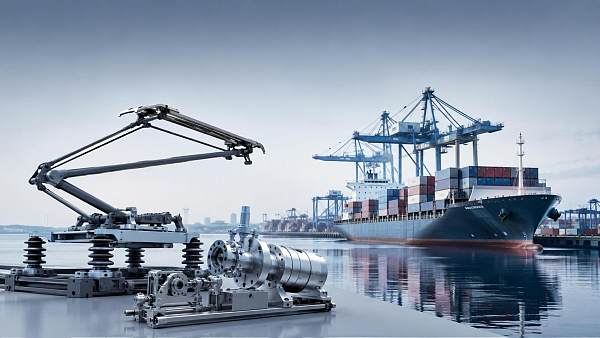
Mechanical claims need the same discipline. Pantograph systems and rail braking assemblies experience dynamic loads driven by speed, track condition, aerodynamic effects, contact-force control, and repeated stop-start duty. Marine machinery and vessel-mounted equipment experience different combinations of rolling, pitching, vibration, thermal expansion, and structural deflection. Ask whether fatigue assumptions, fastening methods, surface treatments, bearing arrangements, and inspection intervals are traceable to the actual duty profile. Similar-looking vibration tests do not prove equivalent service life when the frequency content and load direction differ.
Look for a shared systems engineering method
The practical indicator is whether requirements flow cleanly from operation to subsystem design and then into verification. A capable source can explain which functions are safety-related, which are availability-related, and which are informational. It can distinguish a control signal needed to prevent a hazardous state from a data point used for maintenance planning. This distinction affects network architecture, redundancy, response time, fault logging, cybersecurity controls, and acceptance testing.
Request a traceable view of the interfaces rather than a marketing diagram. It should identify physical connections, power sources, communications protocols, clock synchronization, operational states, alarm ownership, degraded modes, and configuration dependencies. For example, a train arrival prediction sent to a terminal planning system is useful only if time references, update latency, confidence status, and exception handling are understood. A vessel schedule feed has similar challenges, but its delay causes may include berth availability, weather routing, pilotage, cargo operations, or onboard system status. Combining both sources of data without quality rules can produce false precision.
Use the operating model to decide whether integration has economic value
The case for a dual-sector source strengthens when asset availability depends on coordinated maintenance. Rail control systems, traction collection equipment, braking systems, shipboard automation, and cargo-related systems generate different fault signatures. Their maintenance rhythms also differ. Rail fleets often have tightly scheduled inspection windows, while vessel maintenance must account for port calls, voyage duration, dry-docking opportunities, and onboard spare holdings.
A common support model can reduce friction only when it preserves the specific maintenance discipline of each asset. Shared data platforms are useful when fault codes, component serial numbers, revision status, and work history are governed consistently. They are less useful when raw sensor data is combined without operational context. A rising temperature in an electrical cabinet could be caused by an overloaded circuit, a blocked filter, a failed cooling unit, solar exposure, or a sensor drift. Treating every alarm as the same kind of predictive-maintenance signal creates unnecessary interventions and distracts attention from genuine degradation.
Ask whether condition monitoring has a defined decision path. Which events prompt inspection? Which require controlled operation? Which trigger a shutdown or a voyage or movement restriction? Who owns the threshold when a shore-side system and a mobile asset disagree? These questions matter more than the presence of dashboards. They expose whether the proposed integration supports action under pressure.
Procurement scope should separate common control from false bundling
There is a difference between consolidating responsibility and forcing unrelated equipment into one package. A sound dual-sector procurement structure typically centralizes the elements that benefit from common ownership: requirements management, interface control, cybersecurity architecture where systems exchange data, configuration baselines, integration testing, and incident analysis. It leaves highly specialized components open to the source best suited to their detailed design and service obligations.
For safety-critical rail controls, do not assume that maritime experience substitutes for evidence of railway safety lifecycle competence. For LNG-related vessel systems, do not assume that rail electrical expertise establishes competence in cryogenic containment, gas handling, or marine propulsion interfaces. Dual-sector capability should widen the ability to coordinate, not dilute the proof required for each specialized system.
Contract language should make this boundary visible. Define which party owns interface documents, who approves changes affecting more than one package, how software versions are frozen before testing, and how defects are classified when their symptom appears in one system but their cause sits in another. Ambiguity is especially expensive after hardware has been installed: cable lengths, equipment-room space, mounting provisions, power supply capacity, and access clearances are then difficult to alter without disrupting operations.
Pay attention to installation and commissioning conditions
Site integration often reveals whether a dual-sector claim has substance. Rail-side installations may need to fit narrow possession windows, constrained access routes, existing cable troughs, electromagnetic compatibility limits, and tightly sequenced cutovers. Port and vessel work can be affected by berth access, crane availability, weather exposure, cargo activity, restricted hot work, and vessel sailing schedules. A source that understands both environments plans work around these constraints rather than treating commissioning as a final software task.
Commissioning should progress through defined operational scenarios, including loss of communications, power transfer disturbances, delayed external data, conflicting status indications, and restoration after partial failure. The purpose is not to simulate every theoretical defect. It is to verify that operators receive understandable information, equipment defaults to the intended state, and the recovery sequence does not introduce a new conflict between rail movement, terminal operations, and vessel schedules.
Before award, require a staged integration plan that identifies the configuration baseline for each test phase. Factory acceptance confirms the subsystem against its own requirements. Integrated testing confirms interfaces under controlled conditions. Site testing proves installation quality and live dependencies. Operational trial work confirms that procedures, maintenance access, data ownership, and degraded modes function under real constraints. Collapsing these phases into a generic “commissioning” milestone obscures unresolved responsibility.
A practical threshold for the final choice
Choose dual-sector capability when the project needs one accountable engineering thread across rail, port, and maritime systems; when shared data or power interfaces affect availability or safety; when future extensions are likely to change those interfaces; or when lifecycle support depends on a common configuration and incident process. Require demonstrated depth in the specialist systems, together with tangible evidence of cross-sector integration.
Choose separate specialists when the interfaces are mature, limited, and independently verifiable, or when one narrow subsystem carries nearly all technical risk. The deciding question is whether the connection between land and sea assets is merely commercial, or whether it changes how the equipment is designed, tested, operated, maintained, and modified. Only the latter warrants placing material value on dual-sector capability.
Recommended News
 Sep 29, 2026What drives traction systems price differences between rail projects?Traction systems price differences explained: compare duty cycles, voltage compatibility, integration, localization, and lifecycle costs for smarter rail procurement.
 Sep 26, 2026What to assess before selecting an electric traction system manufacturerChoose an electric traction system manufacturer with confidence. Explore key criteria for performance, reliability, safety, integration, energy efficiency, and lifecycle support.
 Sep 25, 2026When do full digitalization systems justify the investment?Full digitalization systems: discover when rail and maritime operators can turn connected data into safer operations, higher availability, and measurable ROI.
 Sep 23, 2026What drives automatic train control systems cost on rail projects?Automatic train control systems cost depends on integration, migration, safety testing, communications, and lifecycle support. Explore the key budget drivers for rail projects.
 Sep 21, 2026How to assess an ocean going vessel builder’s delivery riskAssess an ocean going vessel builder’s delivery risk with proven checks for schedules, capacity, design maturity, critical equipment, quality, and project controls.
 Sep 20, 2026What drives rail safety technology costs over a project lifecycle?Rail safety technology cost goes beyond equipment—explore lifecycle drivers from integration and safety assurance to cybersecurity, commissioning, and obsolescence.
 Sep 16, 2026What to verify before choosing an advanced ocean-going vessels supplierAdvanced ocean-going vessels supplier checklist: verify design authority, build quality, digital systems, delivery reliability, and lifecycle support before you buy.
 Sep 15, 2026What rail safety technology best reduces level-crossing risks in Southeast Asia?Rail safety technology Southeast Asia: discover how fail-safe signalling, barriers, obstacle detection and remote monitoring reduce level-crossing risks.
 Sep 14, 2026How exporters can reduce customs delays in global trade logisticsGlobal trade logistics for exporters: reduce customs delays with accurate data, clearance-ready documents, early filing, and proactive exception management.
 Sep 13, 2026When do global transportation network systems reduce delivery delays?Global transportation network systems reduce delivery delays by improving rail-port-vessel coordination, real-time visibility, and proactive decisions across complex land-sea supply chains.
 Sep 09, 2026When should you choose a rail and maritime manufacturer with dual-sector capability?Rail and maritime manufacturer guide: learn when dual-sector capability reduces integration risk, improves lifecycle support, and strengthens rail-to-port operations.
 Sep 08, 2026What to verify before selecting a railway signalling equipment supplierRailway signalling equipment supplier checklist: verify safety evidence, integration, cybersecurity, delivery capability, and lifecycle support before award.
 Sep 07, 2026How to size a traction power transformer for railway load demandTraction power transformer sizing guide: model railway load demand, peak duty, voltage regulation, harmonics, and contingency capacity for reliable service.
 Sep 07, 2026How do customization options for industrial connectors affect lead times?Customization options for industrial connectors can impact lead times, cost, and compliance. Learn how to specify smarter for rail and marine projects.
 Sep 05, 2026What information should an industrial sourcing guide include?Industrial sourcing information procurement guide: evaluate suppliers, compliance, lifecycle costs, interfaces, and lead times for smarter rail and maritime purchasing decisions.
 Sep 01, 2026How to find reliable maritime tender information before biddingMaritime tender information: learn how to verify sources, define bid-ready scopes, check qualifications, and reduce risk before submitting competitive marine bids.
 Aug 30, 2026How to select railway automation equipment for depots with phased upgradesRailway automation equipment for depots: learn how to plan phased upgrades that improve safety, throughput, integration, and lifecycle control.
 Aug 27, 2026How industrial sourcing intelligence pricing data supports budget approvalIndustrial sourcing intelligence pricing data helps teams benchmark scope, assess supplier risk, and build defensible budget approvals for complex rail and maritime assets.
 Aug 26, 2026When does a marine fuel efficiency solution make financial sense in the Middle East?Marine fuel efficiency solution Middle East: learn when retrofit savings, compliance value, and vessel data align to deliver credible ROI and smarter shipping investment decisions.
 Aug 24, 2026When does maritime automation for tankers deliver a real payback?Maritime automation for tankers delivers real payback when it cuts fuel use, reduces cargo risk, and improves uptime. See how owners can time investment for stronger ROI.
 Aug 23, 2026When do maritime logistics systems in the Middle East justify the costMaritime logistics systems Middle East: discover when rising delays, manual coordination, and poor visibility make system investment the smarter move for regional operators.
 Aug 22, 2026What drives vessel navigation system price for commercial fleetsVessel navigation system price depends on integration, compliance, automation, and support—not just hardware. Learn what drives fleet costs and compare quotes with confidence.
 Aug 21, 2026How to assess shipbuilding maritime tenders before biddingShipbuilding maritime tenders require more than price checks. Learn how to assess technical scope, compliance, supply chain, and commercial risk before bidding with confidence.
 Aug 20, 2026When does working with an ocean-going vessels distributor reduce supply risk?Ocean-going vessels distributor: learn when this partner cuts supply risk through stronger compliance, faster response, and better sourcing resilience in complex maritime procurement.