Search News
Industry Portal
Popular Tags
How to evaluate motion control application references for a new project
Author
Time
Click Count
A motion control reference is useful only when it shows how a solution performed under conditions that matter to the new project. A similar machine name or an impressive installation count may help identify candidates, but neither establishes that the drive, actuator, feedback system, or control architecture can handle a different load, environment, or safety function.
The strongest engineering application references for motion control connect operating conditions to measurable results. They also make differences visible: a reference with a higher peak load may still be less demanding if it runs briefly, while a lower-load application may expose a drive to continuous heat or frequent reversals. Start by defining the new application’s critical operating cases, then compare each reference against those cases.
Start with the motion, not the industry label
References are often grouped by sector: rail, marine, manufacturing, or energy. That makes them easy to browse, but the same sector can contain very different control problems. A railway door actuator, for example, has a different duty cycle and consequence of failure from a traction control system. A marine positioning mechanism and a propulsion drive may share an onboard environment while requiring different levels of dynamic response and redundancy.
Describe the new application in terms that allow a direct technical comparison:
- Controlled movement: rotary or linear motion, travel range, speed range, direction changes, and required positioning or speed accuracy.
- Load behavior: inertia, friction, external forces, variation over the cycle, and what happens during startup, braking, or a jam.
- Duty cycle: operating time, idle time, frequency of starts and stops, and the sequence of high and low loads.
- Operating conditions: temperature, vibration, moisture, contamination, power quality, and access for maintenance.
- Consequences of failure: whether loss of motion causes an inconvenience, damages equipment, or creates a safety hazard.
Use ranges and operating sequences rather than a single nominal value. A reference that matches the rated motor power but lacks information about peak torque, acceleration, or stopping behavior is a starting point for discussion, not evidence of equivalence.
Compare the full load cycle
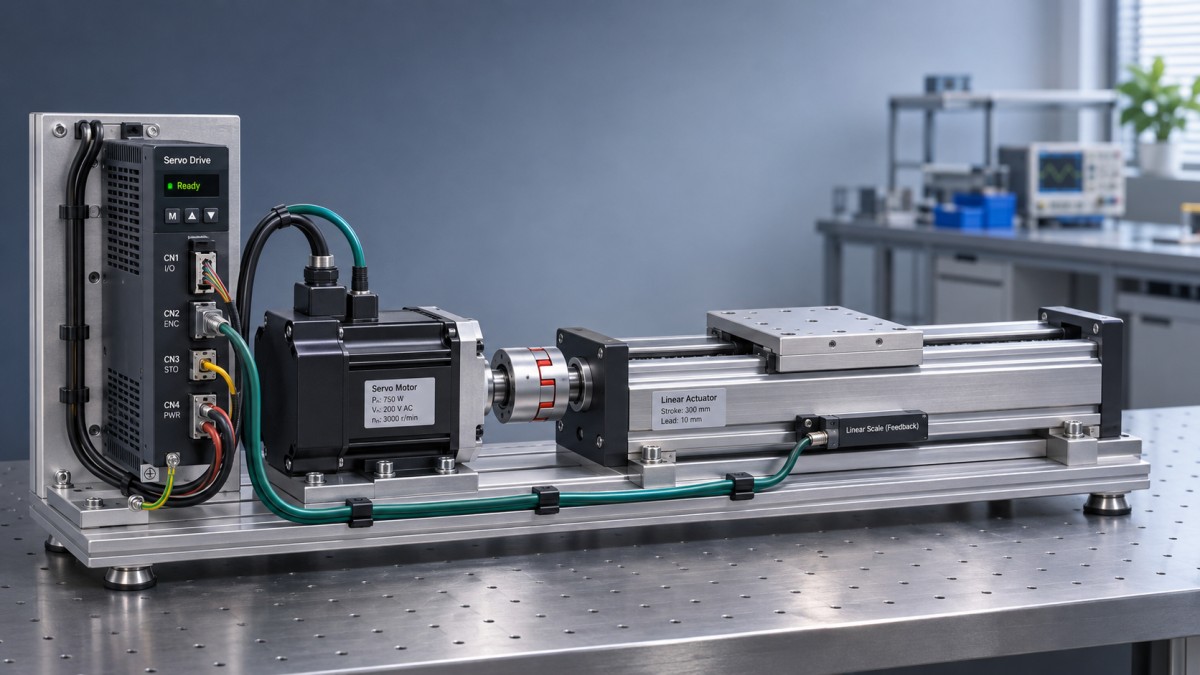
Motion control components are selected for a changing relationship between torque, speed, and time. Peak torque matters during acceleration or when overcoming a temporary obstruction, but continuous and repeated loading determine whether the motor and drive can manage heat. A solution that handles a short peak in one application may overheat when a comparable peak repeats with little recovery time.
Ask for a representative load profile from the reference installation, including normal cycles and demanding events. Compare the profiles at the same boundary: motor shaft, gearbox output, or moving load. Gear ratio, mechanical efficiency, and inertia reflected through the transmission can change what the motor actually sees.
Braking deserves equal attention. Decelerating a load returns energy to the drive system. Depending on the architecture and operating cycle, that energy may be returned to the supply, stored, or dissipated as heat. A reference that demonstrates smooth acceleration but says little about repeated deceleration leaves an important selection question open.
Also distinguish controlled loads from loads driven by the environment. Gravity, vessel movement, wind, or another machine can force an axis to move even when the motor is commanded to stop. The reference should show how holding, braking, and energy management work under those conditions if they are relevant to the new design.
Look at control performance in context
A published positioning accuracy or response time is meaningful only alongside the conditions under which it was achieved. Feedback resolution, mechanical backlash, structural flexibility, sensor placement, tuning, and load changes can all affect the result at the point where motion matters.
For example, accurate measurement at the motor does not necessarily demonstrate accurate positioning at the end of a flexible transmission. Conversely, a system that performs adequately at a steady speed may struggle during fast reversals because mechanical compliance or backlash becomes more influential.
When reviewing performance claims, ask for the commanded motion, the measured response, the load, and the measurement location. Check whether the result represents a single commissioning test, repeated operation, or performance over a broader range of conditions. Where settling time or overshoot matters, the reference should define how each was measured and what limits were accepted.
A useful reference need not match every parameter. A project with a similar mechanical arrangement and documented tuning challenges may be more informative than a superficially closer installation supported only by a short performance claim. The difference is whether it helps the team predict behavior and plan validation.
Separate environmental similarity from component suitability
Railway and maritime equipment can face vibration, shock, temperature changes, moisture, and restricted maintenance access, but those conditions vary widely by installation location. A cabinet in a protected equipment room and an actuator exposed on deck should not be treated as equivalent simply because both are onboard a vessel.
Examine the complete installation, including the enclosure, connectors, cables, cooling arrangement, and mounting. A drive may have operated successfully in a harsh application because it was protected by a cabinet, conditioned air, or isolation mounts. If the proposed design removes those protections, the reference no longer supports the same conclusion.
For rail equipment, consider the effects of the electrical supply, electromagnetic interference, mechanical vibration, and the installation’s location on the vehicle or infrastructure. For maritime equipment, consider salt exposure where applicable, condensation, vessel motion, and the practicality of inspecting or replacing components. The applicable project specifications determine which conditions and evidence matter; a general statement that equipment is “rail-ready” or “marine-ready” does not describe its limits.
Trace safety claims to the function being performed
A reference can show that a component was used in a safety-related system without proving that the new application achieves the same safety outcome. The relevant question is what the complete system must do when a fault occurs: remove torque, hold a load, apply a brake, prevent unintended movement, or transition to another defined state.
Ask which parts of the reference architecture contributed to that function. A drive’s torque-removal capability, for example, may prevent the motor from producing torque, but it does not by itself guarantee that a suspended or externally driven load will stop or remain stationary. A mechanical brake, monitoring circuit, or other measures may be needed as part of the overall design.
Review the assumptions behind the reference: fault detection, response time, power loss behavior, independence between channels where required, and the interaction between control software and mechanical devices. Evidence for a component should be considered alongside the system-level assessment and the requirements of the intended application. A safety designation quoted without its scope, configuration, and operating assumptions is too narrow a basis for selection.
Check integration before treating a reference as transferable
Motion control performance depends on the surrounding system. A successful reference may rely on a particular controller, encoder, network, supply arrangement, or mechanical assembly. Changing one of those elements can alter communication timing, fault handling, tuning, or the available diagnostic information.
Request an architecture diagram and identify the interfaces that cross supplier boundaries. Pay particular attention to command updates and feedback timing, startup and shutdown sequences, synchronization between axes, loss-of-communication behavior, and ownership of alarms. If the reference used a different controller or feedback device, establish what needs to change and how the resulting configuration will be tested.
Software versions and configuration management matter too. A reference built on a different firmware version or a customized control library may still be relevant, but it is evidence for that configuration. Ask which features were standard, which required project-specific engineering, and who maintains the application code.
Integration effort can influence the choice between two technically capable solutions. A system with a close mechanical match but unfamiliar interfaces may need substantial development; another with a less exact load match may offer a better-supported integration path. The better choice depends on whether the remaining performance gap can be demonstrated safely within the project’s test plan.
Distinguish evidence of installation from evidence of performance
A reference list establishes where a solution was reportedly used. It rarely shows whether the system met the same requirements, how long it operated, or which issues arose after commissioning. Ask for evidence proportionate to the decision, while recognizing that customer confidentiality can limit what a supplier can share.
A test report is stronger when it includes the conditions and acceptance criteria, not just a pass result. Service information is more useful when it distinguishes operating hours or cycles from calendar time and explains what was replaced or modified. An installation that has been in place for years may have accumulated little operating exposure, while an actively cycled system may provide more relevant wear information.
Absence of a shareable report does not automatically rule out a solution. It does change the decision: unsupported claims should become test items, engineering assumptions, or procurement conditions rather than being recorded as demonstrated capability.
Turn gaps into a selection and validation plan
Build a comparison around the requirements that could prevent acceptance or cause major redesign. For each candidate, record the new project’s requirement, the closest reference condition, the evidence available, and the gap. Assign an owner and a way to close each material gap before the relevant design or purchasing decision.
For example, a reference may demonstrate the required positioning accuracy at a lighter load. The next step could be a representative test with the intended load and transmission, including reversals and stopping. If the difference is environmental, a component or assembly test may be more useful than repeating a control performance test. If the gap concerns a safety function, the architecture and its fault response need to be assessed at the appropriate system level.
Keep the test boundary clear. A bench test can demonstrate a drive and motor’s behavior under a simulated load, but it may not reveal structural vibration, cable routing effects, or the maintenance constraints of the final installation. Site acceptance can address some of those issues, though problems found that late may be expensive to correct. Use earlier tests to resolve the assumptions with the greatest design impact.
When comparing proposals, give more weight to a documented, relevant operating case than to the number of references. A candidate with fewer installations may still be the stronger choice if its load cycle, control architecture, and verification evidence align closely with the new project. Where no reference is sufficiently close, select on the strength of the engineering rationale and the agreed validation work, with responsibilities and acceptance criteria established before commitment.
Recommended News
 Nov 23, 2026Can an AI route optimization platform handle cross-border truck restrictions in Europe?AI route optimization platform Europe: Discover how to assess cross-border truck restrictions, validate compliant routes, and avoid costly routing errors.
 Nov 21, 2026How to assess carrier integration in an intermodal transportation platformEvaluate an intermodal transportation platform with a practical guide to carrier coverage, event accuracy, integration failures, security and acceptance testing.
 Nov 20, 2026How to identify which railway safety standards apply to a projectRailway safety standards guide: Learn how to identify applicable requirements, map interfaces and build a defensible compliance baseline for your project.
 Nov 19, 2026How to evaluate motion control application references for a new projectEvaluate engineering application references for motion control with confidence. Compare load cycles, safety, integration, and evidence to reduce project risk.
 Nov 18, 2026When does electric marine propulsion make sense for ferries?Electric marine propulsion technology can transform ferry operations. Explore when battery-electric or hybrid systems make sense for your routes, charging access, and costs.
 Nov 17, 2026How much does it cost to buy an ocean-going vessel?Ocean going vessel cost ranges from a few million to hundreds of millions of dollars. Explore purchase prices, hidden costs, and key factors before you buy.
 Nov 16, 2026How to verify solution provider references before signing a contractVerify solution provider references before signing. Learn what to ask, which evidence to check, and how to turn findings into stronger contract terms.
 Nov 14, 2026How does automatic train control affect metro train headways?Discover how automatic train control for metro systems can reduce headways, improve service consistency and support capacity planning without compromising safety.
 Nov 13, 2026How to assess the financial return on rail infrastructure investmentAssess rail infrastructure investment with confidence. Explore lifecycle costs, NPV, IRR and risk scenarios to make better-informed funding decisions.
 Nov 12, 2026How to assess an ocean vessel technology provider's integration capabilitiesAssess an ocean vessel technology provider with a practical guide to interfaces, cybersecurity, failure testing, and lifecycle support. Make a confident choice.
 Nov 10, 2026When is external supplier evaluation support worth the cost?Discover when supplier evaluation support is worth the cost, how to estimate its return, and where independent expertise can reduce sourcing risks.
 Nov 09, 2026How can evaluation support help component suppliers prepare for audits?Supplier evaluation support for component suppliers helps uncover audit gaps, strengthen traceability, and build a clear, risk-based preparation plan.
 Nov 07, 2026How smart intermodal transportation reduces transfer delaysDiscover how smart intermodal transportation reduces transfer delays through real-time coordination, cargo-ready forecasts, and faster decisions.
 Nov 06, 2026How to evaluate AI route optimization suppliers in North AmericaAI route optimization supplier North America: discover how to compare providers, validate savings, assess security and choose a solution that fits your operations.
 Nov 04, 2026Can LTE-M track rail assets in areas with limited coverage?LTE-M rail transit for asset tracking can bridge coverage gaps with offline data storage. Discover its limits and how to assess your routes.
 Nov 01, 2026When is rail freight cheaper than maritime shipping?Compare rail and maritime cost to discover when rail freight can save money on inland routes, inventory and delays. Learn how to assess the full door-to-door cost.
 Oct 31, 2026How an AI route optimization dashboard handles traffic delaysDiscover how an AI route optimization dashboard responds to traffic delays, compares feasible routes, updates ETAs, and helps operators make informed decisions.
 Oct 29, 2026How to assess an automatic train control manufacturer for retrofitsAssess an automatic train control manufacturer for your retrofit. Learn how to verify compatibility, safety assurance, migration plans, and long-term support before choosing a supplier.
 Oct 28, 2026Does technical selection support in Southeast Asia cover local codes?Explore technical selection support Southeast Asia projects need to address local codes, assess compliance evidence, and map approval pathways. Learn what to ask before procurement.
 Oct 26, 2026How a product information platform keeps product data consistentDiscover how a product information platform keeps data consistent with clear ownership, validation, and approved updates. Learn what to check before choosing a solution.
 Oct 23, 2026When is renting heavy mining equipment cheaper than buying?Renting heavy industry equipment for mining? Discover when it costs less than buying, compare hidden fees and break-even points, and make a smarter fleet investment.
 Oct 21, 2026Can absolute safety monitoring eliminate all operational risk?Can absolute safety monitoring eliminate all risk? Discover its limits, hidden failure points, and practical safeguards to strengthen protection and make smarter safety decisions.
 Oct 19, 2026How to vet a European railway safety technology supplier’s track recordSeeking a railway safety technology supplier Europe can trust? Learn how to verify project references, safety credentials, and lifecycle support to build a defensible shortlist.
 Oct 15, 2026How to size train traction systems for frequent-stop rail serviceSize train traction systems for frequent-stop rail service with practical guidance on power, adhesion, thermal loads, and braking. Learn how to meet timetables without costly oversizing.