Search News
Industry Portal
Popular Tags
How a product information platform keeps product data consistent
Author
Time
Click Count
When a braking specification differs between a supplier spreadsheet and a maintenance reference sheet, the newest file is not automatically the right one. The correct value depends on the equipment variant, the approved revision, and the conditions under which that specification applies. A product information platform helps keep these details consistent by managing product records, checking incoming data, and distributing approved changes to connected systems.
That consistency requires more than putting documents in one place. Each important value needs an identifiable source, a responsible owner, and a clear release status. For rail components and marine equipment, users also need to distinguish general product information from instructions approved for a particular installation.
Consistency starts with identifying the exact product
Two records can look contradictory while describing different configurations. A pantograph may belong to the same product family as another unit but use a different collector head or mounting arrangement. A marine valve may share a commercial name with another version while having different materials or service limitations.
A useful platform connects information to a stable product identifier and records the relationships between families, models, variants, and replacement parts. Supplier names, internal stock codes, and purchasing descriptions can remain searchable aliases, but they should resolve to the appropriate record.
Without this structure, centralization can make errors easier to spread. A specification copied into a family-level record may appear to apply to every variant, even when its source describes only one configuration.
Consistency also does not mean displaying identical information everywhere. A procurement view may show packaging and ordering details, while a maintenance view emphasizes identification, compatibility, and supporting documents. Both should draw shared facts from the same approved record while preserving the context each task requires.
How a product information platform controls conflicting data
A product information platform, often implemented through product information management software, can coordinate data from suppliers, engineering systems, purchasing records, and document repositories. Its effectiveness depends on how authority is assigned across those sources.
Storing every incoming value without deciding which source governs it simply creates a larger collection of disagreements.
Assign ownership at the field level
Different teams usually control different facts. Engineering may own technical characteristics and compatibility rules. Procurement may manage supplier identifiers and ordering information. A documentation function may control released manuals and translations.
The platform should reflect these responsibilities. An imported supplier file might update a packaging description automatically while placing a proposed technical change into review. Treating every source as equally authoritative allows routine imports to overwrite carefully reviewed information.
This is why a shared product record does not require one application to originate every fact. It requires a defined authority for each field and predictable rules for exchanging information.
Make values comparable before checking them
Specifications need structured fields that preserve meaning. A pressure value requires a unit and may also need a reference condition. A temperature field should distinguish normal operation from storage or a temporary limit. Dimensions need clear labels so that overall length is not confused with installation clearance.
Validation rules can require essential fields, restrict entries to approved terms, and flag incompatible combinations. Unit conversion can help align incoming records, provided the original value and unit remain traceable and rounding does not change the intended meaning.
Some checks must consider relationships between fields. A record may be complete but still contain a document assigned to the wrong variant or a replacement part listed without its compatibility conditions. These problems are harder to catch with mandatory fields alone.
Resolve disagreements before release
When two sources disagree, the system should preserve the conflict for review. Choosing whichever value arrived last is unreliable because upload order says nothing about technical authority.
A useful review presents the existing value, the proposed value, their sources, and the affected products or documents. The responsible person can then approve the change, reject it, or request supporting information.
Validation can detect missing or inconsistent information; technical approval establishes whether the information is suitable for its intended use. A value can pass a format check and still be wrong for the equipment concerned.
Follow a change through to the point of use
Consider a hypothetical update to the storage guidance for a replacement brake component. The supplier submits a revised document, but the existing guidance remains visible in a maintenance reference and an exported parts catalog.
A controlled process connects the proposed change to the exact component identifier, compares it with the released information, and routes it to the appropriate reviewer. Approval then creates a traceable revision and triggers updates to the relevant destinations.
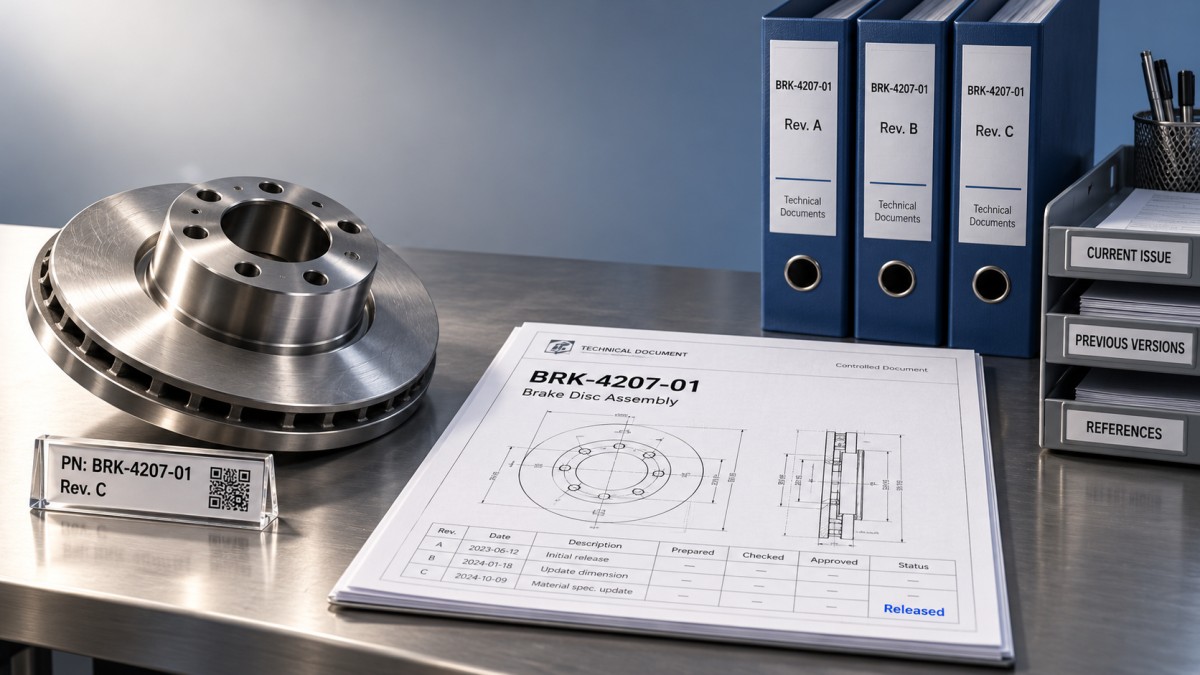
The important checkpoints are:
- Identify the scope: establish which variants, documents, and records the change affects.
- Review the evidence: compare the proposed information with the current approved source.
- Release deliberately: record the approval, revision, effective date, and any applicability conditions.
- Confirm distribution: check that connected systems received and accepted the update.
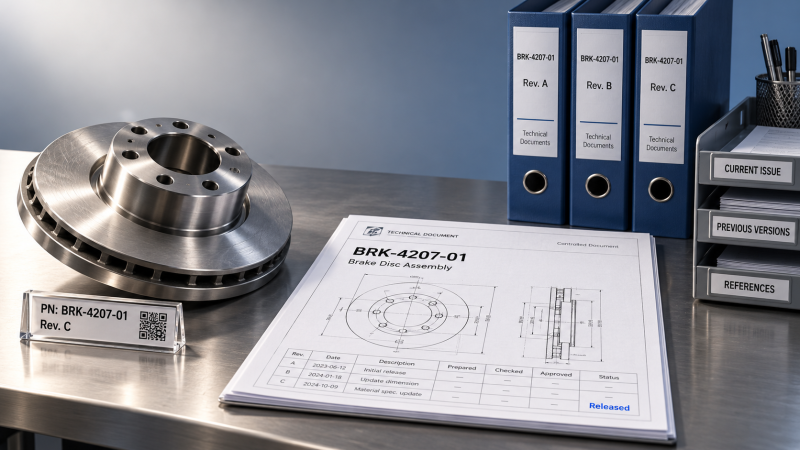
- Control older copies: preserve history while making superseded information distinguishable from current guidance.
Each checkpoint addresses a different failure. Review prevents an unsupported change from being released. Distribution checks prevent an approved change from remaining isolated in the central system. Clear revision status helps someone recognize an outdated download.
The latest revision may not apply to the installed equipment
Revision control answers what changed over time. Applicability answers where that change belongs. Both are necessary when equipment remains in service through modifications, component replacements, or software updates.
A revised manual might cover newly manufactured units while an earlier release remains applicable to an existing configuration. A replacement component might require an associated modification before it can be used. Simply labeling one document “latest” does not resolve either situation.
Where relevant, product records should link to configuration details, serial ranges, software dependencies, or modification status held in the appropriate engineering or asset system. The product information platform may present those relationships without becoming the master record for every installed asset.
For someone checking a technical value, the useful questions are practical: Does this record match the equipment identifier? Is the document released? Does its applicability include this installation? Are there conditions attached to the value?
A recent upload date provides little reassurance if those questions remain unanswered. Interfaces should make release status and applicability easy to see beside the specification or document link.
Consistency can break after publication
A correct central record does not guarantee correct information in every destination. An integration may fail, a receiving system may reject a field, or an export may omit an important qualifier. A spreadsheet downloaded earlier may continue circulating after the source changes.
Integration monitoring should therefore show more than whether a transfer was attempted. It should reveal whether the destination accepted the update, which records failed, and what action is needed. Important qualifiers must survive the transfer: publishing a temperature limit without its operating conditions can change the meaning of the specification.
Downloaded files need their own context. A useful export identifies the product, revision, release status, and export date. Where practical, it also provides a route back to the maintained record. This helps readers recognize what they have without assuming that a static copy updates itself.
Disconnected working environments need an explicit process for refreshing approved information. If a vessel or maintenance location uses locally stored documents, the team needs to know which release is available there and how updates reach it. Central publication alone does not establish local availability.
Keep technical reference data within its proper role
Product information supports equipment selection, documentation searches, and maintenance preparation. A catalog record does not, by itself, authorize a component substitution or a change to an operating setting.
For example, matching dimensions and a similar description may help identify a candidate replacement, but compatibility can also depend on interfaces, materials, software, or approved configuration. The platform should expose those dependencies and connect users to the relevant controlled documentation.
This distinction also matters when using industry intelligence. GTOT’s coverage of railway control systems, pantographs, braking equipment, smart container ships, and LNG carriers provides context for understanding technologies and sector developments. Equipment-specific decisions require a connection to the applicable product record and released technical documentation.
A platform is most useful when it makes that connection easy to follow and clearly distinguishes descriptive content from controlled instructions.
Evaluate the platform with a realistic task
A demonstration built around a simple product listing may show attractive screens without revealing how the system handles conflicting technical information. A stronger evaluation follows a task from identification through an approved update.
Choose a representative component with several variants and supporting documents. Ask the team to find the correct record using an internal code, introduce a supplier update that conflicts with an existing value, and trace the result through review and publication.
Observe whether someone completing the task can:
- Distinguish the required variant from similar products without relying on its name alone.
- See the source, approval status, and applicability of an important specification.
- Understand why a proposed change was blocked or sent for review.
- Find the applicable manual alongside related product information.
- Recognize a superseded document or a failed downstream update.
- Report a discrepancy to an identifiable owner.
These checks reveal whether governance is usable in daily work. A technically detailed record offers limited value if people cannot locate it or understand its status.
Selection should also reflect the task boundary. If the main difficulty is maintaining multilingual specifications and distributing approved product content, product information management may be a strong fit. If the primary requirement is controlling engineering changes or tracking maintenance against individual assets, engineering or asset management capabilities may need to lead, with product information connected to them.
Start with the disagreement that causes repeated work
A practical implementation can begin with one product family where mismatched records repeatedly interrupt work. Define its identifiers, the fields that matter, the authority for each field, and the destinations that consume the information. Resolve duplicate and conflicting records before making them part of automated distribution.
Then follow a meaningful update from its source to the place where someone uses it. Check that the released value retains its units, conditions, document links, and applicability. Confirm that a rejected transfer becomes visible and that an older copy can be recognized.
The outcome to look for is concrete: someone should be able to find the correct product, understand which information applies, and trace an approved change without reconstructing the answer from several spreadsheets. That is how consistent data becomes reliable support for daily decisions.
Recommended News
 Nov 23, 2026Can an AI route optimization platform handle cross-border truck restrictions in Europe?AI route optimization platform Europe: Discover how to assess cross-border truck restrictions, validate compliant routes, and avoid costly routing errors.
 Nov 21, 2026How to assess carrier integration in an intermodal transportation platformEvaluate an intermodal transportation platform with a practical guide to carrier coverage, event accuracy, integration failures, security and acceptance testing.
 Nov 20, 2026How to identify which railway safety standards apply to a projectRailway safety standards guide: Learn how to identify applicable requirements, map interfaces and build a defensible compliance baseline for your project.
 Nov 19, 2026How to evaluate motion control application references for a new projectEvaluate engineering application references for motion control with confidence. Compare load cycles, safety, integration, and evidence to reduce project risk.
 Nov 18, 2026When does electric marine propulsion make sense for ferries?Electric marine propulsion technology can transform ferry operations. Explore when battery-electric or hybrid systems make sense for your routes, charging access, and costs.
 Nov 17, 2026How much does it cost to buy an ocean-going vessel?Ocean going vessel cost ranges from a few million to hundreds of millions of dollars. Explore purchase prices, hidden costs, and key factors before you buy.
 Nov 16, 2026How to verify solution provider references before signing a contractVerify solution provider references before signing. Learn what to ask, which evidence to check, and how to turn findings into stronger contract terms.
 Nov 14, 2026How does automatic train control affect metro train headways?Discover how automatic train control for metro systems can reduce headways, improve service consistency and support capacity planning without compromising safety.
 Nov 13, 2026How to assess the financial return on rail infrastructure investmentAssess rail infrastructure investment with confidence. Explore lifecycle costs, NPV, IRR and risk scenarios to make better-informed funding decisions.
 Nov 12, 2026How to assess an ocean vessel technology provider's integration capabilitiesAssess an ocean vessel technology provider with a practical guide to interfaces, cybersecurity, failure testing, and lifecycle support. Make a confident choice.
 Nov 10, 2026When is external supplier evaluation support worth the cost?Discover when supplier evaluation support is worth the cost, how to estimate its return, and where independent expertise can reduce sourcing risks.
 Nov 09, 2026How can evaluation support help component suppliers prepare for audits?Supplier evaluation support for component suppliers helps uncover audit gaps, strengthen traceability, and build a clear, risk-based preparation plan.
 Nov 07, 2026How smart intermodal transportation reduces transfer delaysDiscover how smart intermodal transportation reduces transfer delays through real-time coordination, cargo-ready forecasts, and faster decisions.
 Nov 06, 2026How to evaluate AI route optimization suppliers in North AmericaAI route optimization supplier North America: discover how to compare providers, validate savings, assess security and choose a solution that fits your operations.
 Nov 04, 2026Can LTE-M track rail assets in areas with limited coverage?LTE-M rail transit for asset tracking can bridge coverage gaps with offline data storage. Discover its limits and how to assess your routes.
 Nov 01, 2026When is rail freight cheaper than maritime shipping?Compare rail and maritime cost to discover when rail freight can save money on inland routes, inventory and delays. Learn how to assess the full door-to-door cost.
 Oct 31, 2026How an AI route optimization dashboard handles traffic delaysDiscover how an AI route optimization dashboard responds to traffic delays, compares feasible routes, updates ETAs, and helps operators make informed decisions.
 Oct 29, 2026How to assess an automatic train control manufacturer for retrofitsAssess an automatic train control manufacturer for your retrofit. Learn how to verify compatibility, safety assurance, migration plans, and long-term support before choosing a supplier.
 Oct 28, 2026Does technical selection support in Southeast Asia cover local codes?Explore technical selection support Southeast Asia projects need to address local codes, assess compliance evidence, and map approval pathways. Learn what to ask before procurement.
 Oct 26, 2026How a product information platform keeps product data consistentDiscover how a product information platform keeps data consistent with clear ownership, validation, and approved updates. Learn what to check before choosing a solution.
 Oct 23, 2026When is renting heavy mining equipment cheaper than buying?Renting heavy industry equipment for mining? Discover when it costs less than buying, compare hidden fees and break-even points, and make a smarter fleet investment.
 Oct 21, 2026Can absolute safety monitoring eliminate all operational risk?Can absolute safety monitoring eliminate all risk? Discover its limits, hidden failure points, and practical safeguards to strengthen protection and make smarter safety decisions.
 Oct 19, 2026How to vet a European railway safety technology supplier’s track recordSeeking a railway safety technology supplier Europe can trust? Learn how to verify project references, safety credentials, and lifecycle support to build a defensible shortlist.
 Oct 15, 2026How to size train traction systems for frequent-stop rail serviceSize train traction systems for frequent-stop rail service with practical guidance on power, adhesion, thermal loads, and braking. Learn how to meet timetables without costly oversizing.