



Search News
Industry Portal
Popular Tags
What drives traction systems price differences between rail projects?
Author
Time
Click Count
What Drives Traction Systems Price Differences Between Rail Projects?
A traction package can look comparable on a bid summary and still carry a very different commercial risk. Two projects may both require electric multiple units, metro cars, locomotives, or high-speed trainsets, yet the quoted traction systems price can diverge sharply once the technical baseline is examined. The reason is simple: traction equipment is not bought in isolation. It has to work with the vehicle, the overhead supply, the wheel-rail environment, the braking strategy, the signalling architecture, depot practices, and the operator’s expected service pattern.
For procurement teams, the most expensive mistake is often treating traction systems as a commodity line item. A lower equipment price may reflect a narrower scope, fewer validation activities, limited local support, shorter warranty assumptions, or interface responsibilities left unresolved. Conversely, a higher proposal is not automatically better value; it may include engineering allowances that the project does not need. A sound comparison begins by separating the base equipment cost from the conditions that make it suitable for a particular railway.
The traction system is priced around the duty cycle, not just power output
Buyers often start with installed traction power: how many kilowatts per vehicle, inverter, or motor. That is necessary, but it is not enough. The real engineering burden comes from how frequently that power must be delivered, at what ambient temperature, on what gradients, with how much passenger load, and under what adhesion conditions.
An urban metro operating with short station spacing may accelerate and brake thousands of times across a service day. Its traction converters, cooling arrangement, control logic, and regenerative-braking coordination face a very different workload from an intercity train spending long periods at steady speed. A heavy-haul locomotive may need sustained tractive effort on grades and tolerate a different axle-load regime. High-speed rolling stock adds aerodynamic resistance, demanding current collection, vibration management, and thermal performance at the top end of its operating envelope.
This is why a proposal based only on nominal motor rating can be misleading. A supplier may quote similar rated power while using a different thermal margin, cooling capacity, redundancy arrangement, or software configuration. The initial traction systems price then appears favorable, but the equipment may be less suited to the actual timetable. Procurement should request the assumed duty cycle in writing and ask whether the offer is validated against that cycle rather than against a generic vehicle profile.
The same principle applies to regenerative braking. On a network able to accept regenerated energy, the traction package can support meaningful energy recovery. On a network with limited receptivity, crowded substations, or no practical path for energy absorption at certain times, the train needs another braking strategy. The cost impact may sit partly in traction control, partly in resistors, and partly in system integration. It should not be hidden in a broad “electrical package” line.
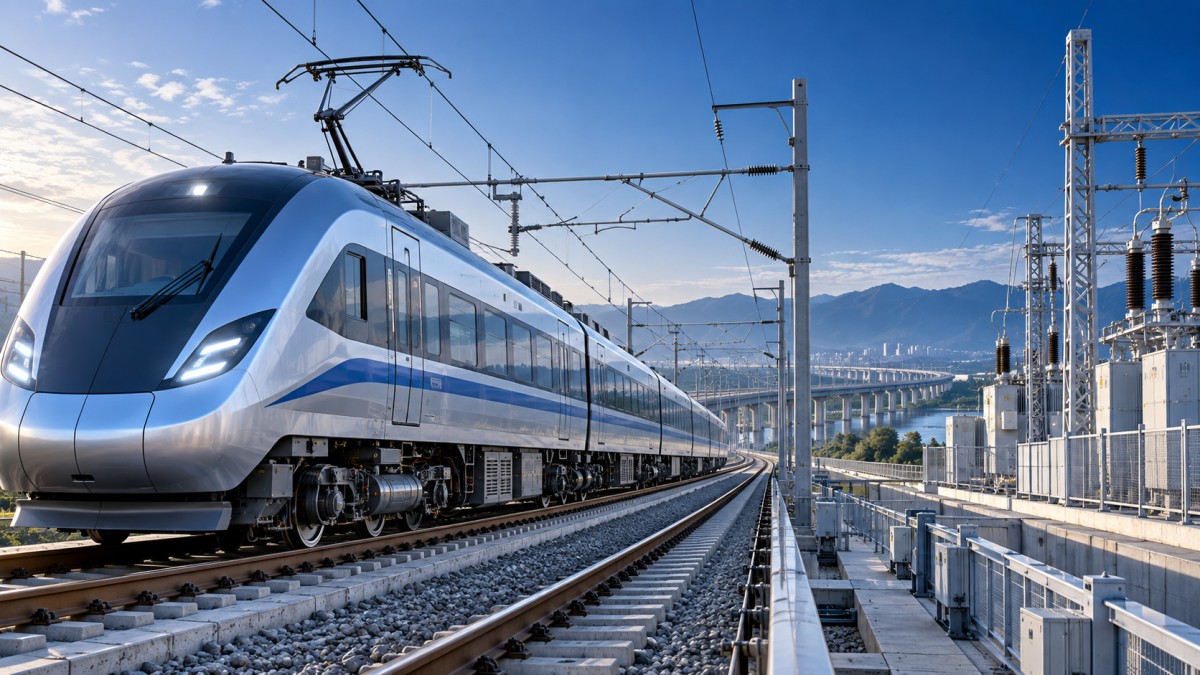
Supply voltage and network compatibility change the cost base
Voltage is one of the clearest reasons why rail projects that appear similar are priced differently. A fleet designed for one established electrification system generally has a more straightforward electrical architecture than a fleet required to operate across multiple voltage systems. Multi-system capability can affect the transformer, converter arrangement, insulation coordination, protective devices, control software, testing scope, and physical packaging within the vehicle.
Even where projects use the same nominal voltage, local network conditions matter. Procurement documentation should clarify expected voltage variation, harmonic limits where applicable, fault conditions, neutral-section operation, earthing approach, and requirements for electromagnetic compatibility. These are not minor technical notes. They can determine whether a standard platform configuration is acceptable or whether a supplier must redesign part of the traction chain.
Pantograph and traction decisions are also connected more closely than commercial packages sometimes suggest. At higher operating speeds, stable current collection becomes increasingly sensitive to aerodynamic effects, contact-force behavior, vibration, and the overhead line condition. A traction package can only perform as intended when the vehicle’s power collection system remains stable. If pantograph responsibility is assigned to a separate supplier, the interface must be commercially and technically explicit. Otherwise, the project may discover late in commissioning that each party has met its own narrow specification while the train-level result is still unacceptable.
Fleet size affects unit price, but platform maturity matters more
Larger orders usually spread engineering, tooling, test, and documentation costs across more vehicles. That does not mean the lowest unit price always comes from the largest fleet. A small order based on a mature, already-qualified traction platform may be commercially cleaner than a larger order demanding a bespoke architecture, unusual packaging, new interfaces, or a localized design variant.
The key distinction is between repeat production and project-specific engineering. Procurement teams should ask suppliers to separate:
- serial equipment supply;
- non-recurring engineering and vehicle integration work;
- type testing, validation, and acceptance support;
- software adaptation and cybersecurity-related scope where specified;
- special tools, depot equipment, training, and documentation;
- spares, obsolescence support, and long-term service provisions.
Without this breakdown, a low first-offer price can be difficult to compare with a more transparent proposal. It also makes later change orders more likely. In rail procurement, the “standard” option should be challenged politely but directly: standard for which vehicle platform, which voltage, which climate, which operating speed, and which regulatory environment?
Safety, interfaces, and validation are often where budgets move
Traction is part of a train-level safety and availability picture. It exchanges information with train control, braking, auxiliary power, doors, diagnostics, and sometimes platform or wayside systems. A change in one area can create work in another. For example, blended braking behavior has to align with pneumatic or friction braking performance; wheel-slide protection and adhesion management may influence how braking effort is distributed; signalling and automatic train operation requirements can affect traction inhibition, speed supervision, and fault handling.
Projects with high-density automation or a requirement for the highest safety-integrity approach, such as SIL4 functions in the relevant control architecture, usually require disciplined evidence, interface control, and verification. It is not accurate to assume that a traction supplier alone “delivers” the system safety case. Still, the supplier’s documentation quality, failure-mode analysis, diagnostic coverage, and support during integration can materially change project cost and schedule exposure.
This is where an apparently cheaper bid sometimes becomes costly. If the bid excludes interface workshops, software support during dynamic testing, fault investigation during commissioning, or responsibility for resolving incompatible data exchanges, the buyer is effectively carrying those risks. The bid evaluation should identify both included activities and exclusions, not merely compare hardware totals.
Localization can lower exposure—or introduce a new one
Local assembly, local content commitments, domestic repair capability, and local engineering support frequently shape the traction systems price. Their effect is not automatically positive or negative. Local work can shorten logistics routes, improve depot response, and meet contractual or public-procurement expectations. It can also add qualification work, supplier-development effort, duplicate inventory, or complexity in quality assurance when the local supply base is still developing.
The practical question is not “Is localization included?” but “Which activities are localized, under whose quality system, and from what production stage?” Assembly of cabinets, repair of modules, harness manufacture, software support, and final testing are materially different commitments. A buyer should avoid crediting a bid for local capability unless the scope, staffing, parts availability, escalation route, and warranty responsibility are sufficiently defined.
Currency exposure and import logistics deserve the same level of attention. Traction electronics depend on specialist components with long planning horizons. A quote may be valid only under stated exchange-rate, freight, and delivery assumptions. These conditions should be visible in the commercial comparison rather than buried in supplier qualifications.
Lifecycle cost is not a slogan when a fleet is tied to one diagnostic ecosystem
The purchase price matters, especially in a tightly funded rolling-stock program, but traction systems remain in service for many years. Cost and operational flexibility are influenced by how faults are diagnosed, whether depot personnel can access meaningful data, how software updates are governed, what repair level is permitted locally, and how future component obsolescence will be managed.
A buyer does not need to demand unrestricted access to every proprietary design detail. That is rarely realistic. But the operating organization should understand the practical support model. Can the depot isolate a fault to a replaceable unit? Is remote support included or charged separately? Who approves parameter changes? What is the process if an electronic component becomes unavailable? Are critical spare modules identified before revenue service begins?
Availability commitments also need careful reading. They are only comparable when the definitions match: which failures count, what response time applies, whether vehicle availability depends on depot readiness, and whether a delay caused by an external interface is excluded. A strong reliability statement without clear remedies, data access, and service boundaries has limited procurement value.
How to compare quotations without rewarding omissions
A useful bid review works from a common technical and commercial baseline. Before ranking suppliers, normalize the offers around the actual operating profile and record every assumption that changes the price. This may feel slower during tender evaluation, but it is usually much faster than resolving a vague scope after contract award.
Start with a train-level interface matrix. It should show responsibility for power collection, traction, auxiliary power, braking coordination, train control and management, signalling-related functions, diagnostics, and commissioning support. Then compare the offers on an “included, optional, excluded, or assumed” basis. This catches a common problem: one supplier includes dynamic test support and another prices only factory delivery, yet both are presented as complete traction packages.
Ask for a lifecycle schedule beside the equipment quotation. It need not predict every future expense, but it should identify recommended spares, planned maintenance activities, specialist tools, training, repair pathways, software support, and obsolescence responsibilities. If a supplier cannot state the assumptions behind its lifecycle proposal, the buyer should treat the headline price with caution.
Independent intelligence can help at this stage, particularly where rail control, pantograph behavior, brake integration, and traction performance overlap. GTOT’s work across railway signal control systems, high-speed traction technology, pantographs, and rail braking reflects a useful procurement reality: subsystem prices make sense only when viewed through their operational interfaces. The same disciplined approach used to assess complex marine systems—where propulsion, containment, navigation, and operational support cannot be separated neatly—applies to modern rail assets.
The best price is the one attached to a complete operating promise
Traction systems price differences are ultimately a map of project assumptions. Speed, route duty, electrification, fleet scale, integration scope, local content, testing, maintenance, and software support all leave a commercial trace. The procurement task is to determine which differences represent necessary engineering and which represent unclear scope, unnecessary customization, or deferred cost.
Before selecting a preferred bidder, require one final confirmation: that the offered configuration is suitable for the defined route, timetable, electrical network, vehicle interfaces, and maintenance model. That single discipline does more to protect long-term value than negotiating a lower headline number after the technical basis has already become ambiguous.
Recommended News
 Sep 29, 2026What drives traction systems price differences between rail projects?Traction systems price differences explained: compare duty cycles, voltage compatibility, integration, localization, and lifecycle costs for smarter rail procurement.
 Sep 26, 2026What to assess before selecting an electric traction system manufacturerChoose an electric traction system manufacturer with confidence. Explore key criteria for performance, reliability, safety, integration, energy efficiency, and lifecycle support.
 Sep 25, 2026When do full digitalization systems justify the investment?Full digitalization systems: discover when rail and maritime operators can turn connected data into safer operations, higher availability, and measurable ROI.
 Sep 23, 2026What drives automatic train control systems cost on rail projects?Automatic train control systems cost depends on integration, migration, safety testing, communications, and lifecycle support. Explore the key budget drivers for rail projects.
 Sep 21, 2026How to assess an ocean going vessel builder’s delivery riskAssess an ocean going vessel builder’s delivery risk with proven checks for schedules, capacity, design maturity, critical equipment, quality, and project controls.
 Sep 20, 2026What drives rail safety technology costs over a project lifecycle?Rail safety technology cost goes beyond equipment—explore lifecycle drivers from integration and safety assurance to cybersecurity, commissioning, and obsolescence.
 Sep 16, 2026What to verify before choosing an advanced ocean-going vessels supplierAdvanced ocean-going vessels supplier checklist: verify design authority, build quality, digital systems, delivery reliability, and lifecycle support before you buy.
 Sep 15, 2026What rail safety technology best reduces level-crossing risks in Southeast Asia?Rail safety technology Southeast Asia: discover how fail-safe signalling, barriers, obstacle detection and remote monitoring reduce level-crossing risks.
 Sep 14, 2026How exporters can reduce customs delays in global trade logisticsGlobal trade logistics for exporters: reduce customs delays with accurate data, clearance-ready documents, early filing, and proactive exception management.
 Sep 13, 2026When do global transportation network systems reduce delivery delays?Global transportation network systems reduce delivery delays by improving rail-port-vessel coordination, real-time visibility, and proactive decisions across complex land-sea supply chains.
 Sep 09, 2026When should you choose a rail and maritime manufacturer with dual-sector capability?Rail and maritime manufacturer guide: learn when dual-sector capability reduces integration risk, improves lifecycle support, and strengthens rail-to-port operations.
 Sep 08, 2026What to verify before selecting a railway signalling equipment supplierRailway signalling equipment supplier checklist: verify safety evidence, integration, cybersecurity, delivery capability, and lifecycle support before award.
 Sep 07, 2026How to size a traction power transformer for railway load demandTraction power transformer sizing guide: model railway load demand, peak duty, voltage regulation, harmonics, and contingency capacity for reliable service.
 Sep 07, 2026How do customization options for industrial connectors affect lead times?Customization options for industrial connectors can impact lead times, cost, and compliance. Learn how to specify smarter for rail and marine projects.
 Sep 05, 2026What information should an industrial sourcing guide include?Industrial sourcing information procurement guide: evaluate suppliers, compliance, lifecycle costs, interfaces, and lead times for smarter rail and maritime purchasing decisions.
 Sep 01, 2026How to find reliable maritime tender information before biddingMaritime tender information: learn how to verify sources, define bid-ready scopes, check qualifications, and reduce risk before submitting competitive marine bids.
 Aug 30, 2026How to select railway automation equipment for depots with phased upgradesRailway automation equipment for depots: learn how to plan phased upgrades that improve safety, throughput, integration, and lifecycle control.
 Aug 27, 2026How industrial sourcing intelligence pricing data supports budget approvalIndustrial sourcing intelligence pricing data helps teams benchmark scope, assess supplier risk, and build defensible budget approvals for complex rail and maritime assets.
 Aug 26, 2026When does a marine fuel efficiency solution make financial sense in the Middle East?Marine fuel efficiency solution Middle East: learn when retrofit savings, compliance value, and vessel data align to deliver credible ROI and smarter shipping investment decisions.
 Aug 24, 2026When does maritime automation for tankers deliver a real payback?Maritime automation for tankers delivers real payback when it cuts fuel use, reduces cargo risk, and improves uptime. See how owners can time investment for stronger ROI.
 Aug 23, 2026When do maritime logistics systems in the Middle East justify the costMaritime logistics systems Middle East: discover when rising delays, manual coordination, and poor visibility make system investment the smarter move for regional operators.
 Aug 22, 2026What drives vessel navigation system price for commercial fleetsVessel navigation system price depends on integration, compliance, automation, and support—not just hardware. Learn what drives fleet costs and compare quotes with confidence.
 Aug 21, 2026How to assess shipbuilding maritime tenders before biddingShipbuilding maritime tenders require more than price checks. Learn how to assess technical scope, compliance, supply chain, and commercial risk before bidding with confidence.
 Aug 20, 2026When does working with an ocean-going vessels distributor reduce supply risk?Ocean-going vessels distributor: learn when this partner cuts supply risk through stronger compliance, faster response, and better sourcing resilience in complex maritime procurement.