



Search News
Industry Portal
Popular Tags
How to find reliable maritime tender information before bidding

Author
Time
Click Count
Reliable maritime tender information begins with a simple test: can the original source, scope, timing, and commercial route be traced without relying on a reposted summary? A notice found through a news item, broker message, or supplier network may be useful as an alert, but it is not enough to support bid planning. Before engineering hours are assigned or documents are translated, the tender should be connected to the issuing entity and the current procurement record.
This distinction matters because marine projects often move through several layers. An owner may announce an investment, a shipyard may later issue a package inquiry, an engineering contractor may divide that package into equipment lots, and a purchasing agent may circulate a request for quotation. Each document can describe the same vessel program while creating very different obligations. Treating an early market signal as a formal invitation to bid is a common cause of wasted work.
Start with the procurement trail, not the headline
A credible tender normally leaves a traceable trail: an official procurement portal, the owner or shipyard's documented vendor channel, a named project contact using an organizational email domain, or a tender document with a reference number and controlled issue date. The source does not need to be public to be legitimate. Restricted invitations are common in shipbuilding and marine equipment procurement. What matters is whether the invitation can be authenticated through a known commercial or technical channel.
When a notice is public, compare the text on the publishing page with any downloadable documents. The project name, tender reference, closing date, contact details, and scope description should align. Small differences deserve attention. A closing date that differs between a portal and a copied PDF may indicate an amendment. A document that names a vessel owner but asks suppliers to submit through an unrelated intermediary may require confirmation before confidential drawings or pricing are shared.
Search results often surface older notices because archived tenders can remain indexed long after an award, cancellation, or scope revision. Look for issue dates, addenda, clarification records, and a visible tender status. A tender with no stated document version is harder to assess than one with a controlled revision history. When the material is received by email, verify that the attachment is complete, that its pages use consistent document references, and that the sender has authority to issue procurement correspondence.
Information becomes stronger when two independent paths lead to the same opportunity. For example, a vessel construction announcement may establish that a program exists, while a shipyard vendor registration notice or a package inquiry confirms that procurement is active. The first signal supports market awareness; the second supports bid action. They should not be treated as interchangeable.
Separate the project from the actual package
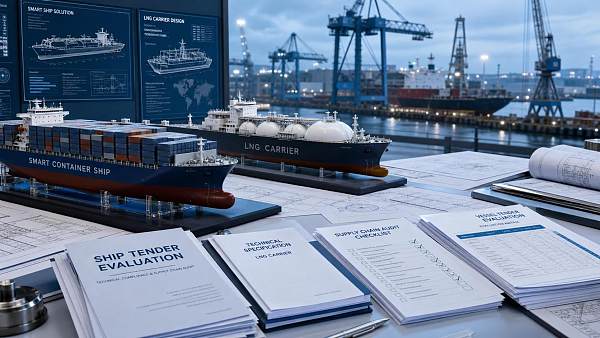
A contract for a smart container ship or LNG carrier can involve hundreds of distinct scopes. A project announcement may mention propulsion, cargo systems, digital navigation, or energy efficiency without showing which items are open for competition. The relevant tender could concern a single control cabinet, a valve actuator, insulation support, cargo monitoring interface, deck machinery component, or commissioning service. Reliable maritime tender information identifies the package boundary.
Read the scope language for nouns that define supply responsibility: “supply only,” “supply and commissioning,” “maker's supervision,” “yard installation,” “retrofit integration,” and “owner-furnished equipment” lead to very different estimating assumptions. A request for a piece of equipment is not necessarily a request for its interfaces, cabling, foundations, software configuration, onboard testing, spare parts, or training.
Pay close attention to the vessel stage. Newbuild procurement, conversion work, dry-dock repair, and onboard retrofit can use similar descriptions while carrying different constraints. A newbuild package may allow design interfaces to be settled early with the yard. A retrofit may depend on onboard measurements, limited shutdown windows, existing cable routes, steelwork access, and compatibility with legacy automation. A quotation based only on a generic product catalogue is unlikely to capture those distinctions.

The following comparison helps distinguish a useful lead from bid-ready information:
Read requirements as connected conditions
Technical requirements in maritime tenders are rarely independent. A stated material grade, pressure rating, temperature range, or enclosure classification gains meaning only when connected to operating conditions and installation details. This is especially evident in LNG-related systems, where a component's suitability can depend on low-temperature exposure, insulation arrangement, thermal movement, sealing method, and the location of controls relative to hazardous or protected spaces. A material reference alone does not establish fitness for the complete duty.
For smart vessel systems, an interface requirement can be more decisive than the headline function. A monitoring device may need to communicate with an existing onboard network, report through a specified protocol, retain data during temporary loss of connection, and fit within a cybersecurity or access-control framework defined elsewhere in the tender. A statement such as “remote monitoring required” is incomplete until the data owner, alarm routing, integration point, onboard network architecture, and acceptance test are understood.
Document hierarchy deserves the same scrutiny. Tender instructions, technical specifications, drawings, data sheets, owner requirements, and clarification responses can conflict. A bid should not quietly select the most convenient version. Record the conflict and raise a targeted clarification. The answer should identify the document and clause being superseded, rather than merely providing an informal technical preference.
Details that change the effort behind an apparently simple supply scope
- A requested equipment rating may be based on normal operation, while the actual selection must accommodate startup loads, fault conditions, vibration, ambient heat, or intermittent high-demand modes.
- “Compatible with existing system” can require site verification, interface drawings, software access, spare input/output capacity, and responsibility for changes to legacy panels.
- A delivery date may refer to readiness at the factory, arrival at the shipyard gate, delivery alongside, or completion of onboard commissioning. These milestones produce different logistics and cost exposure.
- Spare-parts language may cover commissioning spares, operational consumables, capital spares, or an itemized recommended list. Combining them in one allowance can make a bid difficult to compare and administer.
Reliable information therefore has depth as well as source quality. A formal tender notice with an unclear technical package is authentic but incomplete. It may still justify early engagement, document review, or a request to join the bidder list, but it does not support a firm commercial commitment.
Check qualification rules before pricing the solution
Many maritime opportunities are limited by entry conditions that appear outside the technical specification. The tender may require registration in a shipyard vendor system, prior acceptance of commercial terms, a local service arrangement, class-related documentation, financial disclosures, confidentiality commitments, or evidence of comparable delivery capability. These conditions can determine whether a bid is admissible, even when the equipment itself meets the stated performance requirements.
Qualification wording needs careful interpretation. “Approved maker” may mean the exact manufacturer is already named in an owner or yard list. “Approved equivalent” may permit an alternative, but only after a technical review conducted before the tender deadline. “Previous marine references” may apply to the product family, the manufacturing site, the proposed project lead, or a complete installed system. These are materially different requirements. Do not assume that a reference from an adjacent industrial application will be accepted merely because the operating principle is similar.
Commercial eligibility also changes across the procurement chain. A shipowner may define the required equipment standard, while a shipyard selects vendors. An engineering contractor may manage technical evaluation, but a procurement entity issues the purchase order. Establishing who evaluates, who nominates, who pays, and who receives the equipment prevents incorrect assumptions about contract terms and communication routes.
Where the tender requires a local representative or after-sales capability, determine whether the condition concerns legal representation, installation attendance, warranty response, stockholding, or language support. A nominal agency agreement may satisfy none of these practical expectations. Conversely, building an unnecessarily broad support structure before the scope is confirmed can consume resources without improving eligibility.
Use timing signals carefully
Timing is one of the most valuable parts of maritime tender intelligence, but dates are frequently misunderstood. The publication date indicates when the opportunity became visible. The bid deadline indicates when the response is due. Neither necessarily shows when equipment must be delivered, when technical approval will occur, or when a purchase order will be placed.
Trace the sequence around the deadline. A short response period combined with detailed technical documents may indicate that the issuer expects familiarity with the package or has already conducted earlier market engagement. A long period may reflect a complex design review rather than an open opportunity with abundant time for new qualification. Clarification deadlines also matter. If questions close well before commercial submission, unresolved interfaces may need to be identified immediately.
Look for lead-time dependencies that are hidden behind broad vessel schedules. Equipment involving custom fabrication, specialized coatings, low-temperature materials, embedded electronics, type-specific testing, or integration software may require information freeze points long before ship delivery. The tender may not state every dependency, yet its drawings, requested documentation schedule, and factory test requirements can reveal the real planning pressure.
Do not infer urgency only from language such as “immediate response” or “priority project.” A valid urgency signal is supported by a short bid period, a documented delivery milestone, a request for manufacturing capacity confirmation, or an imminent design-release requirement. Promotional urgency in an unverified message is not procurement evidence.
Build an evidence record while the opportunity is still open
Early research becomes useful when observations can be separated from assumptions. Keep the original notice, downloaded documents, issue and revision dates, source links, named contacts, scope extracts, and clarification responses together. Record where each fact came from. This avoids a frequent problem in bid preparation: a copied statement circulates internally until nobody can identify whether it came from a controlled specification, an old presentation, or an unverified conversation.
A compact evidence record should distinguish three states: confirmed requirements, open questions, and commercial assumptions. Confirmed requirements are traceable to a current controlled document or authenticated communication. Open questions need a clarification or a defined qualification action. Commercial assumptions should be visible in the quotation, exclusions, or internal approval record rather than buried in calculation notes.
Version control is especially important when tender documents are distributed through several channels. A revised drawing can alter dimensions, cable entry locations, process connections, mounting arrangements, or electrical loads without changing the project title. Compare revisions rather than replacing old files without review. The change may affect only one component, but it can also alter installation labor, test procedures, or the boundary between supplier and yard work.
Recognize weak signals and misleading signals
Some information is useful for watching the market but weak for bidding. Vessel order news, fleet expansion statements, shipyard capacity announcements, and trade-show discussions can indicate future demand. They do not confirm an active tender, a defined package, or access to procurement. Treat them as research prompts: identify the project, likely build location, equipment category, and expected procurement path, then wait for authenticated evidence before committing sensitive pricing or engineering data.
Other signals require caution because they imitate formal procurement. Generic email addresses, payment requests before document access, inconsistent project names, missing bid references, unusually broad equipment descriptions, and pressure to disclose proprietary drawings are warning signs. So are requests that bypass the documented communication channel of a known owner, yard, or contractor. Verification should be direct and proportionate: use independently found contact details, confirm the tender reference, and ask whether the sender is authorized to issue or collect bid material.
Silence is also information. When key design questions receive no answer, no addendum is issued, or the technical contact cannot identify the governing specification, the scope may still be immature. That does not automatically mean the opportunity is invalid. It means the bid should be framed around explicit assumptions, alternatives, and validity conditions rather than presented as an unconditional fixed offer.
The strongest pre-bid position comes from a clear chain of evidence: an authenticated procurement route, a defined package, current controlled documents, understood qualification conditions, and timing that matches the actual technical work. Once those elements are visible, effort can move from searching for an opportunity to resolving the few uncertainties that will shape the bid.
Recommended News
 Sep 29, 2026What drives traction systems price differences between rail projects?Traction systems price differences explained: compare duty cycles, voltage compatibility, integration, localization, and lifecycle costs for smarter rail procurement.
 Sep 26, 2026What to assess before selecting an electric traction system manufacturerChoose an electric traction system manufacturer with confidence. Explore key criteria for performance, reliability, safety, integration, energy efficiency, and lifecycle support.
 Sep 25, 2026When do full digitalization systems justify the investment?Full digitalization systems: discover when rail and maritime operators can turn connected data into safer operations, higher availability, and measurable ROI.
 Sep 23, 2026What drives automatic train control systems cost on rail projects?Automatic train control systems cost depends on integration, migration, safety testing, communications, and lifecycle support. Explore the key budget drivers for rail projects.
 Sep 21, 2026How to assess an ocean going vessel builder’s delivery riskAssess an ocean going vessel builder’s delivery risk with proven checks for schedules, capacity, design maturity, critical equipment, quality, and project controls.
 Sep 20, 2026What drives rail safety technology costs over a project lifecycle?Rail safety technology cost goes beyond equipment—explore lifecycle drivers from integration and safety assurance to cybersecurity, commissioning, and obsolescence.
 Sep 16, 2026What to verify before choosing an advanced ocean-going vessels supplierAdvanced ocean-going vessels supplier checklist: verify design authority, build quality, digital systems, delivery reliability, and lifecycle support before you buy.
 Sep 15, 2026What rail safety technology best reduces level-crossing risks in Southeast Asia?Rail safety technology Southeast Asia: discover how fail-safe signalling, barriers, obstacle detection and remote monitoring reduce level-crossing risks.
 Sep 14, 2026How exporters can reduce customs delays in global trade logisticsGlobal trade logistics for exporters: reduce customs delays with accurate data, clearance-ready documents, early filing, and proactive exception management.
 Sep 13, 2026When do global transportation network systems reduce delivery delays?Global transportation network systems reduce delivery delays by improving rail-port-vessel coordination, real-time visibility, and proactive decisions across complex land-sea supply chains.
 Sep 09, 2026When should you choose a rail and maritime manufacturer with dual-sector capability?Rail and maritime manufacturer guide: learn when dual-sector capability reduces integration risk, improves lifecycle support, and strengthens rail-to-port operations.
 Sep 08, 2026What to verify before selecting a railway signalling equipment supplierRailway signalling equipment supplier checklist: verify safety evidence, integration, cybersecurity, delivery capability, and lifecycle support before award.
 Sep 07, 2026How to size a traction power transformer for railway load demandTraction power transformer sizing guide: model railway load demand, peak duty, voltage regulation, harmonics, and contingency capacity for reliable service.
 Sep 07, 2026How do customization options for industrial connectors affect lead times?Customization options for industrial connectors can impact lead times, cost, and compliance. Learn how to specify smarter for rail and marine projects.
 Sep 05, 2026What information should an industrial sourcing guide include?Industrial sourcing information procurement guide: evaluate suppliers, compliance, lifecycle costs, interfaces, and lead times for smarter rail and maritime purchasing decisions.
 Sep 01, 2026How to find reliable maritime tender information before biddingMaritime tender information: learn how to verify sources, define bid-ready scopes, check qualifications, and reduce risk before submitting competitive marine bids.
 Aug 30, 2026How to select railway automation equipment for depots with phased upgradesRailway automation equipment for depots: learn how to plan phased upgrades that improve safety, throughput, integration, and lifecycle control.
 Aug 27, 2026How industrial sourcing intelligence pricing data supports budget approvalIndustrial sourcing intelligence pricing data helps teams benchmark scope, assess supplier risk, and build defensible budget approvals for complex rail and maritime assets.
 Aug 26, 2026When does a marine fuel efficiency solution make financial sense in the Middle East?Marine fuel efficiency solution Middle East: learn when retrofit savings, compliance value, and vessel data align to deliver credible ROI and smarter shipping investment decisions.
 Aug 24, 2026When does maritime automation for tankers deliver a real payback?Maritime automation for tankers delivers real payback when it cuts fuel use, reduces cargo risk, and improves uptime. See how owners can time investment for stronger ROI.
 Aug 23, 2026When do maritime logistics systems in the Middle East justify the costMaritime logistics systems Middle East: discover when rising delays, manual coordination, and poor visibility make system investment the smarter move for regional operators.
 Aug 22, 2026What drives vessel navigation system price for commercial fleetsVessel navigation system price depends on integration, compliance, automation, and support—not just hardware. Learn what drives fleet costs and compare quotes with confidence.
 Aug 21, 2026How to assess shipbuilding maritime tenders before biddingShipbuilding maritime tenders require more than price checks. Learn how to assess technical scope, compliance, supply chain, and commercial risk before bidding with confidence.
 Aug 20, 2026When does working with an ocean-going vessels distributor reduce supply risk?Ocean-going vessels distributor: learn when this partner cuts supply risk through stronger compliance, faster response, and better sourcing resilience in complex maritime procurement.