



Search News
Industry Portal
Popular Tags
How to select railway automation equipment for depots with phased upgrades
Author
Time
Click Count
Selecting railway automation equipment for depots is not primarily a question of buying the most advanced available technology. For project managers responsible for a live railway asset, the more difficult question is whether a proposed system can improve safety, throughput, and maintenance control without creating unacceptable operational disruption during the transition.
That challenge becomes sharper when upgrades must be phased. A depot may need to keep stabling, inspection, washing, servicing, fault response, and train dispatch running while legacy interlockings, supervisory systems, communications networks, and workshop tools are progressively replaced. In that environment, a technically capable automation package can still be the wrong selection if its migration path depends on a long shutdown, proprietary interfaces, immature integration logic, or operational assumptions that do not fit the depot.
For buyers evaluating railway automation equipment for depots, the central task is to select a modernization architecture, not simply a collection of devices. The equipment matters, but so do its interfaces, safety case, commissioning method, cyber controls, maintainability, and the supplier's ability to remain accountable after handover.
Start with the operating problem, not the automation catalogue
Depot automation can cover a wide range of functions: route setting and protection, automated train movement, wheelset and underframe inspection, train positioning, access control, washing-plant coordination, condition monitoring, power isolation, workshop scheduling, and links to fleet maintenance systems. These functions do not all deliver value in the same way, and they should not automatically be procured as one large program.
A useful early distinction is between operational bottlenecks and visibility gaps. A depot with constrained entry and exit routes may benefit most from improved signalling automation, route release logic, and conflict management. A depot where trains spend too long in inspection bays may need integrated diagnostic data and maintenance workflow control before it needs unattended movement. A site with recurring personnel-safety incidents may need better access zoning, isolation management, and equipment status confirmation ahead of higher levels of automation.
Project teams should document the current process in enough detail to expose the handoffs. For each movement or maintenance event, identify who initiates it, what authority is required, which system holds the current state, what field equipment confirms completion, and what happens when data is unavailable. This exercise often reveals that apparent automation opportunities are actually interface or operating-rule problems.
The business case should also separate capacity from resilience. A new automated depot control layer may reduce routine movement time, but its larger benefit may be faster recovery after a late arriving train, failed asset, or route conflict. Those recovery benefits are real only if dispatchers, maintainers, and control-room staff can understand and intervene in the system under degraded conditions.
Phased upgrades change the selection criteria
In a greenfield depot, it may be possible to define a single control architecture and commission it as an integrated whole. Existing depots rarely have that luxury. They contain equipment from multiple generations, often with documentation gaps, modified wiring, site-specific operating practices, and systems that cannot be taken out of service for extended periods.
A phased program needs defined interim states. Each state must be safe, operationally workable, testable, and supportable. The preferred solution is usually not the one with the shortest final-state diagram; it is the one that has credible, controlled transitions between today's operation and the target operation.
Procurement documents should require bidders to describe the migration sequence explicitly. That description should cover which functions remain on the legacy system, where command authority sits during each phase, how conflicting commands are prevented, which interfaces are temporary, how staff operate across old and new screens, and what rollback is possible after a failed possession or test. “Future-ready” language is not enough unless it is attached to named interface standards, version-control responsibilities, and acceptance criteria.
There is a common but misleading assumption that modular equipment automatically enables low-risk phasing. Modularity helps only when the modules can operate with clear ownership boundaries. A modular depot management platform that still requires access to every legacy signal state, train position feed, and maintenance database before it can deliver any value may create a large first-stage integration burden. Conversely, a narrowly scoped subsystem with an open and documented interface can be deployed early while the wider architecture matures.
Ask suppliers to prove the interim architecture
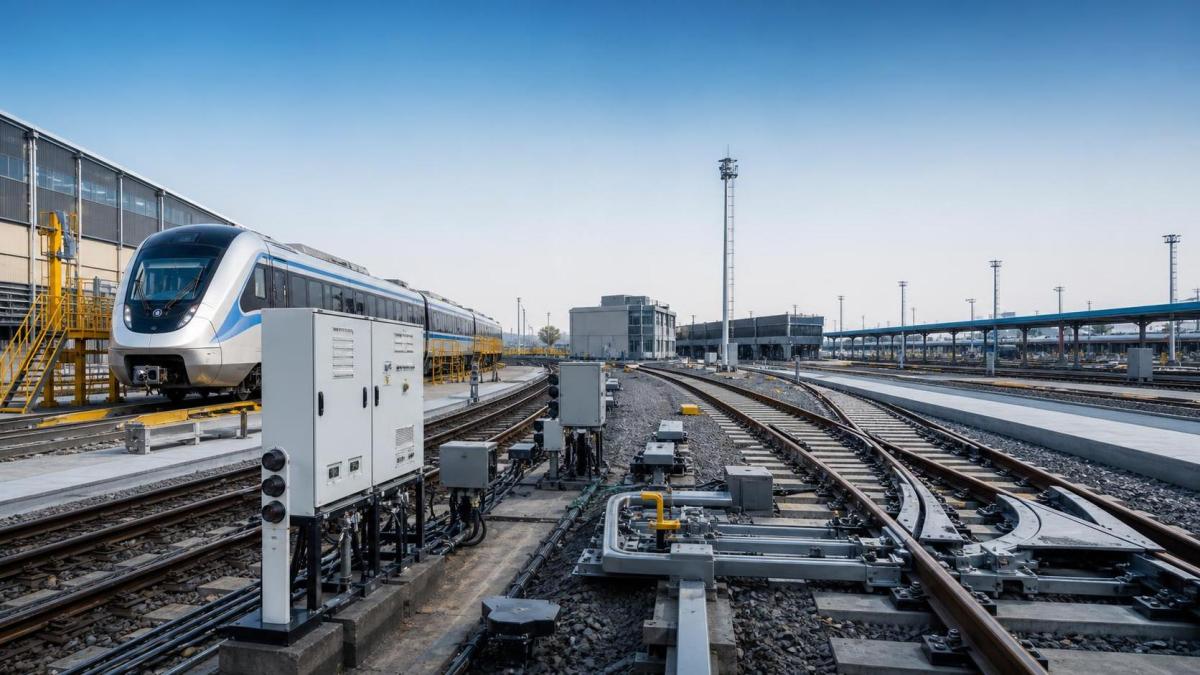
Project managers should request a phase-by-phase architecture pack, rather than a final-state drawing alone. It should show physical equipment, communications paths, safety boundaries, data flows, time synchronization, cybersecurity zones, and human-machine interfaces for every major stage. It should also specify the failure behavior when one side of a temporary interface is unavailable.
Particular attention is needed where a new automation layer reads data from a legacy signalling or depot control system. Read-only access may seem low risk, but incorrect state interpretation, delayed updates, or ungoverned data mapping can lead operators to act on misleading information. When automation sends commands across the boundary, authority management and fail-safe behavior become even more important.
Safety integrity is an engineering obligation, not a tender label
Railway depot automation often sits close to safety-critical functions. Depending on the scope, the system may influence train separation, movement authority, route locking, derailment protection, worksite protection, traction power isolation, or the release of equipment access. The required safety integrity level must be derived from the actual hazard analysis and applicable local railway requirements; it should not be assigned because a supplier brochure uses the term SIL4.
For functions that require the highest railway safety assurance, project teams need to examine the complete chain: sensors, communication paths, logic solvers, actuators, operator interfaces, configuration data, power supplies, and maintenance procedures. A certified controller does not make a complete application safe by itself. The project-specific application data, interface assumptions, field installation quality, and test evidence remain part of the safety case.
Relevant standards and regulatory obligations vary by jurisdiction and project type. In many rail contexts, the CENELEC lifecycle standards commonly associated with railway RAMS, software, and safety-related electronic systems may be relevant, alongside national approval rules and operator standards. The exact applicable edition, approval route, and assessment requirements should be confirmed with the infrastructure manager, operator, independent assessor, and regulator as appropriate.【待核实】
Buyers should require clarity on four points:
- Which functions are safety-related, which are operational-support functions, and where the boundary is drawn.
- Who owns hazard identification, safety requirements allocation, safety case production, and independent assessment.
- How legacy equipment, temporary works, and manual fallback procedures are represented in the safety argument.
- What changes can be made after commissioning, by whom, and under what configuration and revalidation controls.
Manual fallback deserves more scrutiny than it usually receives. During a staged modernization, staff may need to operate both conventional and automated processes. The fallback process must be practical at 03:00 during disruption, not merely theoretically available in a procedure. It needs clear authority, training, communications, local indications, and a defined process for returning to automated operation without leaving ambiguous route, vehicle, or isolation states behind.
Compatibility should be assessed at four layers
Integration claims are often reduced to a list of protocols. That is necessary but insufficient. Technical compatibility must be tested at the physical, data, operational, and governance layers.
Existing signalling is normally the most sensitive integration point, but it is not the only one. Traction power control, rolling-stock diagnostic platforms, computerized maintenance management systems, automatic vehicle identification, CCTV, radio networks, and enterprise scheduling tools may all affect depot operation. A solution that operates well in isolation can still burden the control room if it creates separate alarm streams and incompatible asset identifiers.
Open interfaces can reduce long-term dependence on one supplier, but “open” should be treated as a verifiable property. Buyers should ask for interface specifications, data dictionaries, licensing terms, test tools, and evidence that a third party has successfully integrated with the relevant version of the product. An undocumented application programming interface or a standard protocol with proprietary data semantics may not provide practical interoperability.
Evaluate throughput claims against real depot constraints
Automation suppliers may present nominal movement rates, route-setting times, or equipment utilization improvements. These figures can be useful, but a depot's achievable capacity is constrained by its specific topology and processes: throat layout, crossover locations, platform or shed occupancy, walking routes, inspection duration, cleaning resources, traction isolation arrangements, and fleet availability patterns.
The strongest evaluation approach uses representative operating scenarios. These should include a normal peak, a late inbound service, a failed train blocking a key route, an unavailable inspection road, reduced staff availability, communications loss, and a planned possession during an upgrade phase. The supplier should model or demonstrate how the proposed system manages each scenario, including the operator workload and time to recover stable service.
It is important to distinguish automatic route setting from autonomous depot operation. Automatically setting routine routes can provide value with a manageable operating change. Fully automated train movement, by contrast, may require far broader changes to detection, obstacle protection, operating rules, workforce competence, emergency response, and assurance evidence. The right investment may be a staged path that improves movement planning and protection first, while preserving a viable route to higher automation if fleet, site, and regulations later support it.
Lifecycle cost is shaped by maintainability and change control
Capital cost comparisons can mislead when depot automation has a service life measured in decades. The lifecycle question is whether the operator can sustain the system through software updates, hardware obsolescence, network changes, staff turnover, fleet changes, and future alterations to the depot layout.
Project teams should request an obsolescence-management plan covering processors, field controllers, communications hardware, operating systems, cybersecurity components, and specialist test equipment. They should understand which components can be replaced without full revalidation, what notice will be provided before end-of-support, and whether a future migration requires the original supplier's proprietary engineering environment.
Maintainability also means diagnostic usefulness. A depot fault that takes ten minutes to identify may have a very different operational impact from one that takes two hours, even when the same hardware is ultimately replaced. Maintenance personnel need role-appropriate diagnostics, clear fault localization, access to configuration records, and training that covers both normal servicing and post-change troubleshooting.
Cybersecurity has become part of that lifecycle burden. Connecting depot controls to fleet, enterprise, or remote support networks can improve visibility, but it expands the attack surface. The selected architecture should support network segmentation, least-privilege access, authenticated remote support, logging, backup and recovery, vulnerability management, and an agreed patching process. Security controls must be designed around availability and safety requirements; a patch process that requires frequent uncontrolled downtime is not operationally credible.
Supplier selection should test delivery behavior, not just product maturity
Railway automation projects fail as often through delivery interfaces as through equipment defects. A credible supplier should be able to explain how it manages surveys, design authority, subcontractors, factory acceptance testing, site acceptance testing, trial operation, safety assurance, training, and transition to maintenance.
References should be comparable in operating environment and project complexity. A successful installation in a new depot does not necessarily demonstrate competence in a constrained brownfield site with live signalling and limited possession windows. Reference discussions should ask about commissioning overruns, interface issues, defect response, documentation quality, change requests, and performance after the warranty period, not simply whether the system was delivered.
Commercial terms should preserve the buyer's ability to operate and modify the asset responsibly. This does not always require full ownership of every software element, but it does require durable access to configuration data, documentation, diagnostic tools, training, and a defined route for third-party support where appropriate. The strongest contracts also set measurable obligations for interface delivery, defect resolution, cybersecurity support, spares, and acceptance evidence.
Build the procurement around decision gates
For phased depot upgrades, a single award decision can conceal too much uncertainty. It is often more effective to structure the program around gated evidence: initial survey and requirements validation, interface-definition completion, prototype or simulation review, factory testing, limited deployment, operational trial, and broader rollout. Each gate should have criteria that combine technical performance, safety assurance, operational readiness, and readiness of the next interface.
This approach does not eliminate risk, but it prevents a project from discovering fundamental integration problems after its options have narrowed. It also gives the organization a disciplined basis for deciding whether to proceed, alter the scope, defer a higher-automation function, or retain a proven legacy component for longer.
The most defensible choice is rarely the system with the longest feature list. It is the one that can make a live depot safer and more predictable at each phase, preserve clear operational control during disruption, and leave the owner with enough technical and commercial control to adapt the asset when the next fleet, timetable, or infrastructure change arrives.
Recommended News
 Sep 29, 2026What drives traction systems price differences between rail projects?Traction systems price differences explained: compare duty cycles, voltage compatibility, integration, localization, and lifecycle costs for smarter rail procurement.
 Sep 26, 2026What to assess before selecting an electric traction system manufacturerChoose an electric traction system manufacturer with confidence. Explore key criteria for performance, reliability, safety, integration, energy efficiency, and lifecycle support.
 Sep 25, 2026When do full digitalization systems justify the investment?Full digitalization systems: discover when rail and maritime operators can turn connected data into safer operations, higher availability, and measurable ROI.
 Sep 23, 2026What drives automatic train control systems cost on rail projects?Automatic train control systems cost depends on integration, migration, safety testing, communications, and lifecycle support. Explore the key budget drivers for rail projects.
 Sep 21, 2026How to assess an ocean going vessel builder’s delivery riskAssess an ocean going vessel builder’s delivery risk with proven checks for schedules, capacity, design maturity, critical equipment, quality, and project controls.
 Sep 20, 2026What drives rail safety technology costs over a project lifecycle?Rail safety technology cost goes beyond equipment—explore lifecycle drivers from integration and safety assurance to cybersecurity, commissioning, and obsolescence.
 Sep 16, 2026What to verify before choosing an advanced ocean-going vessels supplierAdvanced ocean-going vessels supplier checklist: verify design authority, build quality, digital systems, delivery reliability, and lifecycle support before you buy.
 Sep 15, 2026What rail safety technology best reduces level-crossing risks in Southeast Asia?Rail safety technology Southeast Asia: discover how fail-safe signalling, barriers, obstacle detection and remote monitoring reduce level-crossing risks.
 Sep 14, 2026How exporters can reduce customs delays in global trade logisticsGlobal trade logistics for exporters: reduce customs delays with accurate data, clearance-ready documents, early filing, and proactive exception management.
 Sep 13, 2026When do global transportation network systems reduce delivery delays?Global transportation network systems reduce delivery delays by improving rail-port-vessel coordination, real-time visibility, and proactive decisions across complex land-sea supply chains.
 Sep 09, 2026When should you choose a rail and maritime manufacturer with dual-sector capability?Rail and maritime manufacturer guide: learn when dual-sector capability reduces integration risk, improves lifecycle support, and strengthens rail-to-port operations.
 Sep 08, 2026What to verify before selecting a railway signalling equipment supplierRailway signalling equipment supplier checklist: verify safety evidence, integration, cybersecurity, delivery capability, and lifecycle support before award.
 Sep 07, 2026How to size a traction power transformer for railway load demandTraction power transformer sizing guide: model railway load demand, peak duty, voltage regulation, harmonics, and contingency capacity for reliable service.
 Sep 07, 2026How do customization options for industrial connectors affect lead times?Customization options for industrial connectors can impact lead times, cost, and compliance. Learn how to specify smarter for rail and marine projects.
 Sep 05, 2026What information should an industrial sourcing guide include?Industrial sourcing information procurement guide: evaluate suppliers, compliance, lifecycle costs, interfaces, and lead times for smarter rail and maritime purchasing decisions.
 Sep 01, 2026How to find reliable maritime tender information before biddingMaritime tender information: learn how to verify sources, define bid-ready scopes, check qualifications, and reduce risk before submitting competitive marine bids.
 Aug 30, 2026How to select railway automation equipment for depots with phased upgradesRailway automation equipment for depots: learn how to plan phased upgrades that improve safety, throughput, integration, and lifecycle control.
 Aug 27, 2026How industrial sourcing intelligence pricing data supports budget approvalIndustrial sourcing intelligence pricing data helps teams benchmark scope, assess supplier risk, and build defensible budget approvals for complex rail and maritime assets.
 Aug 26, 2026When does a marine fuel efficiency solution make financial sense in the Middle East?Marine fuel efficiency solution Middle East: learn when retrofit savings, compliance value, and vessel data align to deliver credible ROI and smarter shipping investment decisions.
 Aug 24, 2026When does maritime automation for tankers deliver a real payback?Maritime automation for tankers delivers real payback when it cuts fuel use, reduces cargo risk, and improves uptime. See how owners can time investment for stronger ROI.
 Aug 23, 2026When do maritime logistics systems in the Middle East justify the costMaritime logistics systems Middle East: discover when rising delays, manual coordination, and poor visibility make system investment the smarter move for regional operators.
 Aug 22, 2026What drives vessel navigation system price for commercial fleetsVessel navigation system price depends on integration, compliance, automation, and support—not just hardware. Learn what drives fleet costs and compare quotes with confidence.
 Aug 21, 2026How to assess shipbuilding maritime tenders before biddingShipbuilding maritime tenders require more than price checks. Learn how to assess technical scope, compliance, supply chain, and commercial risk before bidding with confidence.
 Aug 20, 2026When does working with an ocean-going vessels distributor reduce supply risk?Ocean-going vessels distributor: learn when this partner cuts supply risk through stronger compliance, faster response, and better sourcing resilience in complex maritime procurement.