



Search News
Industry Portal
Popular Tags
How to assess an ocean going vessel builder’s delivery risk
Author
Time
Click Count
A builder’s quoted delivery date has little value until it is tied to a credible production path. The central assessment question is whether the yard can convert the contract design, equipment commitments, labor plan, and berth availability into a vessel that passes trials without a late wave of unfinished work. A large facility, a long orderbook, or a recently delivered ship may be encouraging signals, but none independently proves delivery reliability.
Start by separating schedule risk from completion risk. A vessel can be launched on time while machinery integration, accommodation work, cable termination, cargo-system commissioning, or documentation remains substantially incomplete. Conversely, a delayed block erection sequence may be recoverable if the remaining production stages have slack and critical equipment is already secured. The assessment should identify where recovery is physically possible and where a missed date will propagate directly into sea trials, handover, and operational readiness.
Test the delivery date against the actual build sequence
Ask for a vessel-specific master schedule rather than a high-level milestone chart. It should show design release dates, steel-cutting, block fabrication, grand-block assembly, dock entry, launching or float-out, outfitting, machinery installation, harbor acceptance tests, sea trials, and delivery. The useful question is not whether these milestones exist, but whether their logic reflects the vessel’s engineering dependencies.
For example, late delivery of a main engine affects more than engine installation. It can postpone shaft alignment, fuel-system completion, automation testing, vibration measurements, and propulsion trials. On a dual-fuel vessel, delays around fuel-gas supply equipment, control cabinets, piping materials, or hazardous-area interfaces may compress commissioning into a period already reserved for other systems. A schedule that treats these activities as parallel without showing access restrictions, test prerequisites, and interface handoffs deserves close scrutiny.
Examine the interval between launch and delivery. This period often contains the highest concentration of uncertainty because many trades must work in confined spaces while systems move from installation to functional testing. A short interval is not automatically unrealistic for a repeat vessel with mature drawings and stable suppliers. It is far less persuasive for a first-of-class design, a vessel with novel fuel arrangements, a complex cargo-handling system, or extensive automation integration.
Look for internal schedule buffers rather than a single contractual float at the end. Float assigned only after sea trials is weak protection: defects found during trials may require dockside access, class review, replacement parts, or a retest in suitable weather. Buffers located before equipment installation and commissioning are more valuable because they preserve options while the work remains accessible.
Read the orderbook as a capacity problem, not a reputation signal
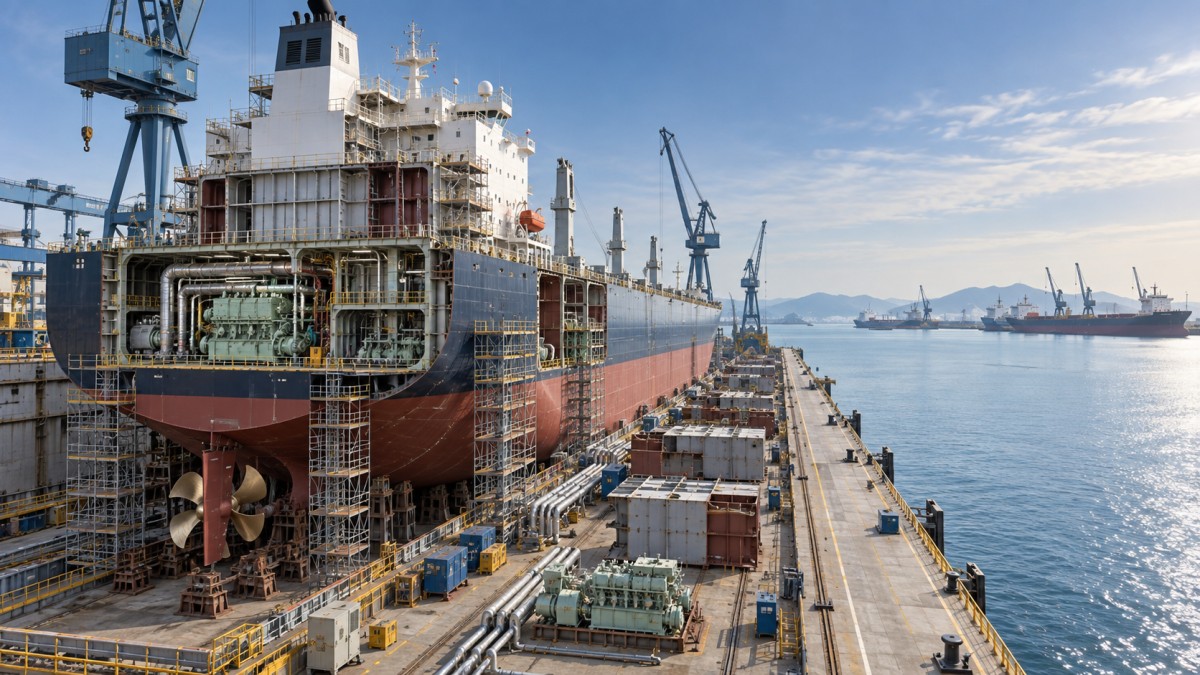
An ocean going vessel builder may have a strong delivery record while still being exposed by its current workload. Review the active orderbook by delivery window, vessel type, dock or berth assignment, and degree of design similarity. The relevant constraint is often not annual tonnage capacity. It may be panel-line throughput, covered block space, heavy-lift availability, pipe-shop capacity, painting halls, electrical outfitting teams, commissioning engineers, or a limited number of fitting-out berths.
Two vessels with similar deadweight can consume very different resources. A basic bulk carrier places pressure on hull production and machinery installation. A container vessel with high electrical load, a gas carrier with specialized containment interfaces, or a vessel designed around battery, shore-power, or advanced navigation systems shifts pressure toward engineering, cable work, instrumentation, software integration, and test capacity. Compare the proposed ship against the builder’s recent work at that level of detail.
A crowded orderbook is not inherently negative when berth allocation, supplier slots, and labor resources are visibly matched to it. The concern arises when several vessels reach outfitting or commissioning at the same time, especially when they rely on the same specialist subcontractors. Ask how conflicts are resolved when a critical trade is required aboard multiple ships. A convincing answer identifies dedicated teams, sequencing rules, and the escalation route when a predecessor vessel overruns.
Measure design maturity before treating production dates as firm
Steel can be cut before every drawing is complete, but unresolved engineering eventually appears as rework, work stoppages, or late material changes. The issue is most acute at interfaces: equipment foundations, pipe penetrations, cable transits, structural supports, fire boundaries, deckhouse modules, and control-system connections. Small drawing changes at these points can force work across several disciplines.
Request visibility into the design-release plan and distinguish between basic design, class-approved drawings, production drawings, and work packages issued to the shop floor. A builder may legitimately retain some detail design after contract signature. What matters is whether long-lead interfaces are frozen early enough to support procurement and fabrication.
Pay particular attention to items selected late by the owner, charterer, or equipment vendor. A change in bridge electronics, cargo pumps, engine maker, hatch-cover arrangement, accommodation layout, insulation arrangement, or fuel treatment system does not remain local to that package. It can alter cable lists, piping isometrics, foundations, weight distribution, structural openings, cooling loads, and approval submissions. The contract change procedure should state how schedule impact is assessed before a change is released, rather than allowing the impact to emerge during outfitting.
Repeat design and first-of-class work require different evidence
A repeat hull reduces risk only when the same production design, key equipment configuration, and construction sequence are retained. Calling a vessel a sister ship can obscure meaningful changes in cargo capacity, propulsion, emissions equipment, deck machinery, digital systems, or flag-related requirements. Even a familiar hull becomes a different delivery challenge when the engine room arrangement or electrical architecture is materially changed.
For a first-of-class vessel, seek evidence of engineering closure rather than assurances of capability. This includes interface registers, a decision log for unresolved technical matters, model-review records, vendor data requirements, and a clear path for approving deviations. The important distinction is between an identified open item with an owner, due date, and downstream impact analysis, and an open item simply described as “under review.”
Trace critical equipment from specification to site acceptance
Critical equipment must be assessed as a chain: technical selection, vendor design, manufacturing slot, factory testing, shipment, receipt at the yard, installation, integration, and commissioning. A purchase order alone does not establish the chain’s health. It may not secure a manufacturing slot, final documentation, test attendance, export clearance, transport planning, or the ancillary materials needed for installation.
Create a focused register for items whose absence would interrupt the critical path. Typical entries include main propulsion machinery, generators, switchboards, propulsion controls, steering gear, shaftline components, cargo equipment, specialized valves, automation cabinets, navigation and communication packages, cranes, hatch covers, and selected pumps. For each item, identify the latest acceptable arrival date at the yard, not merely the vendor’s promised dispatch date.
Transport risk is often underestimated. Large machinery and prefabricated modules may require specialized lifting, route clearance, port handling, protective packaging, and delivery within a narrow dockside window. Sensitive electrical equipment can arrive physically intact but remain unusable if software versions, certificates, wiring diagrams, or factory-test records are incomplete. The delivery review should therefore include documentation readiness and vendor attendance obligations, especially for systems that cannot be commissioned entirely by yard personnel.
Material risk deserves the same discipline. Steel availability is only one part of it. Pipe material grades, corrosion-resistant alloys, cable types, insulation systems, valves with defined pressure and temperature duties, and certified fasteners can create isolated but consequential shortages. Substitution should be assessed for fabrication impact, approval implications, corrosion performance, weld procedures, and traceability. A nominally equivalent material can create delay when it requires new documentation or changes a previously qualified process.
Inspect the quality system where defects are created
Quality documentation is useful, but delivery risk is better revealed by observing how nonconformities move through production. Review the process for weld repairs, dimensional deviations, coating defects, pressure-test failures, electrical faults, and missing traceability records. The concern is not that defects occur; complex shipbuilding inevitably produces some. The concern is repetitive defects, late discovery, unclear ownership, or corrective actions that repair the immediate issue without addressing the cause.
Block construction deserves close attention because dimensional error can become expensive once blocks are joined. Check how the yard controls shrinkage, alignment, and fit-up; how survey results are recorded; and how deviations are handed from fabrication to assembly. Hull fairness, shaft-bearing alignment, foundation geometry, and watertight boundary integrity are difficult to recover when problems are carried forward across stages.
Coating work also affects schedule in ways that are easy to miss. Surface preparation, environmental conditions, cure time, access, inspection, and repair of damaged areas must be sequenced around other trades. If pipe installation, cable pulling, insulation, and accommodation finishing begin before coating work has reached the required condition, later repairs can spread through completed spaces. Ask whether coating areas are released by defined criteria and whether the schedule includes realistic access windows.
Assess workforce stability and subcontractor control
Headcount is a blunt measure. A yard may report sufficient labor while lacking experienced welders for a particular material, pipe fitters familiar with the vessel’s system complexity, electricians able to complete termination and fault finding, or commissioning personnel qualified on vendor-specific controls. Workforce risk rises when the schedule relies heavily on overtime, temporary labor, or rapid transfer of trades from a predecessor vessel.
Examine supervision ratios, trade sequencing, onboarding controls, and the builder’s authority over subcontractors. Subcontracting is common and can work well when work packages, quality expectations, access planning, and accountability are tightly managed. It becomes a risk multiplier when separate subcontractors arrive with overlapping scopes, unclear boundaries, or incomplete drawings. Cable tray installation, insulation, pipe supports, and penetration sealing are frequent interface areas where fragmented responsibility creates late rework.
Ask to see how the builder tracks unfinished work at block, zone, and system level. Broad statements that work is “substantially complete” are insufficient. A useful completion measure distinguishes installed, inspected, tested, commissioned, and accepted work. Equipment bolted in place is not operationally complete if cabling, software configuration, alarms, safeguards, and supporting services remain open.
Use financial review to identify interruption exposure
Financial strength matters because shipbuilding requires continuous cash flow across steel, machinery deposits, labor, subcontractors, and warranty obligations. The goal is not to forecast a yard’s financial future from a single document. It is to identify whether payment stress could interrupt procurement, reduce subcontractor participation, defer maintenance of production equipment, or create pressure to seek premature milestone acceptance.
Review payment terms alongside tangible progress, title transfer provisions, refund-security arrangements where applicable, and the treatment of owner-furnished equipment. Milestones should correspond to verifiable value and retained control over the asset, not merely calendar events. A contract that pays heavily before critical equipment is secured shifts exposure toward the purchaser while doing little to protect the delivery date.
Warning signs include repeated requests to alter payment timing, unexplained vendor payment disputes, changes in bank or contracting entity, frequent claims for routine coordination work, or reluctance to disclose the status of major purchase orders. Each sign has possible benign explanations. Taken together, they warrant a deeper review of procurement commitments and project cash requirements.
Turn due diligence into enforceable project controls
Risk assessment has limited value if it ends at builder selection. The contract and governance structure should convert the main findings into observable controls. Establish a reporting cadence linked to critical-path activities, design release, procurement status, block completion, system turnover, and trial readiness. Require forecast dates to show variance from the baseline, the cause of movement, the proposed recovery action, and the decision needed from each responsible party.
Preserve independent access to progress evidence. This may include attendance at model reviews, selected factory tests, block inspections, dockside meetings, and trial preparation reviews. The objective is early detection of a broken dependency, not routine attendance for its own sake. Escalation thresholds should be agreed before the first serious delay, because recovery options narrow quickly once outfitting congestion begins.
The strongest selection decision is supported by a coherent narrative: the vessel design is sufficiently mature, constrained equipment has a credible route to installation, the yard has protected capacity at the stages that matter, and completion status will be measured by tested systems rather than visible construction progress. Where that narrative contains gaps, the delivery date should be treated as an assumption to be protected through contract controls, evidence-based reporting, and timely technical intervention.
Recommended News
 Sep 29, 2026What drives traction systems price differences between rail projects?Traction systems price differences explained: compare duty cycles, voltage compatibility, integration, localization, and lifecycle costs for smarter rail procurement.
 Sep 26, 2026What to assess before selecting an electric traction system manufacturerChoose an electric traction system manufacturer with confidence. Explore key criteria for performance, reliability, safety, integration, energy efficiency, and lifecycle support.
 Sep 25, 2026When do full digitalization systems justify the investment?Full digitalization systems: discover when rail and maritime operators can turn connected data into safer operations, higher availability, and measurable ROI.
 Sep 23, 2026What drives automatic train control systems cost on rail projects?Automatic train control systems cost depends on integration, migration, safety testing, communications, and lifecycle support. Explore the key budget drivers for rail projects.
 Sep 21, 2026How to assess an ocean going vessel builder’s delivery riskAssess an ocean going vessel builder’s delivery risk with proven checks for schedules, capacity, design maturity, critical equipment, quality, and project controls.
 Sep 20, 2026What drives rail safety technology costs over a project lifecycle?Rail safety technology cost goes beyond equipment—explore lifecycle drivers from integration and safety assurance to cybersecurity, commissioning, and obsolescence.
 Sep 16, 2026What to verify before choosing an advanced ocean-going vessels supplierAdvanced ocean-going vessels supplier checklist: verify design authority, build quality, digital systems, delivery reliability, and lifecycle support before you buy.
 Sep 15, 2026What rail safety technology best reduces level-crossing risks in Southeast Asia?Rail safety technology Southeast Asia: discover how fail-safe signalling, barriers, obstacle detection and remote monitoring reduce level-crossing risks.
 Sep 14, 2026How exporters can reduce customs delays in global trade logisticsGlobal trade logistics for exporters: reduce customs delays with accurate data, clearance-ready documents, early filing, and proactive exception management.
 Sep 13, 2026When do global transportation network systems reduce delivery delays?Global transportation network systems reduce delivery delays by improving rail-port-vessel coordination, real-time visibility, and proactive decisions across complex land-sea supply chains.
 Sep 09, 2026When should you choose a rail and maritime manufacturer with dual-sector capability?Rail and maritime manufacturer guide: learn when dual-sector capability reduces integration risk, improves lifecycle support, and strengthens rail-to-port operations.
 Sep 08, 2026What to verify before selecting a railway signalling equipment supplierRailway signalling equipment supplier checklist: verify safety evidence, integration, cybersecurity, delivery capability, and lifecycle support before award.
 Sep 07, 2026How to size a traction power transformer for railway load demandTraction power transformer sizing guide: model railway load demand, peak duty, voltage regulation, harmonics, and contingency capacity for reliable service.
 Sep 07, 2026How do customization options for industrial connectors affect lead times?Customization options for industrial connectors can impact lead times, cost, and compliance. Learn how to specify smarter for rail and marine projects.
 Sep 05, 2026What information should an industrial sourcing guide include?Industrial sourcing information procurement guide: evaluate suppliers, compliance, lifecycle costs, interfaces, and lead times for smarter rail and maritime purchasing decisions.
 Sep 01, 2026How to find reliable maritime tender information before biddingMaritime tender information: learn how to verify sources, define bid-ready scopes, check qualifications, and reduce risk before submitting competitive marine bids.
 Aug 30, 2026How to select railway automation equipment for depots with phased upgradesRailway automation equipment for depots: learn how to plan phased upgrades that improve safety, throughput, integration, and lifecycle control.
 Aug 27, 2026How industrial sourcing intelligence pricing data supports budget approvalIndustrial sourcing intelligence pricing data helps teams benchmark scope, assess supplier risk, and build defensible budget approvals for complex rail and maritime assets.
 Aug 26, 2026When does a marine fuel efficiency solution make financial sense in the Middle East?Marine fuel efficiency solution Middle East: learn when retrofit savings, compliance value, and vessel data align to deliver credible ROI and smarter shipping investment decisions.
 Aug 24, 2026When does maritime automation for tankers deliver a real payback?Maritime automation for tankers delivers real payback when it cuts fuel use, reduces cargo risk, and improves uptime. See how owners can time investment for stronger ROI.
 Aug 23, 2026When do maritime logistics systems in the Middle East justify the costMaritime logistics systems Middle East: discover when rising delays, manual coordination, and poor visibility make system investment the smarter move for regional operators.
 Aug 22, 2026What drives vessel navigation system price for commercial fleetsVessel navigation system price depends on integration, compliance, automation, and support—not just hardware. Learn what drives fleet costs and compare quotes with confidence.
 Aug 21, 2026How to assess shipbuilding maritime tenders before biddingShipbuilding maritime tenders require more than price checks. Learn how to assess technical scope, compliance, supply chain, and commercial risk before bidding with confidence.
 Aug 20, 2026When does working with an ocean-going vessels distributor reduce supply risk?Ocean-going vessels distributor: learn when this partner cuts supply risk through stronger compliance, faster response, and better sourcing resilience in complex maritime procurement.