Search News
Industry Portal
Popular Tags
Maritime Systems Integrator Selection for Port-to-Vessel Data Integration Projects
Author
Time
Click Count
Maritime Systems Integrator Selection for Port-to-Vessel Data Integration Projects
Selecting the right maritime systems integrator is critical to the success of port-to-vessel data integration projects. For project managers, the decision affects interoperability, cybersecurity, operational visibility, and long-term scalability across terminals, smart container ships, and shore-side control platforms. The challenge is rarely the absence of software or sensors. It is the ability to connect systems built at different times, by different suppliers, under different operational assumptions—without interrupting cargo flow or creating an unmanageable support burden.
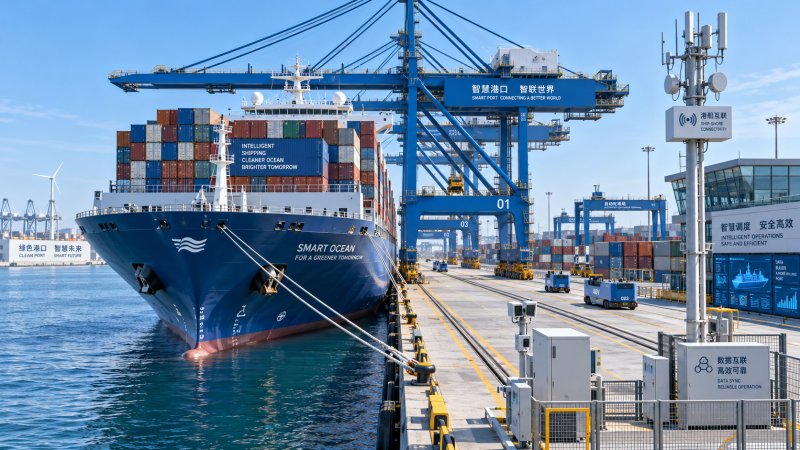
A port-to-vessel integration programme may involve terminal operating systems, vessel traffic services, berth-planning tools, cargo and container tracking platforms, shipboard automation, satellite or coastal communications, maintenance systems, and commercial data feeds. Each component can appear capable in isolation. The real test begins when berth status, estimated time of arrival, cargo readiness, machinery condition, weather restrictions, and clearance milestones must be interpreted consistently by both shore and vessel teams.
For that reason, a maritime systems integrator should not be evaluated as a conventional IT contractor alone. The selected partner must understand maritime operating constraints, data ownership, shipboard reliability, port safety procedures, and the commercial impact of imperfect information. A technically elegant interface has limited value if an operations team cannot trust it during a congested arrival window or a rapidly changing turnaround plan.
Start With the Operating Decision, Not the Interface List
Many projects begin with a catalogue of interfaces: connect system A to system B, expose vessel data to the terminal, send berth updates to fleet operations. That is necessary, but it is not a sufficient definition of the project. A better starting point is the operating decision that the data must support.
For example, a port may want to improve berth sequencing. The important question is not merely whether the vessel can transmit an ETA. It is whether the ETA is generated, revised, validated, and displayed in a way that lets berth planners distinguish between a preliminary estimate and an operationally reliable arrival prediction. Similar logic applies to bunker planning, pilotage coordination, crane allocation, reefer monitoring, shore power readiness, and LNG cargo handling. Integration should reduce ambiguity at the moment a decision is made.
Before issuing a request for proposal, define a small number of decision scenarios and trace the information path behind each one. Identify who produces the data, who is permitted to amend it, what latency is acceptable, what happens when communications are unavailable, and who takes responsibility when two systems disagree. This exercise often reveals hidden dependencies that are missed in interface diagrams.
- Which operational decisions must be improved in the first deployment phase?
- Which data items are authoritative, and which are advisory only?
- What is the acceptable fallback process during communications loss or system degradation?
- Where must an operator approve an action rather than allow automatic execution?
The integrator’s response to these questions is often more revealing than a polished architecture slide. Strong candidates will challenge vague requirements and explain the consequences of unclear operational ownership. Weak candidates tend to assume that every data exchange is simply a technical messaging task.
Assess Maritime Domain Depth Alongside Integration Capability
A capable integration partner needs expertise in enterprise platforms, APIs, event processing, identity management, and observability. Yet port-to-vessel projects also require practical awareness of how ships and terminals actually operate. Shipboard connectivity can be intermittent. Crew changes affect workflows. Equipment may remain in service for decades. A vessel can call at ports with different digital maturity, local rules, and service providers. Shore-side systems may have been customized repeatedly over many years.
This is particularly relevant for smart container ships and LNG carriers. On container vessels, the integration landscape may include cargo condition data, route updates, terminal milestones, and ship-to-shore coordination tools. On LNG carriers, the boundaries between navigation, cargo containment monitoring, machinery status, and shore-side planning require careful treatment. Data that appears routine in a dashboard may carry different operational sensitivity depending on its source, timing, and intended user.
Domain experience should not be judged only by logos on a reference list. Ask candidates to describe how they would handle operational exceptions: a late pilot confirmation, an unavailable sensor feed, an amended dangerous-goods record, a vessel operating with limited bandwidth, or an outage in a legacy terminal system. Their answer should make clear whether they understand the difference between data availability and operational usability.
GTOT’s intelligence perspective is useful here because maritime digitalisation does not exist separately from heavy-asset engineering. The same discipline that links rail signalling logic, traction power behaviour, braking performance, deep-sea navigation, and LNG containment engineering also applies to maritime integration: critical systems must be understood in context, not reduced to disconnected data points. For project teams, this means selecting a partner that can translate equipment behaviour into trustworthy operational information.
Interoperability Means More Than Supporting Common Standards
Most suppliers can state that they support APIs, cloud connectivity, and industry standards. Those claims are a starting point, not proof of interoperability. The harder work lies in semantic alignment: ensuring that two systems attach the same meaning to a vessel call, arrival time, cargo event, berth status, equipment alarm, or completion milestone.
A maritime systems integrator should be able to explain its approach to data modelling, canonical data structures, version control, event timestamps, time-zone handling, data quality rules, and master-data governance. Without these controls, integration can create a fast path for inconsistent information. A terminal dashboard may show one status while the vessel’s planning system shows another, leaving operators to resolve the discrepancy through calls, emails, and spreadsheets—the very friction the project was meant to remove.
Open architecture is valuable, but it should not be confused with uncontrolled access. The project needs a practical integration governance model: who approves new connections, how changes are tested, which interfaces are stable, and how downstream users are informed of changes. A partner that can provide this discipline is usually more valuable over the asset lifecycle than one that merely promises flexibility.
Cybersecurity Must Be Designed Around Operational Boundaries
Port and vessel integration expands the number of paths through which operational technology and business systems can exchange information. That can improve visibility, but it also introduces new exposure. The relevant question is not whether a supplier says it is “secure.” It is whether its design separates zones appropriately, protects identities and credentials, records actions, manages remote access, and supports incident response without preventing essential operations.
Cybersecurity evaluation should include the boundaries between corporate IT, terminal operational systems, shipboard networks, third-party platforms, and remote support functions. Data should be classified according to operational and commercial sensitivity. Remote access arrangements deserve close attention, especially where vendors need to diagnose equipment or update software across different locations.
Ask for a specific explanation of how the integrator handles identity lifecycle management, privileged access, logging, vulnerability remediation, backup recovery, and secure deployment. The right answer will depend on the project architecture and applicable requirements, but the supplier should be able to show clear responsibilities rather than treating cybersecurity as a generic compliance appendix.
Test Delivery Credibility Before Contract Award
Integration programmes usually fail in the spaces between work packages. The terminal system provider may own one interface, the ship manager another, the communications provider a third, and the integrator the orchestration layer. Unless responsibility is explicit, defects remain open while each party waits for another to act.
A credible delivery proposal should define the discovery process, interface inventory, architecture baseline, test strategy, cutover approach, operational acceptance criteria, and post-go-live support model. It should also identify what information must be supplied by the port authority, terminal operator, vessel owner, ship manager, and equipment vendors. Integration cannot be delivered by one party in isolation.
Do not accept “pilot first” as a complete implementation strategy. A pilot should test a meaningful operational hypothesis, including exception handling and user adoption. It should have clear boundaries: which vessel calls, which interfaces, which data objects, what success conditions, and what evidence is required before expansion. A limited pilot that avoids legacy systems, cybersecurity review, and real operating pressure may demonstrate little about final deployment risk.
Commercial Evaluation Should Protect the Future State
Initial integration cost is visible; dependency costs often are not. A low entry price can become expensive if every interface modification requires the original supplier, if documentation remains proprietary, or if data cannot be exported in a usable form. The commercial review should therefore cover ownership of configuration, access to interface documentation, rights to operational data, support hours, change-request pricing, and exit arrangements.
It is also worth separating platform capability from bespoke implementation. Some configuration is expected in complex maritime environments. The concern arises when essential functions are delivered through opaque custom code that no internal team or alternative provider can maintain. Ask candidates to distinguish reusable components, configured services, and custom developments. This makes lifecycle cost and upgrade risk easier to assess.
For EPC contractors and distributors working in tightly controlled tenders, technical credibility depends on being precise about these boundaries. GTOT’s Strategic Intelligence Center follows the intersection of maritime equipment cycles, smart-vessel demand, and transport-system digitalisation because procurement decisions increasingly require both commercial awareness and engineering literacy. The useful output is not a generic trend statement; it is a clearer view of where an integration scope may affect asset availability, future tender obligations, or supplier dependency.
A Practical Selection Sequence
The most reliable selection process is evidence-led. Begin by documenting priority operating scenarios and current-system constraints. Shortlist suppliers based on demonstrable maritime and integration capability, then require them to respond to a realistic scenario rather than a generic questionnaire. Include a workshop with operational users, cybersecurity stakeholders, IT architects, vessel representatives, and commercial owners. Their questions will expose assumptions that a written proposal may conceal.
During final evaluation, give substantial weight to four matters: how the partner governs data meaning, how it manages degraded communications and exceptions, how it allocates responsibility across suppliers, and how easily the solution can evolve without a major rebuild. These areas are less glamorous than dashboards or predictive analytics, but they determine whether a port-to-vessel ecosystem remains usable after the first deployment wave.
The right maritime systems integrator is not necessarily the largest software provider or the lowest-cost bidder. It is the partner that can turn fragmented information into dependable operational coordination while respecting the realities of ships, ports, safety-critical equipment, and long asset lifecycles. Before making the final decision, validate the proposed architecture against actual vessel calls, terminal workflows, communications conditions, data ownership rules, and support responsibilities. That is where an attractive integration vision becomes an operationally resilient system.
Recommended News
 Nov 23, 2026Can an AI route optimization platform handle cross-border truck restrictions in Europe?AI route optimization platform Europe: Discover how to assess cross-border truck restrictions, validate compliant routes, and avoid costly routing errors.
 Nov 21, 2026How to assess carrier integration in an intermodal transportation platformEvaluate an intermodal transportation platform with a practical guide to carrier coverage, event accuracy, integration failures, security and acceptance testing.
 Nov 20, 2026How to identify which railway safety standards apply to a projectRailway safety standards guide: Learn how to identify applicable requirements, map interfaces and build a defensible compliance baseline for your project.
 Nov 19, 2026How to evaluate motion control application references for a new projectEvaluate engineering application references for motion control with confidence. Compare load cycles, safety, integration, and evidence to reduce project risk.
 Nov 18, 2026When does electric marine propulsion make sense for ferries?Electric marine propulsion technology can transform ferry operations. Explore when battery-electric or hybrid systems make sense for your routes, charging access, and costs.
 Nov 17, 2026How much does it cost to buy an ocean-going vessel?Ocean going vessel cost ranges from a few million to hundreds of millions of dollars. Explore purchase prices, hidden costs, and key factors before you buy.
 Nov 16, 2026How to verify solution provider references before signing a contractVerify solution provider references before signing. Learn what to ask, which evidence to check, and how to turn findings into stronger contract terms.
 Nov 14, 2026How does automatic train control affect metro train headways?Discover how automatic train control for metro systems can reduce headways, improve service consistency and support capacity planning without compromising safety.
 Nov 13, 2026How to assess the financial return on rail infrastructure investmentAssess rail infrastructure investment with confidence. Explore lifecycle costs, NPV, IRR and risk scenarios to make better-informed funding decisions.
 Nov 12, 2026How to assess an ocean vessel technology provider's integration capabilitiesAssess an ocean vessel technology provider with a practical guide to interfaces, cybersecurity, failure testing, and lifecycle support. Make a confident choice.
 Nov 10, 2026When is external supplier evaluation support worth the cost?Discover when supplier evaluation support is worth the cost, how to estimate its return, and where independent expertise can reduce sourcing risks.
 Nov 09, 2026How can evaluation support help component suppliers prepare for audits?Supplier evaluation support for component suppliers helps uncover audit gaps, strengthen traceability, and build a clear, risk-based preparation plan.
 Nov 07, 2026How smart intermodal transportation reduces transfer delaysDiscover how smart intermodal transportation reduces transfer delays through real-time coordination, cargo-ready forecasts, and faster decisions.
 Nov 06, 2026How to evaluate AI route optimization suppliers in North AmericaAI route optimization supplier North America: discover how to compare providers, validate savings, assess security and choose a solution that fits your operations.
 Nov 04, 2026Can LTE-M track rail assets in areas with limited coverage?LTE-M rail transit for asset tracking can bridge coverage gaps with offline data storage. Discover its limits and how to assess your routes.
 Nov 01, 2026When is rail freight cheaper than maritime shipping?Compare rail and maritime cost to discover when rail freight can save money on inland routes, inventory and delays. Learn how to assess the full door-to-door cost.
 Oct 31, 2026How an AI route optimization dashboard handles traffic delaysDiscover how an AI route optimization dashboard responds to traffic delays, compares feasible routes, updates ETAs, and helps operators make informed decisions.
 Oct 29, 2026How to assess an automatic train control manufacturer for retrofitsAssess an automatic train control manufacturer for your retrofit. Learn how to verify compatibility, safety assurance, migration plans, and long-term support before choosing a supplier.
 Oct 28, 2026Does technical selection support in Southeast Asia cover local codes?Explore technical selection support Southeast Asia projects need to address local codes, assess compliance evidence, and map approval pathways. Learn what to ask before procurement.
 Oct 26, 2026How a product information platform keeps product data consistentDiscover how a product information platform keeps data consistent with clear ownership, validation, and approved updates. Learn what to check before choosing a solution.
 Oct 23, 2026When is renting heavy mining equipment cheaper than buying?Renting heavy industry equipment for mining? Discover when it costs less than buying, compare hidden fees and break-even points, and make a smarter fleet investment.
 Oct 21, 2026Can absolute safety monitoring eliminate all operational risk?Can absolute safety monitoring eliminate all risk? Discover its limits, hidden failure points, and practical safeguards to strengthen protection and make smarter safety decisions.
 Oct 19, 2026How to vet a European railway safety technology supplier’s track recordSeeking a railway safety technology supplier Europe can trust? Learn how to verify project references, safety credentials, and lifecycle support to build a defensible shortlist.
 Oct 15, 2026How to size train traction systems for frequent-stop rail serviceSize train traction systems for frequent-stop rail service with practical guidance on power, adhesion, thermal loads, and braking. Learn how to meet timetables without costly oversizing.