



Search News
Industry Portal
Popular Tags
How EN 45545 shapes material selection for railway safety systems
Author
Time
Click Count
For technical evaluators, EN 45545 is more than a compliance benchmark. It is a practical decision framework for selecting materials that reduce fire risk across railway safety systems.
The central question is rarely whether a material can pass one laboratory test. Evaluators must determine whether its documented performance remains suitable within an installed rail vehicle assembly.
That distinction affects control cabinets, cable routing, connector housings, brake-related equipment, passenger interiors, and electronic enclosures deployed across regional, metro, and high-speed fleets.
A sound material decision therefore combines EN 45545 classification, vehicle operating category, installation location, component function, maintenance exposure, supplier evidence, and project-specific risk allocation.
Start with the Material Decision, Not the Test Certificate
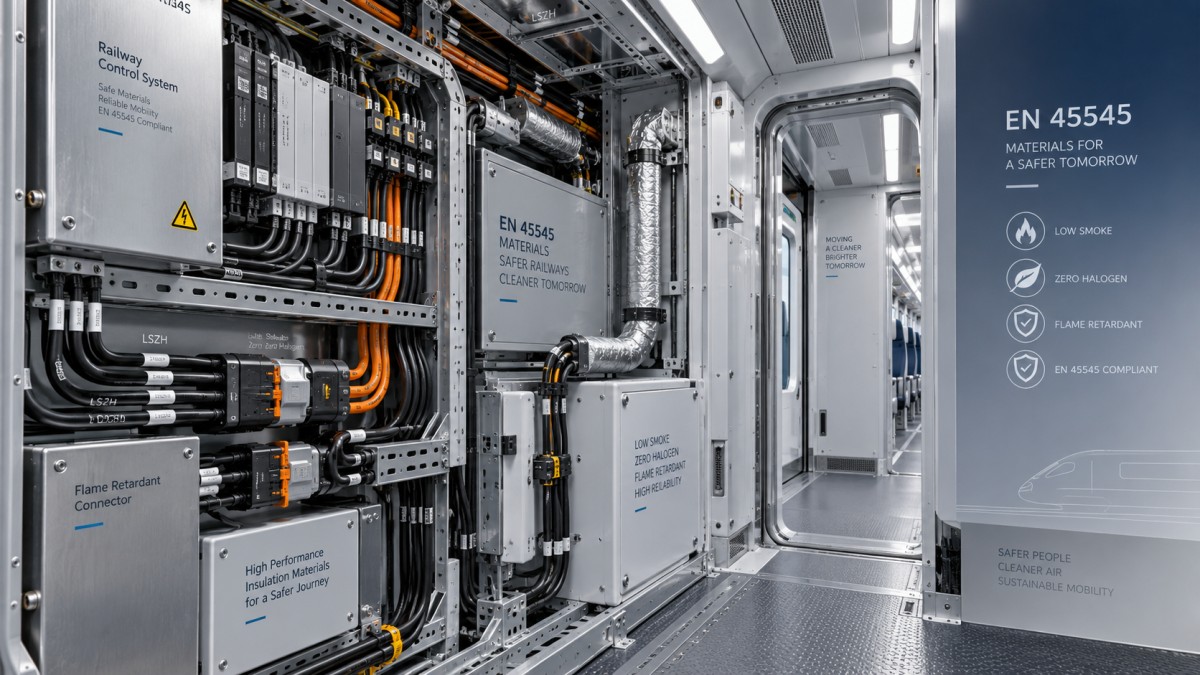
Railway safety systems EN 45545 assessments should begin by defining the component's actual fire exposure and operational consequence, rather than requesting generic compliance declarations from potential suppliers.
EN 45545-2 classifies material requirements according to hazard level, operational category, and the applicable requirement set. Those factors determine which fire-performance thresholds a material must satisfy.
Hazard levels range from HL1 to HL3. Higher hazard levels generally demand stronger limits for flame spread, smoke density, smoke toxicity, heat release, and flaming droplets.
Vehicle operating categories reflect the environment in which passengers and equipment operate. Underground routes, sleeping vehicles, and constrained evacuation conditions normally create more demanding requirements.
Technical evaluators should identify the required hazard level before comparing polymers, elastomers, coatings, laminates, cable compounds, and insulation systems. Material selection cannot be separated from vehicle classification.
A cable jacket that performs acceptably in an above-ground commuter application may be unsuitable for a long tunnel route. The same material chemistry can have different project viability.
The applicable requirement set also matters. EN 45545-2 groups products by intended application, such as interior surfaces, electrical equipment, cables, and electrotechnical components.
This means product naming is not enough. A “fire-retardant enclosure” or “low-smoke cable” may still fail to meet the requirement set associated with its installation position.
Evaluators should ask where the material sits, what surrounds it, whether passengers can be exposed, and whether the component supports a safety-critical function during a fire.
That early scoping exercise prevents a common procurement error: approving a material based on a relevant-looking test result that does not match the required EN 45545 condition.
Translate EN 45545 Requirements into Component-Level Design Choices
Material selection becomes more reliable when project teams convert standard requirements into a component matrix. Each row should connect an assembly, location, function, material, and evidence package.
For control cabinets, the enclosure material must be assessed alongside internal wiring, terminal blocks, cable glands, insulation barriers, labels, and coating systems.
A compliant metal cabinet does not automatically make the full cabinet compliant. Internal non-metallic components can contribute smoke, toxicity, flame propagation, or molten particle hazards.
Electrical cabinets are often assessed through their installed configuration. Openings, ventilation paths, cable entries, mounting arrangements, and neighboring materials can change actual fire behavior.
For railway signalling and train control equipment, selection decisions must also protect operational reliability. Materials must preserve insulation, dimensional stability, and mechanical integrity under thermal stress.
High-performance thermoplastics may offer excellent electrical insulation and lightweight construction. However, evaluators must verify their EN 45545 test status at the actual thickness and formulation supplied.
Thickness is a frequent source of mistakes. A polymer tested at three millimeters may not retain the same classification when molded into a thinner cover or connector housing.
Colorants, recycled content, fillers, flame retardants, and surface finishes can also alter fire behavior. A certificate for one grade should never be assumed valid for every commercial variant.
Cable systems require particular discipline because they cross multiple compartments and can become pathways for smoke or flame. Their sheath, insulation, screen, bedding, and installation method all matter.
For cables, evaluators should review applicable cable-specific requirements, installation density, bundle geometry, and the possibility of fire spread through trunking or equipment rooms.
Low-smoke and halogen-free claims are useful indicators, but they are not equivalent to EN 45545 conformity. The required performance must be demonstrated against the relevant requirement set.
Interior materials need equally careful classification. Wall panels, floor systems, seats, table surfaces, seals, adhesives, and decorative layers may each fall under different technical requirements.
Composite panels are especially complex because the visible skin, core, adhesive, edge treatment, and backing can behave differently as a finished construction than as individual samples.
Evaluate Fire Performance Alongside Functional Durability
Passing EN 45545 is necessary, but it is not sufficient for dependable railway safety systems. A compliant material that degrades early can create maintenance, availability, and safety risks.
Technical evaluators should assess fire performance alongside vibration resistance, thermal cycling, humidity tolerance, ultraviolet exposure, chemical resistance, dielectric properties, and mechanical fatigue.
Railway control cabinets can experience continuous vibration, temperature variation, electromagnetic interference, cleaning agents, condensation, and prolonged service intervals. Material durability must match those conditions.
For example, a halogen-free cable compound may meet fire requirements but have different handling, bend-radius, abrasion, or termination characteristics than a conventional alternative.
Those differences can affect installation quality. Poor routing, damaged jackets, excessive bending, or incorrect gland selection may undermine both reliability and the intended fire-performance outcome.
Similarly, a flame-retardant polymer enclosure may meet the relevant classification while becoming brittle under low-temperature exposure or losing impact resistance after long-term heat aging.
Evaluators should request data that reflects the full duty cycle, not only initial qualification. Useful evidence includes aging studies, environmental testing, production controls, and field-service history.
Compatibility between adjacent materials deserves explicit review. Sealants, coatings, cleaning fluids, lubricants, and adhesives can affect surface integrity, electrical performance, or flame-retardant additives over time.
Material selection should therefore involve engineering, quality, procurement, safety assurance, and maintenance stakeholders. EN 45545 compliance is strongest when it is treated as a lifecycle requirement.
For high-speed traction and pantograph-related equipment, thermal loads and mechanical stress may be particularly significant. Fire-safe materials must not compromise insulation coordination or structural performance.
For braking systems, nearby polymeric parts, wire insulation, sensor housings, and cable protections must tolerate elevated temperatures without introducing unacceptable smoke or toxic emissions.
Build a Documentation Package That Survives Technical Review
For many projects, the largest EN 45545 risk is not the material itself. It is incomplete, mismatched, expired, or poorly traceable documentation presented during qualification.
A robust documentation package should identify the exact material grade, manufacturer, formulation, thickness range, color, test method, requirement set, and achieved hazard level.
Test reports should be reviewed for applicability rather than merely collected. The evaluator must confirm that the tested specimen accurately represents the proposed production component or assembly.
Certificates should clearly state the standard edition and applicable classification. Where testing was completed under earlier requirements, the project team should confirm formal acceptance conditions.
Supplier declarations are useful, but they should not replace independent laboratory evidence when the specification requires formal proof. Declarations must remain linked to controlled product data.
Traceability is essential for safety-critical procurement. Purchase orders, bills of materials, drawings, and supplier part numbers should all refer to the same approved material identity.
Changes require formal control. A supplier substitution involving pigments, resin source, flame retardants, fillers, or manufacturing location can invalidate assumptions behind the original test evidence.
Technical evaluators should establish a material deviation process before serial production. It should define when a variation requires document review, additional testing, or customer approval.
For assemblies containing multiple non-metallic materials, maintain a fire-performance register. This register helps teams identify gaps before factory acceptance, vehicle integration, or independent assessment.
The register should include component location, requirement set, required hazard level, evidence reference, validity status, responsible owner, and any installation-related restrictions.
Documentation quality has commercial value as well. Well-organized evidence reduces approval delays, tender clarification cycles, redesign risk, and disputes between integrators, operators, and suppliers.
A Practical Evaluation Workflow for Procurement and Engineering Teams
A repeatable workflow reduces late-stage surprises. Begin by mapping the vehicle type, operating category, expected route conditions, passenger exposure, and contractual EN 45545 requirements.
Next, divide the system into meaningful material-bearing assemblies. Avoid broad labels such as “control system” when cabinet doors, cable looms, boards, connectors, and seals differ materially.
Assign every item to its relevant EN 45545-2 requirement set. This task should involve someone who understands both the standard and the physical installation environment.
Then define required hazard levels and evidence thresholds. Critical components may warrant additional conservatism when their failure could impair braking, signalling, emergency lighting, or communication systems.
Screen candidate materials against the specification before detailed design is frozen. Early screening is less expensive than redesigning molds, cable routes, or electronics housings after testing fails.
Review evidence at the exact component geometry wherever possible. When extrapolation is proposed, document the technical basis, assumptions, thickness limits, and approval responsibility.
Conduct a cross-functional review before releasing the bill of materials. Procurement should verify source continuity, while engineering checks configuration integrity and quality confirms document traceability.
During production, confirm that approved materials remain unchanged. Incoming inspection, supplier change notifications, and manufacturing records should support the same material configuration used for qualification.
Finally, retain evidence for the operational life expected by the contract. Railway fleets often remain active for decades, making long-term configuration control more valuable than a one-time test pass.
Common Material Selection Mistakes and How to Avoid Them
One common mistake is treating EN 45545 as a single pass-or-fail label. In reality, compliance depends on hazard level, requirement set, material form, thickness, and intended application.
Another mistake is selecting materials at component level without reviewing the finished assembly. Interfaces can introduce adhesives, labels, overmolds, seals, or cable accessories absent from test samples.
Teams also underestimate supply-chain variation. A technically compliant grade can become unavailable, reformulated, or substituted, creating qualification risk during serial manufacture or aftermarket maintenance.
Over-specification creates its own problems. Selecting HL3 materials everywhere may raise cost, reduce supplier options, complicate processing, and impair performance without improving actual system safety.
The better approach is evidence-based proportionality. Apply the required classification precisely, then evaluate whether additional margin is justified by service conditions, safety function, and route risk.
Finally, do not defer documentation review until tender submission or factory acceptance. Fire-performance evidence should be evaluated while product architecture and sourcing decisions remain flexible.
Conclusion: Use EN 45545 as a Design Control, Not a Procurement Checkbox
EN 45545 shapes material selection by forcing railway teams to connect fire performance with vehicle operation, component location, system function, and verified product configuration.
For technical evaluators, the strongest decisions start with the applicable requirement set and hazard level, then test candidate materials against real installation and lifecycle conditions.
Reliable railway safety systems EN 45545 compliance depends on more than choosing low-smoke or flame-retardant products. It requires precise evidence, controlled sourcing, and disciplined configuration management.
When those elements are integrated early, project teams can protect passengers, preserve safety-system availability, reduce approval risk, and make material decisions that remain defensible throughout fleet operation.
Recommended News
 Oct 05, 2026How EN 45545 shapes material selection for railway safety systemsRailway safety systems EN 45545 guide explains how to select fire-safe materials, verify evidence, and reduce approval risk across rail vehicle assemblies.
 Oct 04, 2026What makes a technical product comparison platform reliable?Technical product comparison platform reliability starts with traceable data, operating context, interface evidence, and transparent methods. Learn what makes comparisons trustworthy.
 Oct 03, 2026What to verify before selecting ocean going vessels suppliersOcean going vessels suppliers: verify shipyard capability, compliance, fuel readiness, digital systems, quality control, delivery reliability, and after-sales support.
 Oct 02, 2026What should operators compare when sourcing high speed rail equipment in Europe?High speed rail equipment Europe sourcing guide: compare interoperability, safety evidence, lifecycle cost and supplier support to protect fleet availability.
 Sep 29, 2026What drives traction systems price differences between rail projects?Traction systems price differences explained: compare duty cycles, voltage compatibility, integration, localization, and lifecycle costs for smarter rail procurement.
 Sep 26, 2026What to assess before selecting an electric traction system manufacturerChoose an electric traction system manufacturer with confidence. Explore key criteria for performance, reliability, safety, integration, energy efficiency, and lifecycle support.
 Sep 25, 2026When do full digitalization systems justify the investment?Full digitalization systems: discover when rail and maritime operators can turn connected data into safer operations, higher availability, and measurable ROI.
 Sep 23, 2026What drives automatic train control systems cost on rail projects?Automatic train control systems cost depends on integration, migration, safety testing, communications, and lifecycle support. Explore the key budget drivers for rail projects.
 Sep 21, 2026How to assess an ocean going vessel builder’s delivery riskAssess an ocean going vessel builder’s delivery risk with proven checks for schedules, capacity, design maturity, critical equipment, quality, and project controls.
 Sep 20, 2026What drives rail safety technology costs over a project lifecycle?Rail safety technology cost goes beyond equipment—explore lifecycle drivers from integration and safety assurance to cybersecurity, commissioning, and obsolescence.
 Sep 16, 2026What to verify before choosing an advanced ocean-going vessels supplierAdvanced ocean-going vessels supplier checklist: verify design authority, build quality, digital systems, delivery reliability, and lifecycle support before you buy.
 Sep 15, 2026What rail safety technology best reduces level-crossing risks in Southeast Asia?Rail safety technology Southeast Asia: discover how fail-safe signalling, barriers, obstacle detection and remote monitoring reduce level-crossing risks.
 Sep 14, 2026How exporters can reduce customs delays in global trade logisticsGlobal trade logistics for exporters: reduce customs delays with accurate data, clearance-ready documents, early filing, and proactive exception management.
 Sep 13, 2026When do global transportation network systems reduce delivery delays?Global transportation network systems reduce delivery delays by improving rail-port-vessel coordination, real-time visibility, and proactive decisions across complex land-sea supply chains.
 Sep 09, 2026When should you choose a rail and maritime manufacturer with dual-sector capability?Rail and maritime manufacturer guide: learn when dual-sector capability reduces integration risk, improves lifecycle support, and strengthens rail-to-port operations.
 Sep 08, 2026What to verify before selecting a railway signalling equipment supplierRailway signalling equipment supplier checklist: verify safety evidence, integration, cybersecurity, delivery capability, and lifecycle support before award.
 Sep 07, 2026How to size a traction power transformer for railway load demandTraction power transformer sizing guide: model railway load demand, peak duty, voltage regulation, harmonics, and contingency capacity for reliable service.
 Sep 07, 2026How do customization options for industrial connectors affect lead times?Customization options for industrial connectors can impact lead times, cost, and compliance. Learn how to specify smarter for rail and marine projects.
 Sep 05, 2026What information should an industrial sourcing guide include?Industrial sourcing information procurement guide: evaluate suppliers, compliance, lifecycle costs, interfaces, and lead times for smarter rail and maritime purchasing decisions.
 Sep 01, 2026How to find reliable maritime tender information before biddingMaritime tender information: learn how to verify sources, define bid-ready scopes, check qualifications, and reduce risk before submitting competitive marine bids.
 Aug 30, 2026How to select railway automation equipment for depots with phased upgradesRailway automation equipment for depots: learn how to plan phased upgrades that improve safety, throughput, integration, and lifecycle control.
 Aug 27, 2026How industrial sourcing intelligence pricing data supports budget approvalIndustrial sourcing intelligence pricing data helps teams benchmark scope, assess supplier risk, and build defensible budget approvals for complex rail and maritime assets.
 Aug 26, 2026When does a marine fuel efficiency solution make financial sense in the Middle East?Marine fuel efficiency solution Middle East: learn when retrofit savings, compliance value, and vessel data align to deliver credible ROI and smarter shipping investment decisions.
 Aug 24, 2026When does maritime automation for tankers deliver a real payback?Maritime automation for tankers delivers real payback when it cuts fuel use, reduces cargo risk, and improves uptime. See how owners can time investment for stronger ROI.