Search News
Industry Portal
Popular Tags
How does a ship-to-shore synergy platform handle data delays?
Author
Time
Click Count
A ship-to-shore synergy platform cannot eliminate the delay of a constrained satellite link or recover a measurement that was never recorded. It can, however, prevent temporary communication loss from becoming permanent data loss: collect and store records on board, preserve when they were produced, transmit the most useful information first, and reconcile the backlog when connectivity returns.
The essential distinction is between data availability and data freshness. A shore dashboard may have a complete operational history after a voyage segment but still lack a current picture during an outage. Conversely, a recent summary may be available while detailed historical records remain queued. A resilient platform makes that distinction visible and keeps time-critical vessel functions independent of the shore connection.
Where delays enter the data path
Delay is not solely a network problem. A sensor may be sampled infrequently, a vessel gateway may batch records before sending them, or a shore application may take time to process an incoming message. A useful end-to-end view separates at least four times: when the observation was made, when the onboard system received it, when it was transmitted, and when the shore application made it available.
For example, a machinery value sampled ten minutes ago and delivered immediately is already ten minutes old. A value sampled seconds ago but held in an onboard queue can become equally stale. Both may appear as a recent update if the interface displays only the shore database’s write time.
Delay also changes with the communication path. A vessel may switch among satellite and terrestrial services as coverage permits, while bandwidth, latency, cost controls and packet loss vary. The platform therefore needs to operate with changing link quality rather than assume a continuous, fixed-capacity connection.
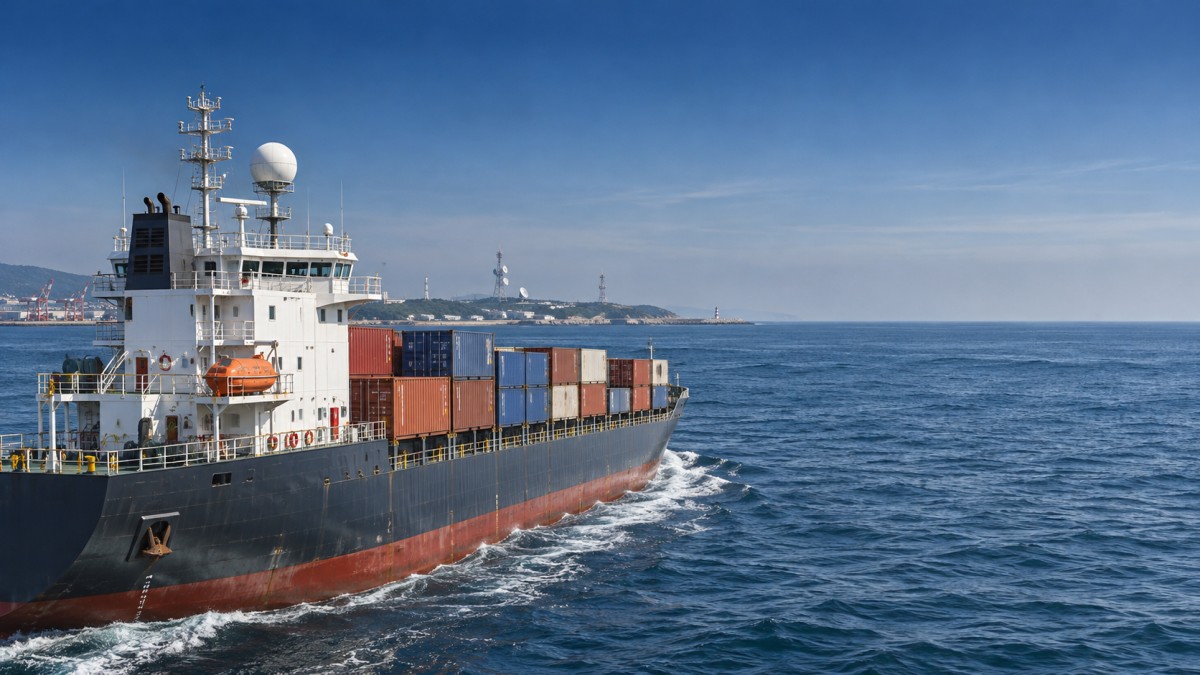
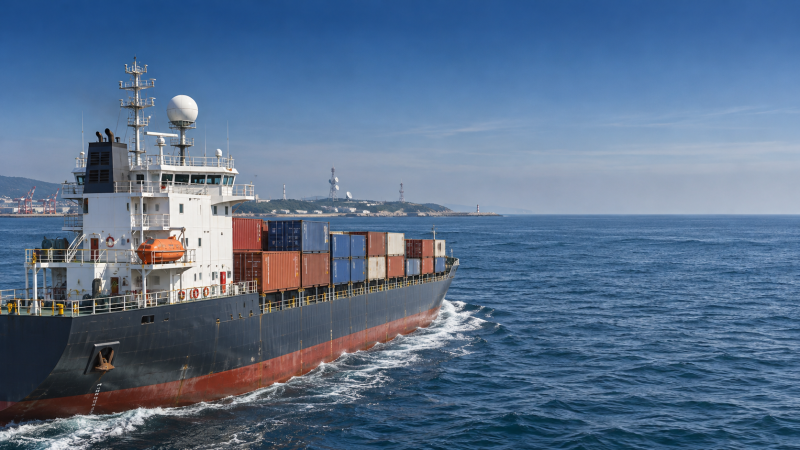
Onboard buffering preserves records, but only within defined limits
When the link degrades or disappears, an onboard gateway can write outgoing records to persistent storage and forward them later. The buffer should survive the failures the design claims to tolerate, such as a communications process restart or an unexpected power interruption. That requires attention not just to storage media, but also to when a record is durably committed and how the queue is recovered after restart.
Buffer sizing starts with the rate at which data is retained, not the nominal capacity of the satellite service. A simplified estimate is:
Required usable storage ≈ retained data rate × expected outage duration + operational margin.
The retained rate must include message overhead, indexes and any replication or journaling used by the implementation. Compression can reduce capacity requirements, but its effect depends on the data and should not be assumed without representative testing. A platform that stores high-frequency raw signals will need substantially more space than one retaining periodic aggregates.
Storage exhaustion is a design decision, not an exceptional detail. The system might stop accepting lower-priority data, reduce sampling where permitted, or overwrite older records according to a declared retention policy. Each choice has consequences. Overwriting the oldest data preserves the latest picture but creates a historical gap; rejecting new data preserves the backlog but prevents recovery of subsequent events. Critical alarms and audit records may require separate reserved capacity.
Timestamping turns a backlog into an intelligible history
Every delayed record needs enough context to place it correctly in time. At minimum, the receiving system needs the observation timestamp, an identifiable source and a way to distinguish one record from another. A separate ingestion timestamp is useful for measuring delivery delay, but it must not replace the original event time.
Clock quality matters. If an onboard device’s clock drifts or is reset, sorting solely by timestamp can put events in the wrong order. Platforms can reduce ambiguity by synchronizing clocks to an available time source, recording synchronization status, and retaining source sequence numbers or monotonic ordering information where supported. Sequence numbers help establish order within a source; they do not by themselves prove the order of events across different devices.
During an extended loss of time synchronization, the platform should expose uncertainty rather than silently imply precision. When a clock is corrected, it should preserve enough metadata to explain the discontinuity. This is particularly important when comparing vessel events with weather, port operations or shore-side instructions generated by different systems.
Time handling must also be consistent across interfaces. Store and exchange timestamps with an explicit time reference, commonly UTC, and apply local time zones only for presentation. Ambiguous local timestamps around daylight-saving transitions can otherwise produce misleading histories.
Prioritization determines what gets through first
When capacity is limited, transmitting every queued record in arrival order can leave an urgent alarm behind hours of routine telemetry. A priority-aware scheduler separates traffic by operational importance and applies rules that remain effective during both congestion and recovery.
A practical arrangement might reserve capacity for alarms and current operational summaries while sending historical detail in the remaining bandwidth. The exact classes and limits depend on the vessel’s systems and operating procedures. Priority should also be assigned with care: if every source labels its messages as critical, the queue has no meaningful way to distinguish them.
Priority alone is not enough. Continuous high-priority traffic can starve the backlog indefinitely, so the scheduling policy may need a minimum allocation for historical transfer. Conversely, an aggressive backlog upload can consume capacity needed for current updates. Rate limits and separate queues help balance these competing needs.
Not all measurements need the same transmission pattern. High-frequency data can be retained locally while summaries, changes of state or threshold events are sent to shore. That reduces traffic, but it also changes what shore systems can infer. Aggregation can hide short-lived spikes; event-triggered reporting can miss patterns that were not anticipated when the triggers were configured. The platform should identify whether a displayed value is raw, sampled or aggregated, and make the aggregation interval available.
Recovery requires more than reconnecting
After a link returns, the platform must establish what was actually received and what remains outstanding. A transport-level acknowledgement does not necessarily mean that a record has been stored and processed by the shore application. The acknowledgement point should therefore be explicit: receipt by a network broker, durable storage, and successful application processing are different states.
Retransmission is necessary when acknowledgements are lost, but it can create duplicates. A common design uses persistent message identifiers and idempotent processing so that receiving the same record again does not create a second operational event. “Exactly once” delivery claims should be examined at the application boundary: a protocol feature alone does not guarantee that downstream databases, alerts and integrations will all process an event only once.
Records can also arrive out of order. Current telemetry may be delivered ahead of older buffered measurements, particularly when priorities differ. Shore applications must be able to insert late data into historical views without treating it as the vessel’s present state. Rules are needed for recalculating aggregates and correcting reports when late records arrive after an initial result has been produced.
Backlog recovery depends on spare capacity. If the vessel retains data at an average rate of 100 units per hour and the link can sustain only 80 units per hour, the queue will continue to grow even after reconnection. If the link sustains 150 units per hour, only 50 units per hour are available to drain the backlog while new data continues to arrive. In this illustrative case, a 500-unit backlog would take at least ten hours to clear, before accounting for overhead, fluctuating capacity or higher-priority traffic.
That arithmetic exposes a frequent weakness in recovery claims: a system may reconnect successfully but never catch up under the configured data rate. Retention rules, filtering and bandwidth allocation need to be assessed together.
Freshness must be visible in operational decisions
A dashboard should distinguish the time of the last observation from the time of the last communication and the time of the last successful shore update. A live connection does not prove that every source is producing fresh data; an individual sensor or onboard collector may have stopped updating while the gateway remains online.
Freshness thresholds should reflect the decision being supported. A delay acceptable for a daily fuel report may be unacceptable for an operational alert. The interface can mark values as current, delayed or unavailable against configured limits, while retaining the actual age and source timestamp for inspection. Missing data should not be displayed as a normal zero or silently carried forward without an indication that it is stale.
Shore-to-ship messages need equivalent care. A command or advisory created before an outage may no longer be appropriate when the connection returns. Messages should carry an identifier and, where relevant, an expiry time, version or validity condition. The vessel-side system should reject or escalate expired and conflicting instructions according to its design and operating procedures, rather than execute an old queue automatically.
Safety-critical control and protective functions should not depend on a delayed shore round trip unless the complete system has been designed and assessed for that dependency. A shore platform may support monitoring or advisory decisions, but its presence does not turn an intermittent communications link into a deterministic control channel.
Testing the behavior, not just the connectivity
Resilience is best assessed through fault scenarios with measurable acceptance criteria. A successful reconnect demonstration shows little about whether data was lost, duplicated, reordered or made misleading during an outage.
- Interrupt the link: Confirm which data is stored locally, how much capacity remains and whether the queue survives a gateway restart or power interruption.
- Constrain bandwidth: Check that alerts and current summaries meet their configured delivery objectives while historical data continues to make progress.
- Restore a congested connection: Measure backlog growth and drain time under continued data generation, not just with an idle source.
- Drop acknowledgements and reorder messages: Verify duplicate handling, late-data insertion and the resulting behavior of alerts and reports.
- Disturb time synchronization: Check how clock drift, correction and uncertain timestamps appear in the shore interface and exported records.
- Fill the buffer: Verify the declared retention or deletion policy, reserved capacity and operator warnings before records are lost.
Acceptance criteria should specify the observation point and workload. “Latency under one minute” is incomplete without saying whether it refers to event-to-display time, which priority class is measured, what proportion of records must meet the target, and what link and data-generation conditions apply. Completeness should likewise identify the records expected, the permitted loss, and how gaps are detected.
For integration, document the timestamps, identifiers, quality flags, acknowledgement semantics and retention behavior exposed through each interface. Relevant standards depend on the equipment and system boundary; a protocol or cybersecurity standard named in a specification is not, by itself, evidence that buffering, freshness or recovery behavior meets an operational requirement. Those properties need to be demonstrated under the conditions the vessel and shore systems are expected to encounter.
Recommended News
 Nov 05, 2026How does a ship-to-shore synergy platform handle data delays?Discover how a ship-to-shore synergy platform handles data delays with onboard buffering, priority-based delivery and reliable recovery.
 Oct 14, 2026How to Identify Top Predictive ETA Suppliers for Standardised Port Call TimestampsTop predictive ETA suppliers for ports for standardised port call timestamp reporting: compare accuracy, data transparency, integration and governance for smarter procurement.
 Oct 13, 2026Where a Synchro Port Operations Platform Helps Reduce Berth and Pilot DelaysA synchro port operations platform helps reduce berth and pilot delays through real-time ETA, resource, tide, and berth-readiness coordination for predictable turnarounds.
 Oct 12, 2026GTOT Integration Checklist for Reliable Port Call Data ExchangeGTOT integration checklist for reliable port call data exchange. Align events, timestamps, exceptions, security, and inland planning to improve operational trust.
 Oct 11, 2026What Is G TOT and How Can It Improve Port Call Coordination?G TOT improves port call coordination by connecting vessel ETA, berth readiness, pilot services, and cargo operations for smarter, faster decisions.
 Sep 22, 2026When smart vessels equipment improves port turnaround timeSmart vessels equipment helps reduce port turnaround time with reliable arrival forecasts, cargo visibility, and equipment readiness. Explore practical integration strategies.
 Sep 17, 2026When does a port vessel integration platform reduce turnaround delays?Port vessel integration platform: discover when connected data, coordinated workflows, and early alerts reduce turnaround delays and improve port-call reliability.
 Sep 04, 2026How smart land-sea interconnection improves cargo visibility at portsSmart land sea interconnection gives ports real-time cargo visibility across vessels, terminals, rail, and inland networks—reducing delays, risk, and costly disruptions.
 Aug 31, 2026When does a smart container ship platform reduce port turnaround delays?Smart container ship platform insights: reduce port turnaround delays with shared timelines, proactive exception management, and faster vessel-port coordination.
 Jul 28, 2026Integrated Ship to Shore Systems: Key Factors for Reliable Port IntegrationIntegrated ship to shore systems guide reliable port integration by addressing interfaces, latency, cybersecurity, failure recovery, and retrofit risks—essential reading before choosing a vendor.
 Jul 13, 2026How to Evaluate a Port Vessel Integration ProviderPort vessel integration provider evaluation starts with scope, interoperability, cybersecurity, and delivery strength. Learn how to choose a reliable partner for safer, smarter port operations.
 Jul 12, 2026How Smart Container Ships Technology Cuts Port DelaysSmart container ships technology helps cut port delays with live ETA data, better berth planning, and faster cargo handling. See how it improves reliability and lowers supply chain disruption.
 Jul 09, 2026Vessel Connectivity for Cargo Ships: Solving Data Gaps at SeaVessel connectivity for cargo ships explained through real voyage scenarios—learn how to reduce data gaps, improve fleet decisions, and choose smarter sea-to-shore connectivity.
 Jul 08, 2026Real Time Ship to Shore: What Delays Data Sync in Port Operations?Real time ship to shore delays can disrupt port efficiency, safety, and turnaround. Discover the hidden causes of data sync issues and practical fixes to improve maritime operations.
![]() Jul 07, 2026Smart Ship Connectivity for Fleet Monitoring: What Delivers ROISmart ship connectivity for fleet monitoring delivers ROI when data, alerts, and workflows match real fleet operations. Learn how to reduce delays, control risk, and improve asset performance.
 Jun 29, 2026Digital Ship to Shore Integration: Key Risks Before DeploymentDigital ship to shore integration: discover the top pre-deployment risks in interoperability, cybersecurity, data quality, workflows, and compliance to ensure a smoother rollout.
 Jun 26, 2026Ship to Shore Integration: Key Performance Checks Before DeploymentShip to shore integration is critical before deployment. Check interface stability, data accuracy, cyber resilience, and crane coordination to boost safety, reduce delays, and improve terminal performance.
 Jun 15, 2026Land-Sea Interconnection Challenges in Port Logistics and Cargo FlowLand-sea interconnection challenges in port logistics can disrupt cargo flow, raise costs, and delay delivery. Discover practical strategies to improve coordination, visibility, and resilience.
 Jun 10, 2026Improving Port Efficiency with Better Ship-to-Shore SynergyShip-to-shore synergy is the key to improving port efficiency. Discover how better vessel-terminal coordination reduces delays, supports rail-yard flow, and boosts reliable throughput.
 Jun 07, 2026How to Compare Intermodal Transport Systems for Port-Centric Cargo FlowsIntermodal transport systems for port-centric cargo flows: compare reliability, rail-sea coordination, scalability, and data visibility to choose smarter, more resilient logistics solutions.
![]() May 23, 2026How Smart Maritime Technology Cuts Port Delay RisksSmart maritime technology helps cut port delay risks with predictive ETA, AI routing, and connected port visibility—reducing fuel waste, improving berth planning, and strengthening supply chain resilience.
 May 21, 2026Maritime Logistics Optimization Techniques That Reduce Port Dwell TimeMaritime logistics optimization techniques help cut port dwell time through smarter berth planning, yard coordination, and real-time visibility—discover practical ways to boost flow and reliability.
 May 17, 2026Land-Sea Interconnection Models That Improve Cargo TurnaroundLand-sea interconnection models that improve cargo turnaround: explore fixed-slot rail-berth links, dry ports, smart visibility, and safer corridor design to cut dwell time and boost logistics performance.