Search News
Industry Portal
Popular Tags
How to check a SIL4 railway systems manufacturer's certification scope
Author
Time
Click Count
A tender submission may describe an entire signalling portfolio as “SIL4 certified,” while the attached certificate covers only one controller, software release, or safety function. Accepting that statement without checking its boundaries can leave the proposed configuration unsupported and create assessment gaps during integration. To check a SIL4 railway systems manufacturer’s certification scope, match the certificate and its referenced documents against the exact equipment, functions, versions, interfaces, and operating conditions you intend to use.
Start by verifying the issuer and certificate status, then examine the scope annex, assessment report, and safety manual together. A certificate is evidence within defined boundaries—not blanket approval of a manufacturer’s catalogue or proof that your installed railway system achieves SIL4.
Define the configuration before reviewing the certificate
Scope verification needs a stable comparison target. A commercial product name is rarely sufficient: the same family can include different processors, input/output modules, software builds, communication options, and architectures. Some variants may support safety-related operation; others may provide monitoring or maintenance functions outside the assessed boundary.
Prepare a short configuration record containing:
- The manufacturer’s legal entity, product designation, hardware revision, and proposed module combination.
- The application software, firmware, operating system, and configurable data versions, where relevant.
- The safety functions required by the project, with their boundaries and safe-state behaviour.
- The intended architecture, external interfaces, operating environment, and maintenance arrangements.
- The standards and editions required by the contract or acceptance framework.
Describe functions precisely. “Train protection” is too broad for a scope comparison; enforcing a movement-authority limit through a defined braking interface provides a more useful boundary. Likewise, an assessed interlocking platform does not automatically cover every application-data set or external subsystem connected to it.
Verify the document and the organisation behind it
Request the complete certificate, including annexes and referenced schedules. A cropped first page, presentation slide, or logo does not establish scope. Check the certificate number, holder, issuing organisation, issue date, revision, and any stated validity or surveillance conditions. Distinguish the certificate holder from a distributor, subsidiary, or production site appearing in the commercial offer.
Verify authenticity through the issuer’s official register where available. Otherwise, contact the issuer through independently obtained contact details and ask whether the document is genuine, current, superseded, suspended, or withdrawn. An older certificate is not automatically invalid, and a document without an expiry date is not automatically valid indefinitely; its status depends on the certification scheme and stated conditions.
Identify what kind of evidence has been supplied. Product certification, an independent safety assessment, a development-process assessment, and a quality-management certificate answer different questions. A process assessment may support confidence in development practices without certifying a particular delivered product. A safety assessment report may contain an assessor’s conclusion without being a product certificate.
Where accreditation is claimed or contractually required, check whether the issuing body’s accreditation covers the relevant activity and scheme. Do not treat accreditation, assessor independence, technical competence, and regulatory acceptance as interchangeable. A legitimate certificate may still fail to meet the project’s specified acceptance route.
Read the SIL4 claim alongside the referenced standards
SIL describes safety integrity associated with defined safety functions and their implementation. It is not a company-wide rating. The wording may identify a function assessed to SIL4, a platform suitable for use in SIL4 applications under conditions, or a development process assessed against requirements associated with SIL4. Those statements do not provide identical assurance.
For railway signalling, the documentary framework commonly includes the following standards. Check the actual editions and amendments cited rather than assuming a familiar standard number proves compatibility with the procurement requirements.
A newer standard publication does not automatically invalidate earlier evidence. Conversely, an older certificate does not automatically satisfy a contract referencing a different edition. Obtain a documented gap analysis or acceptance rationale when the assessment basis and required basis differ.
Keep environmental qualification, electromagnetic compatibility, cybersecurity, and functional safety distinct. Evidence in one area cannot simply substitute for another, although failures or changes in those areas can affect safety assumptions.
Trace the assessed boundary down to functions and versions
The decisive scope information is often in an annex or referenced assessment report rather than on the certificate face. Look for exact product identifiers, approved variants, configuration restrictions, and the assessed safety functions. Establish whether the evidence concerns a generic product, a generic application, or a specific application. A generic assessment can support reuse, but it does not remove the need to demonstrate suitability for the actual installation.
Build a traceability chain from each required safety function to the offered configuration and its supporting evidence:
Required function → implementing hardware and software → certificate scope reference → assessment evidence → applicable safety-manual conditions.
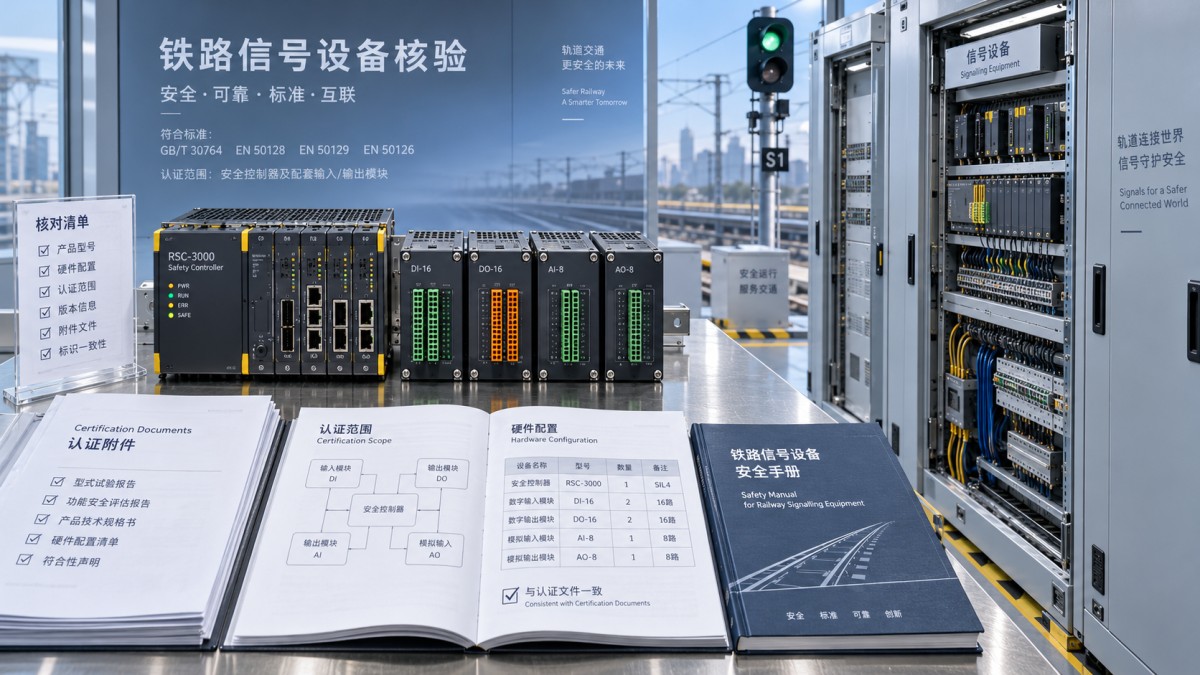
Read exclusions with the same attention as inclusions. A safety computer may be assessed while its engineering workstation, remote diagnostic interface, or external network is outside scope. An excluded component is not necessarily unacceptable, but its effects must be addressed through the applicable integration evidence.
Watch for qualifiers such as “suitable for,” “up to,” “when configured as,” and “subject to.” These may be technically appropriate limitations, not misleading wording. The question is whether the supplier’s claim preserves those limitations.
Resolve version differences through controlled evidence
A proposed release newer than the certified release requires a documented link to the assessed baseline. Ask for the change record, safety-impact analysis, affected verification evidence, and the assessment or certification disposition required by the scheme. “Functionally equivalent” is not sufficient without controlled justification.
The same applies to processor substitutions, compiler changes, replacement modules, firmware patches, and modified safety communication stacks. Not every change requires a new certificate, but the manufacturer should demonstrate how the change was evaluated and why the existing evidence remains applicable. Serial numbers and build records should allow the delivered equipment to be traced to that conclusion.
Test the safety manual against the intended installation
The safety manual translates the assessment assumptions into obligations for integration, operation, and maintenance. Request the exact revision referenced by the assessment, together with any applicable updates. Its safety-related application conditions may define the boundary between acceptable use and an unsupported configuration.
Review these conditions against the design, not just against the supplier’s statement of compliance:
- Architecture: required redundancy, channel independence, segregation, voting arrangements, and common-cause failure controls.
- Interfaces: assumptions about inputs, outputs, external devices, communication protection, and fault responses.
- Timing: watchdog settings, diagnostic intervals, permissible latency, and required reaction to detected faults.
- Environment: temperature, vibration, power supply, electromagnetic conditions, enclosure requirements, and installation restrictions.
- Lifecycle controls: commissioning checks, proof tests where specified, maintenance intervals, repair rules, and authorised modification procedures.
For example, a subsystem may rely on external circuitry to bring outputs to a safe state after a detected failure. Its certification cannot establish that the external circuitry has been correctly designed and installed. Similarly, a safety communication function may depend on specified network assumptions that the proposed topology does not satisfy.
Create an application-condition register with an owner and evidence reference for each obligation. Mark conditions as demonstrated, pending, or not applicable with justification. Conditions allocated to the operator or maintenance organisation need explicit acceptance; they should not disappear when the supplier’s delivery scope ends.
For continuous or high-demand safety functions, scrutinise the dangerous-failure-rate assumptions relevant to the allocated integrity target. A numerical estimate alone does not establish SIL4: systematic capability, architecture, lifecycle evidence, and application conditions also matter. Any claimed quantitative contribution should identify its boundary and assumptions so it can be used correctly in the system safety analysis.
Cross-check the assessment conclusion and unresolved conditions
The supporting assessment report should explain what was assessed, which documents formed the baseline, and what limitations attach to the conclusion. Check whether its product identifiers, revisions, standards, and safety-manual references agree with the certificate and commercial offer. Conflicting revisions are a reason to stop the scope decision until the document hierarchy is clarified.
Look for open findings, recommendations, deferred activities, and exclusions. Their significance depends on the assessor’s conclusion: a condition requiring closure before operation is different from a recommendation for future improvement. Ask who owns each outstanding item and what evidence demonstrates closure.
Some detailed reports contain confidential design information. Controlled access, an assessor-confirmed extract, or a scope statement may be workable alternatives to unrestricted disclosure. However, commercial confidentiality does not justify withholding the information needed to establish applicability, restrictions, and outstanding obligations.
Also separate product evidence from application approval. Route-specific data, braking interfaces, installation wiring, operational rules, and system-level hazard controls may require further verification or independent assessment. A supplier certificate is one input to that work, not a replacement for it.
Record a scope decision that integration teams can use
Document the result as a configuration-specific decision rather than a general judgement about the manufacturer. The record should identify the offered baseline, required functions, relevant certificate and report revisions, matched scope, exclusions, and remaining application obligations.
Where the boundary remains disputed, refer the specific mismatch to the issuing body or responsible independent safety assessor—not merely to the supplier’s sales team. Ask whether the identified configuration and function are covered, under which document revision, and subject to which conditions. Preserve that response with the configuration baseline so later substitutions, software updates, or application changes trigger a fresh applicability review.
Recommended News
 Nov 23, 2026Can an AI route optimization platform handle cross-border truck restrictions in Europe?AI route optimization platform Europe: Discover how to assess cross-border truck restrictions, validate compliant routes, and avoid costly routing errors.
 Nov 21, 2026How to assess carrier integration in an intermodal transportation platformEvaluate an intermodal transportation platform with a practical guide to carrier coverage, event accuracy, integration failures, security and acceptance testing.
 Nov 20, 2026How to identify which railway safety standards apply to a projectRailway safety standards guide: Learn how to identify applicable requirements, map interfaces and build a defensible compliance baseline for your project.
 Nov 19, 2026How to evaluate motion control application references for a new projectEvaluate engineering application references for motion control with confidence. Compare load cycles, safety, integration, and evidence to reduce project risk.
 Nov 18, 2026When does electric marine propulsion make sense for ferries?Electric marine propulsion technology can transform ferry operations. Explore when battery-electric or hybrid systems make sense for your routes, charging access, and costs.
 Nov 17, 2026How much does it cost to buy an ocean-going vessel?Ocean going vessel cost ranges from a few million to hundreds of millions of dollars. Explore purchase prices, hidden costs, and key factors before you buy.
 Nov 16, 2026How to verify solution provider references before signing a contractVerify solution provider references before signing. Learn what to ask, which evidence to check, and how to turn findings into stronger contract terms.
 Nov 14, 2026How does automatic train control affect metro train headways?Discover how automatic train control for metro systems can reduce headways, improve service consistency and support capacity planning without compromising safety.
 Nov 13, 2026How to assess the financial return on rail infrastructure investmentAssess rail infrastructure investment with confidence. Explore lifecycle costs, NPV, IRR and risk scenarios to make better-informed funding decisions.
 Nov 12, 2026How to assess an ocean vessel technology provider's integration capabilitiesAssess an ocean vessel technology provider with a practical guide to interfaces, cybersecurity, failure testing, and lifecycle support. Make a confident choice.
 Nov 10, 2026When is external supplier evaluation support worth the cost?Discover when supplier evaluation support is worth the cost, how to estimate its return, and where independent expertise can reduce sourcing risks.
 Nov 09, 2026How can evaluation support help component suppliers prepare for audits?Supplier evaluation support for component suppliers helps uncover audit gaps, strengthen traceability, and build a clear, risk-based preparation plan.
 Nov 07, 2026How smart intermodal transportation reduces transfer delaysDiscover how smart intermodal transportation reduces transfer delays through real-time coordination, cargo-ready forecasts, and faster decisions.
 Nov 06, 2026How to evaluate AI route optimization suppliers in North AmericaAI route optimization supplier North America: discover how to compare providers, validate savings, assess security and choose a solution that fits your operations.
 Nov 04, 2026Can LTE-M track rail assets in areas with limited coverage?LTE-M rail transit for asset tracking can bridge coverage gaps with offline data storage. Discover its limits and how to assess your routes.
 Nov 01, 2026When is rail freight cheaper than maritime shipping?Compare rail and maritime cost to discover when rail freight can save money on inland routes, inventory and delays. Learn how to assess the full door-to-door cost.
 Oct 31, 2026How an AI route optimization dashboard handles traffic delaysDiscover how an AI route optimization dashboard responds to traffic delays, compares feasible routes, updates ETAs, and helps operators make informed decisions.
 Oct 29, 2026How to assess an automatic train control manufacturer for retrofitsAssess an automatic train control manufacturer for your retrofit. Learn how to verify compatibility, safety assurance, migration plans, and long-term support before choosing a supplier.
 Oct 28, 2026Does technical selection support in Southeast Asia cover local codes?Explore technical selection support Southeast Asia projects need to address local codes, assess compliance evidence, and map approval pathways. Learn what to ask before procurement.
 Oct 26, 2026How a product information platform keeps product data consistentDiscover how a product information platform keeps data consistent with clear ownership, validation, and approved updates. Learn what to check before choosing a solution.
 Oct 23, 2026When is renting heavy mining equipment cheaper than buying?Renting heavy industry equipment for mining? Discover when it costs less than buying, compare hidden fees and break-even points, and make a smarter fleet investment.
 Oct 21, 2026Can absolute safety monitoring eliminate all operational risk?Can absolute safety monitoring eliminate all risk? Discover its limits, hidden failure points, and practical safeguards to strengthen protection and make smarter safety decisions.
 Oct 19, 2026How to vet a European railway safety technology supplier’s track recordSeeking a railway safety technology supplier Europe can trust? Learn how to verify project references, safety credentials, and lifecycle support to build a defensible shortlist.
 Oct 15, 2026How to size train traction systems for frequent-stop rail serviceSize train traction systems for frequent-stop rail service with practical guidance on power, adhesion, thermal loads, and braking. Learn how to meet timetables without costly oversizing.