



Search News
Industry Portal
Popular Tags
How to Evaluate an AI Vessel Routing Provider for Fuel Savings

Author
Time
Click Count
How to Evaluate an AI Vessel Routing Provider for Fuel Savings
Choosing the right AI vessel routing provider can directly impact fuel costs, schedule reliability, and decarbonization goals.
For shipping and logistics leaders, the hard part is not finding AI claims.
It is finding a provider with credible maritime data, operational clarity, and measurable voyage results.
A strong evaluation process helps separate polished demos from real routing performance.
That matters even more as fuel savings, emissions control, and service reliability face tighter scrutiny.
Why the AI vessel routing provider matters more than the model itself

Many teams start with algorithm quality.
That is important, but it is only one layer of the buying decision.
An AI vessel routing provider influences how routing advice is created, delivered, explained, and improved over time.
If the provider lacks shipping context, fuel-saving recommendations can look smart in theory but fail onboard.
In actual operations, route optimization must balance weather, currents, port windows, charter-party obligations, safety margins, and engine behavior.
This is where provider quality becomes visible.
The best AI vessel routing provider does not just output a shortest path.
It supports better voyage decisions under real commercial pressure.
From a broader transport intelligence perspective, this aligns with how advanced systems are judged across rail and sea.
Data integrity, decision support, and operational resilience matter more than marketing language.
Start with the fuel-saving baseline, not the sales claim
A useful evaluation begins with your own baseline.
Without that, it is hard to verify any AI vessel routing provider.
Define current fuel performance by vessel class, service lane, season, and voyage profile.
Separate ballast voyages from laden voyages.
Track speed-loss patterns in heavy weather.
Review deviations caused by port congestion or schedule recovery.
This baseline gives you a fair comparison point for route optimization outcomes.
Ask each AI vessel routing provider to map expected savings against your real operating conditions.
A credible vendor should explain where savings come from.
Examples include reduced weather avoidance, improved speed guidance, smarter ETA control, or lower engine load variability.
If the provider cannot show that logic, treat projected savings carefully.
Questions worth asking early
- How is fuel-saving performance measured across comparable voyages?
- What assumptions are used for speed, trim, weather, and loading condition?
- How often do recommendations change during a voyage?
- How are off-hire events and commercial constraints handled?
- What share of suggested routes were actually followed by crews?
Examine the maritime data stack behind the routing engine
Data quality often decides whether an AI vessel routing provider delivers repeatable value.
The routing engine is only as reliable as its weather, ocean, vessel, and performance inputs.
Start by asking where the provider sources weather forecasts, wave models, and current data.
Then ask how often those feeds refresh and how forecast errors are handled.
More importantly, examine vessel-specific performance modeling.
A generic model may miss the behavior of a smart container ship, LNG carrier, or mixed-age fleet.
A stronger AI vessel routing provider builds recommendations using noon reports, sensor feeds, draft conditions, and hull performance history.
That creates recommendations grounded in how your ships really consume fuel.
This point is easy to miss during procurement.
Two providers can show similar dashboards while relying on very different data maturity.
What strong data governance looks like
- Clear source disclosure for weather, AIS, port, and vessel data
- Documented update frequency and failure handling
- Vessel-type modeling, not one generic fleet model
- Data validation rules for incomplete or conflicting reports
- Audit trails for route changes and recommendation history
Check whether the AI vessel routing provider fits live operations
A route recommendation has little value if crews and shoreside teams cannot use it easily.
That is why workflow fit should be part of every evaluation.
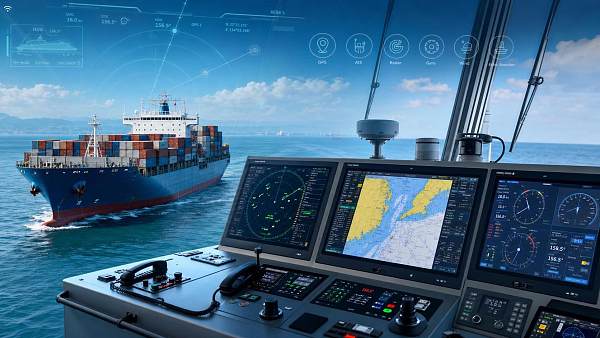
Review how the AI vessel routing provider connects with voyage planning, fleet performance, and reporting systems.
Check whether routing advice can be consumed onboard with low friction.
The best platforms make trade-offs visible.
Users should see why a route was chosen, what fuel benefit is expected, and what schedule risk remains.
In practice, explainability reduces resistance from masters, operators, and chartering teams.
It also helps internal governance, especially when voyage decisions are reviewed after disruption.
More mature providers also support exception handling.
That includes piracy zones, canal restrictions, weather rerouting, and arrival sequencing near congested ports.
Operational fit checklist
- Route recommendations arrive early enough to affect voyage decisions.
- Shore and ship teams see the same recommendation logic.
- Manual overrides are recorded with reasons.
- APIs or exports support existing fleet platforms.
- Post-voyage reports link route choice to fuel and ETA outcomes.
Look for proof, not promises
Every AI vessel routing provider will mention efficiency gains.
The real issue is whether those gains hold across time, vessel classes, and volatile conditions.
Ask for evidence from comparable fleets.
A strong provider should share methodology, comparison windows, and adoption rates.
Focus on verified voyage outcomes rather than isolated peak savings.
This is especially important when fuel costs and carbon intensity targets are tied to executive reporting.
A pilot can help, but it needs discipline.
Run the pilot long enough to include varied weather and operating conditions.
Use matched vessels or matched voyage windows where possible.
Set success criteria before launch.
Sample evaluation scorecard
Evaluate commercial risk, support quality, and long-term fit
The final decision should include more than route accuracy.
An AI vessel routing provider becomes part of your operating decision chain.
That means support quality, contract structure, cybersecurity, and roadmap stability all matter.
Ask how incidents are handled when data feeds fail or route recommendations become unavailable.
Review ownership of performance data and derived insights.
Check whether the provider invests in product improvements tied to decarbonization reporting, smart vessel operations, and future compliance needs.
This is where strategic fit becomes more obvious.
A partner serving advanced shipping operations should understand digitalization as a long-cycle capability, not a one-off software sale.
That perspective matches the wider shift across high-value transport systems, where intelligence, safety, and efficiency increasingly converge.
Red flags during vendor selection
- Savings claims with no methodology disclosure
- Weak vessel-specific modeling
- Limited integration with existing voyage systems
- No clear support model for onboard and shore teams
- Poor visibility into data security and access rights
A practical way to make the final decision
A sound selection process is usually straightforward.
First, define internal fuel, schedule, and emissions priorities.
Next, shortlist each AI vessel routing provider against data quality and operational fit.
Then, run a controlled pilot with clear decision metrics.
Finally, compare proven voyage outcomes with total implementation effort.
The right AI vessel routing provider should help reduce fuel burn while improving confidence in voyage decisions.
That is the real benchmark.
Not the most impressive dashboard, but the provider most likely to deliver repeatable value across your fleet.
When the evaluation is disciplined, fuel savings become easier to verify, and long-term routing decisions become easier to trust.
Recommended News
 Jul 14, 2026Sensor Fusion Navigation Systems Trends Shaping Safer OperationsSensor fusion navigation systems are reshaping safer rail and maritime operations with real-time accuracy, stronger resilience, and smarter automation insights. Learn the key trends now.
 Jul 14, 2026How to Evaluate an AI Vessel Routing Provider for Fuel SavingsAI vessel routing provider selection starts with real fuel baselines, data quality, and live operational fit. Learn how to compare vendors, verify savings, and choose a partner that delivers measurable voyage results.
 Jul 13, 2026How Vessel Intelligence Analytics Improves Fleet ETA AccuracyVessel intelligence analytics improves fleet ETA accuracy by combining AIS, weather, congestion, and port signals—helping operators reduce delays, optimize arrivals, and strengthen end-to-end logistics decisions.
 Jul 12, 2026Marine Navigation for Commercial Vessels: Key Upgrade ChecksMarine navigation for commercial vessels: discover the key upgrade checks that improve safety, redundancy, cyber readiness, and bridge efficiency for smarter fleet decisions.
![]() Jul 07, 2026Navigation Decision Logic Explained: Limits, Risks, and Use CasesNavigation decision logic explained clearly: explore its limits, risks, and real-world use cases in rail and maritime systems to improve safety, resilience, and smarter operational decisions.
Jul 07, 2026Navigation Decision Logic Explained: Limits, Risks, and Use CasesNavigation decision logic explained clearly: explore its limits, risks, and real-world use cases in rail and maritime systems to improve safety, resilience, and smarter operational decisions. Jul 05, 2026Maritime Automation for Tankers: Key Safety and Compliance Gaps to Check FirstMaritime automation for tankers starts with closing safety and compliance gaps. Learn the top risks in alarms, sensors, cyber controls, crew use, and records before problems escalate.
 Jul 04, 2026IMO-Compliant Smart Shipping Solutions: Certification Gaps to CheckSmart shipping solutions IMO compliant: discover the certification gaps that can delay audits, weaken safety assurance, and expose advanced vessels to operational risk.
 Jul 03, 2026Smart Shipping Solutions IMO Compliant: Features That Matter MostSmart shipping solutions IMO compliant deliver safer operations, emissions control, route efficiency, and audit-ready data. Discover the features that protect vessel value and improve fleet performance.
 Jun 22, 2026How Advanced Ocean-Going Vessels Cut Transit Risk in Long-Haul ShippingAdvanced ocean-going vessels cut transit risk through smarter routing, cargo monitoring, and port coordination. See how route-based vessel choices improve long-haul shipping reliability.
 Jun 21, 2026Smart Container Ships: What to Evaluate Before Investing in New SystemsSmart container ships demand more than new tech. Learn how to evaluate integration, lifecycle cost, cyber risk, and ROI before investing in new systems.
 Jun 14, 2026Smart Container Ships: Key Features Worth ComparingSmart container ships comparison guide: explore route intelligence, automation, connectivity, predictive maintenance, and cybersecurity to choose smarter vessels with better efficiency and reliability.
 Jun 13, 2026AI Route Optimization: When Fuel Savings Justify AdoptionAI route optimization explained: learn when fuel savings, ETA reliability, and lower emissions can justify adoption, with practical ROI factors and payback insights for transport operators.
 Jun 07, 2026AI Route Optimization in Shipping: Where It Cuts Delays—and Where It Doesn’tAI route optimization in shipping cuts delays when weather, vessel data, and port timing align—but it won’t fix congestion or canal queues. See where it truly delivers ROI.
![]() May 23, 2026Autonomous Navigation: How Safe Is It at Sea?Smart maritime technology is reshaping autonomous navigation at sea. Explore key safety risks, safeguards, and practical insights buyers need to evaluate trusted vessel autonomy.
May 23, 2026Autonomous Navigation: How Safe Is It at Sea?Smart maritime technology is reshaping autonomous navigation at sea. Explore key safety risks, safeguards, and practical insights buyers need to evaluate trusted vessel autonomy. May 07, 2026AI Route Optimization for Fleet Expansion: What to Evaluate FirstAI route optimization is the first priority for fleet expansion. Learn what buyers should evaluate first to improve accuracy, integration, safety, and scalable transport performance.
 May 07, 2026AI Route Optimization vs Manual Planning: What Changes FirstAI route optimization vs manual planning: discover what changes first—faster decisions, better fuel efficiency, stronger schedule reliability, and smarter risk control.