



Search News
Industry Portal
Popular Tags
How to Evaluate Rail Pantograph Systems for Speed, Contact Stability, and Maintenance Life
Author
Time
Click Count
How to Evaluate Rail Pantograph Systems for Speed, Contact Stability, and Maintenance Life
Evaluating rail pantograph systems is rarely as simple as comparing maximum speed labels on a datasheet. In real projects, the better question is whether the system can keep a reliable current collection window across the operating envelope the train will actually see: sustained high speed, crosswinds, tunnel pressure waves, track irregularity, temperature swings, contamination, and maintenance intervals that may be tighter on paper than they are in depots.
That is why experienced assessment teams usually treat the pantograph not as an isolated roof component, but as part of a moving power-collection interface. The interface includes the overhead contact line, vehicle dynamics, control logic, carbon strip behavior, and even depot practice. A pantograph that performs well in one network can become a poor fit in another if the catenary geometry, service profile, or maintenance organization is different.
For technical assessors working on fleet renewal, new rolling stock, or cross-border compatibility, three criteria tend to drive the decision: speed capability, contact stability, and maintenance life. Everything else matters, but these three usually expose whether a design is robust or merely acceptable under ideal conditions.
Start with the operating envelope, not the brochure speed
A common mistake is to begin with nominal top speed. If a route is specified at 350 km/h, buyers naturally shortlist pantographs advertised for that class. But speed capability on its own says very little. What matters is the combination of speed, uplift behavior, aerodynamic loading, and current collection quality under the route’s actual operating conditions.
For example, a trainset running frequent acceleration and deceleration cycles in a dense corridor places different demands on the head and suspension than a long, steady intercity run. Urban express lines with many tunnels can create repeated pressure fluctuations. Coastal corridors may add salt contamination and stronger wind exposure. In winter regions, ice accretion and low-temperature material behavior become relevant much earlier in the evaluation than many procurement documents admit.
This is one area where an intelligence-led review process helps. Portals such as GTOT, which track not only pantographs but also signalling, braking, and wider transport system trends, are useful because pantograph selection is rarely just a component decision. It sits inside larger choices about route automation, traction performance, maintenance organization, and long-life asset planning.
What “contact stability” really means in assessment work
Contact stability sounds straightforward: keep the strip in contact with the wire. In practice, it is about controlling the quality of that contact, not merely avoiding visible loss of contact. Too little force increases arcing and contact interruptions. Too much force accelerates wear on both the carbon strip and overhead line, and can worsen dynamic interaction at speed.
Assessors usually look for evidence around several linked behaviors:
- How stable the contact force remains across the speed range
- How the head responds to vertical and lateral excitation
- Whether aerodynamic uplift changes significantly in open air, tunnels, or crosswind conditions
- How often dewirements, excessive arcing events, or abnormal strip wear patterns are observed in testing
- How the design behaves when one parameter is no longer ideal, such as wire stagger variation or vehicle roof vibration
The most revealing question is often this: does the pantograph remain predictable when the system is slightly out of tune? Perfect laboratory behavior is less valuable than stable field behavior under ordinary imperfection.
Key technical indicators worth asking for
When reviewing rail pantograph systems, ask suppliers for measured performance data rather than summary claims. The exact test regime depends on the project and applicable standards, but several indicators usually matter more than marketing language:
If the supplier cannot explain how these values were obtained, under what conditions they were measured, and how repeatable the results are, the evaluation is still incomplete.
Speed assessment is mostly about dynamic behavior
Above roughly conventional mixed-traffic speeds, pantograph behavior becomes much more sensitive to coupled dynamics. The issue is not simply whether the mechanism can physically remain raised. It is whether the head can follow wire geometry without generating unstable force peaks or repeated separation events.
This is why technical teams often ask for simulation results and line-test evidence together. Simulation can show expected trends across different wire heights, staggers, or crosswinds. Field testing exposes the non-ideal world: worn infrastructure, different train formations, local turbulence, and maintenance drift. A decent evaluation uses both.
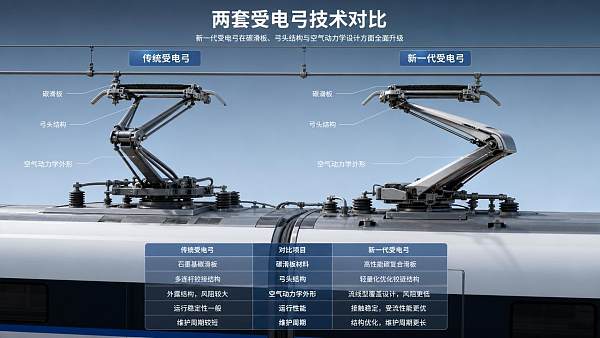
For networks targeting very high-speed operation, aerodynamic design becomes decisive. The pantograph frame, head profile, fairings if used, and roof integration all influence uplift and vibration. A system that looks efficient in isolation may behave differently once installed on a particular roof contour or near HVAC units and other rooftop equipment. Ask for installation-specific assessment, not generic platform-level assurance.
Maintenance life: where many selections are won or lost
Maintenance life is often reduced to carbon strip replacement intervals. That is too narrow. A practical life-cycle review should include strip wear, linkage wear, actuator reliability, spring or pneumatic performance drift, sensor durability where condition monitoring is fitted, and the amount of adjustment the system needs to stay inside tolerance.
In depot reality, the best pantograph is not always the one with the lightest head or the most advanced materials. It is often the one that remains inspectable, adjustable, and recoverable without specialist intervention every time a fault appears. Maintenance teams notice very quickly whether access is awkward, consumables are proprietary, or alignment procedures are overly sensitive.
This is where technical assessment should go beyond component durability and ask operational questions:
- What are the routine inspection tasks and intervals?
- Which wear parts are expected to be replaced most often?
- How much condition drift is acceptable before performance degrades?
- Can frontline maintenance crews diagnose common faults without extensive OEM support?
- Are spare parts and strip materials regionally available, or does the supply chain introduce risk?
A slightly more expensive design can be the safer choice if it avoids frequent tuning or unplanned service withdrawals. That trade-off becomes even more important in high-utilization fleets.
Compatibility is not a side issue
Many assessment problems do not come from the pantograph alone. They come from compatibility gaps: contact wire material, catenary tensioning strategy, stagger, registration accuracy, vehicle roof stiffness, and electrical system requirements. Cross-border or multi-standard operations complicate this further.
If the train will move across different infrastructure regimes, verify early whether the same pantograph configuration is suitable everywhere or whether different heads, strips, or force settings are required. Some projects discover too late that a design validated on one infrastructure family has marginal behavior on another. Fixing that after fleet delivery is rarely elegant.
This broader systems view is one reason transport intelligence platforms such as GTOT matter to evaluators. Pantographs sit alongside signalling, braking, and traction in the same operational chain. A rail program aimed at high-density automated service, for instance, may demand a different tolerance for power collection interruption than a less intensive corridor. Component selection should reflect that operating philosophy.
Common evaluation traps
A few mistakes come up again and again.
One is treating a successful reference project as proof of fit. References help, but they only matter if the infrastructure, speed profile, climate, and maintenance model are genuinely comparable.
Another is overvaluing headline innovation. Active control, lightweight composites, or advanced sensing can be attractive, but only if the added complexity is justified by measurable improvement and supportability. More sophistication is not automatically more robust.
There is also a tendency to separate procurement cost from maintenance burden. In service, those two are linked. If a lower-priced system consumes strips faster, requires tighter adjustment, or causes overhead line wear, the initial saving disappears quickly.
A practical decision framework
For a disciplined selection, build the review around four layers: operating envelope, measured dynamic performance, maintainability, and compatibility. If one of those layers is weak, the overall result is usually weak as well.
In practice, that means shortlisting only those rail pantograph systems that can show credible evidence in the speed band you need, then pressure-testing the shortlist against route-specific disturbances and depot realities. After that, verify integration assumptions with the overhead line and vehicle platform. It is less glamorous than comparing top-speed claims, but it is how expensive surprises are usually avoided.
If project documentation is incomplete, the honest answer is sometimes that no desktop evaluation is enough. Additional simulation, line testing, or infrastructure interface review may be necessary before a final decision. That caution is not indecision; it is usually a sign that the assessment is being done properly.
A good pantograph choice is one that stays quiet in service: stable contact, predictable wear, few interventions, no recurring surprises at speed. That is the benchmark worth buying against.
Recommended News
 Sep 27, 2026How to assess a high speed pantograph supplier in EuropeHigh speed pantograph supplier Europe: learn how to assess technical fit, validation, compliance, and lifecycle support for reliable rail operations.
 Aug 08, 2026How to Evaluate Rail Pantograph Systems for Speed, Contact Stability, and Maintenance LifeRail pantograph systems evaluation made practical: learn how to assess speed performance, contact stability, and maintenance life for safer selection, lower wear, and more reliable rail operations.
 Jul 11, 2026Pantographs for High-Speed Rail: How to Reduce Lifecycle Maintenance CostsPantographs for high-speed rail: learn how smarter design, stable current collection, and serviceable components can cut lifecycle maintenance costs and reduce downtime.
 Jun 30, 2026How to Evaluate High-Speed Rail Pantograph Head Wear and Contact StabilityHigh-speed rail pantograph head evaluation starts with wear patterns, contact stability, and route fit. Learn how to reduce arc risk, prevent failures, and improve replacement decisions.
 Jun 27, 2026How Pantograph Components Affect Current Collection and WearPantograph components directly influence current collection, contact stability, and wear. Learn how strip material, force control, damping, and frame design improve rail reliability and cut maintenance costs.
 Jun 23, 2026How Pantographs for High-Speed Rail Affect Uptime and Maintenance CostsPantographs for high-speed rail directly impact fleet uptime and maintenance costs. Learn how stable contact, smarter inspections, and better design reduce failures and downtime.
 Jun 22, 2026High-Speed Rail Technology: Key Performance Factors Before System SelectionHigh-speed rail technology selection starts with safety, traction, braking, interoperability, and lifecycle value. Discover the key factors that help buyers choose reliable, future-ready systems.
 Jun 13, 2026Pantographs Supplier for Railway Networks: 7 Factors to ComparePantographs supplier for railway networks: compare 7 critical factors including performance, wear life, certification, delivery, service, and total cost to choose a reliable partner.
 Jun 13, 2026How Pantographs for High-Speed Rail Affect Uptime and WearPantographs for high-speed rail directly shape uptime, wear, and lifecycle cost. Learn how contact stability, materials, and aerodynamics impact reliability and maintenance.
 Jun 11, 2026High-Speed Traction Systems: Performance Factors That Affect Rail EfficiencyHigh-speed traction systems drive rail efficiency through better power conversion, thermal control, precision software, and reliability. Learn which upgrades deliver measurable results.
![]() Jun 04, 2026Pantographs for High-Speed Rail: Key Wear Signs to TrackPantographs for high-speed rail: learn the key wear signs to track, from uneven strip wear to arc marks and vibration, to improve safety, uptime, and maintenance decisions.
Jun 04, 2026Pantographs for High-Speed Rail: Key Wear Signs to TrackPantographs for high-speed rail: learn the key wear signs to track, from uneven strip wear to arc marks and vibration, to improve safety, uptime, and maintenance decisions. May 25, 2026Pantographs for High-Speed Rail: Key Performance ChecksPantographs for high-speed rail: discover the key performance checks technical evaluators should review, from contact force and aerodynamics to wear, vibration, and life-cycle reliability.
 May 21, 2026Pantographs for Electric Locomotives: What Affects Contact StabilityPantographs for electric locomotives: discover what affects contact stability, from airflow and catenary dynamics to strip wear and suspension tuning for safer, more reliable rail performance.
 May 20, 2026Pantographs Supplier for Railway Networks: Key Checks Before ShortlistingPantographs supplier for railway networks: learn the key checks for technical fit, compliance, lifecycle support, and reliability before shortlisting the right partner.
 May 07, 2026How to Compare Pantographs for High-Speed Rail UpgradesPantographs comparison for high-speed rail upgrades: learn how to evaluate contact stability, aerodynamics, wear, and lifecycle cost to choose safer, smarter systems.