



What Vessel Connectivity Equipment Is Needed for Reliable Cargo Monitoring?
Reliable cargo monitoring depends on vessel connectivity equipment that can maintain secure, continuous data flow across harsh marine environments. For technical evaluators, the right architecture must integrate satellite communications, onboard IoT gateways, sensor networks, edge processing, and cybersecurity controls to provide real-time visibility into container condition, location, and operational risk.
This guide examines the essential connectivity components that support smarter, safer, and more efficient vessel operations, with emphasis on selection criteria, integration risks, and practical verification before deployment.
Start With the Monitoring Outcome, Not the Communications Product
The core search intent behind vessel connectivity equipment is usually practical: determine which onboard systems are necessary to obtain dependable cargo data throughout a voyage.
Technical evaluators need more than a list of satellite terminals or sensors. They need an architecture that preserves data quality when bandwidth is constrained.
A reliable solution must identify cargo condition, collect information locally, transmit essential alerts, retain missing records, and protect data from manipulation or unauthorized access.
The required equipment changes according to cargo type. Refrigerated containers, LNG-related supplies, high-value machinery, chemicals, and dry containers have different monitoring priorities.
For reefer cargo, temperature deviation, power availability, door status, compressor alarms, and set-point compliance are usually critical indicators throughout the sailing schedule.
For general containerized cargo, evaluators may prioritize location, shock events, humidity, tilt, door opening, seal integrity, and dwell time at transfer points.
The strongest overall judgment is straightforward: vessel connectivity equipment should be designed as a layered operational system, not purchased as isolated communications hardware.
Build the Connectivity Layer Around Multiple Communication Paths
Satellite communications are the primary external link for ocean-going vessels because terrestrial mobile networks cannot provide continuous coverage on deep-sea routes.
Modern vessels commonly use VSAT, L-band satellite services, low-earth-orbit satellite links, or a combination of these systems for operational resilience.
VSAT can support higher data volumes, crew welfare traffic, video-enabled maintenance, cloud synchronization, and regular cargo-monitoring data transfers on suitable routes.
L-band services generally provide lower throughput but remain valuable as a dependable fallback channel for alerts, position reports, and critical operational messages.
Low-earth-orbit connectivity can reduce latency and improve bandwidth availability, but evaluators should confirm route coverage, terminal approval, service maturity, and installation constraints.
A dual-path communications design is often justified when cargo condition data affects claims exposure, food safety, dangerous-goods compliance, or charter-party performance obligations.
Connectivity procurement should include service-level expectations for availability, latency, contention, data caps, prioritization rules, remote support, and restoration after terminal failure.
Equipment decisions should also account for antenna placement, blockage from cranes or superstructure, vibration, saltwater exposure, power backup, and electromagnetic compatibility.
Use an Onboard IoT Gateway as the Control Point
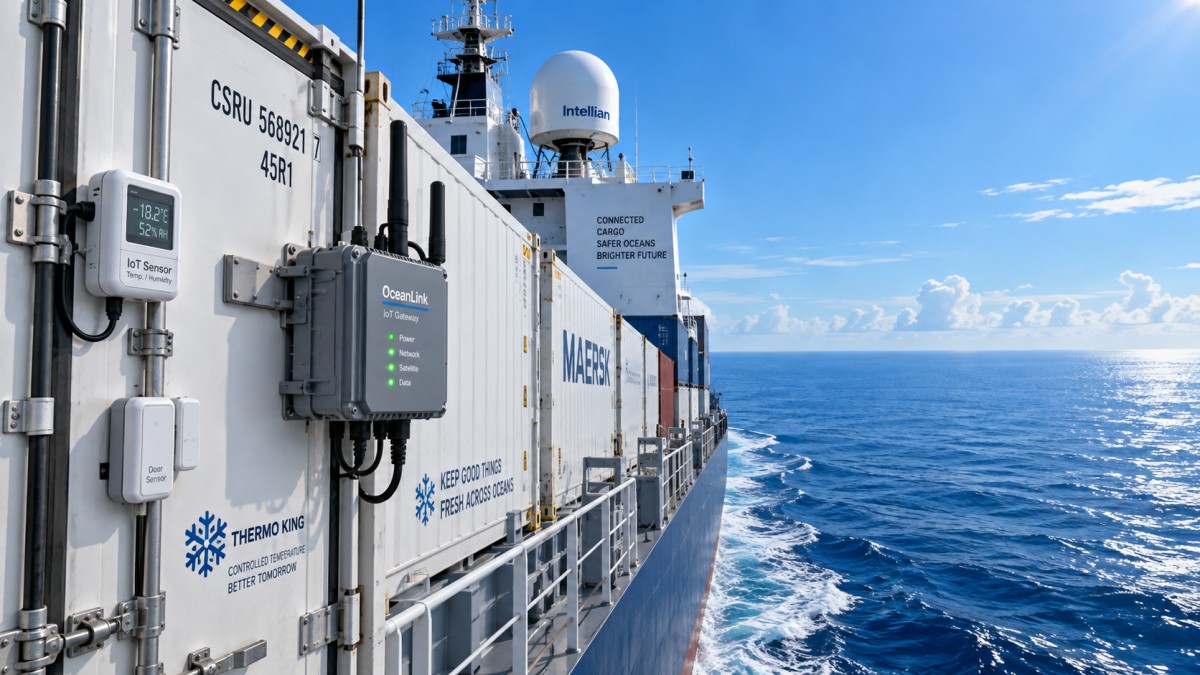
An onboard IoT gateway is the most important integration component in a cargo monitoring architecture because it connects field devices with shore-based applications.
The gateway collects sensor messages, validates device identities, applies communication rules, stores data locally, and forwards prioritized information through available vessel networks.
Without a capable gateway, every sensor may attempt direct cloud communication, creating excessive satellite traffic, inconsistent records, and avoidable dependency on remote connectivity.
Technical evaluators should verify support for common industrial and maritime protocols, including Modbus, CAN bus, NMEA, MQTT, OPC UA, Ethernet, Wi-Fi, Bluetooth, and serial interfaces.
The gateway should support protocol translation because cargo sensors, reefer monitoring equipment, vessel automation systems, and fleet platforms rarely use identical communication standards.
Local device management is equally important. Engineers need remote configuration, firmware updates, health reporting, certificate rotation, event logs, and controlled onboarding for replacement sensors.
For resilient deployment, select industrial hardware rated for marine conditions, with vibration tolerance, suitable ingress protection, wide temperature operation, and redundant power input where justified.
Gateway capacity should be assessed against the expected sensor count, polling frequency, message size, storage retention period, encryption overhead, and future fleet expansion plans.
Select Sensors Based on Cargo Risk and Measurement Reliability
Sensors generate the information that cargo monitoring systems depend on, so measurement integrity matters more than simply maximizing the number of connected devices.
Temperature sensors should have documented accuracy, calibration traceability, suitable response time, and placement guidance that reflects the cargo environment rather than convenient installation locations.
Humidity monitoring is especially relevant for moisture-sensitive goods, agricultural products, paper, electronics, steel products, and containers exposed to condensation or ventilation changes.
Door sensors and electronic seal systems can provide valuable evidence for cargo security, but they must distinguish authorized access, sensor faults, and genuine intrusion events.
Shock, vibration, tilt, and acceleration sensors are useful for project cargo, vehicles, precision equipment, and fragile industrial components where handling damage may be disputed.
GPS positioning is valuable, but onboard cargo tracking should not rely exclusively on individual tracker signals when containers are located below deck or surrounded by steel structures.
Technical teams should test radio propagation conditions in realistic stowage positions. Metal containers, deck structures, and cargo density can significantly reduce wireless reliability.
Battery life calculations must include transmission intervals, wake cycles, sensor sampling, local buffering, cold-weather performance, and the impact of repeated retries during communication outages.
Protect Data Continuity With Edge Processing and Local Storage
Continuous cargo visibility does not require continuous satellite transmission. It requires continuous data collection, reliable local retention, and intelligent delivery after connection interruptions.
Edge processing allows the vessel gateway to analyze readings onboard and transmit exceptions instead of sending every raw measurement through expensive satellite links.
For example, a reefer temperature event can trigger an immediate alert when it exceeds configured limits, while normal readings are bundled for scheduled transmission.
Local storage should retain enough encrypted records to cover extended satellite outages, port congestion, maintenance periods, and delayed synchronization with shore systems.
Evaluators should ask how the system handles duplicate messages, clock drift, incomplete uploads, failed acknowledgments, and data reconciliation after communications are restored.
Time synchronization is often overlooked. Accurate timestamps are essential when investigating cargo claims, comparing reefer alarms, reconstructing incidents, or proving contractual compliance.
Edge rules should be configurable by cargo class, customer requirements, voyage phase, and alarm severity, while changes remain logged for audit and incident analysis.
A well-designed architecture separates urgent operational alerts from bulk reporting, ensuring that critical condition changes are delivered even when available bandwidth is limited.
Integrate Cargo Monitoring With Vessel and Shore Operations
Vessel connectivity equipment creates greater value when cargo information is connected with shipboard operational data and shore-side decision workflows rather than displayed in isolation.
Useful integration points include the vessel management system, reefer monitoring platform, electronic chart and voyage data, maintenance software, terminal systems, and fleet operations centers.
For container ships, cargo condition alerts should be correlated with stowage location, power supply status, weather exposure, port calls, and planned loading operations.
This context helps teams distinguish a sensor anomaly from a genuine cargo risk requiring crew intervention, terminal coordination, customer notification, or insurance escalation.
APIs are important for avoiding manual data exports. Technical evaluators should confirm available interfaces, authentication methods, rate limits, data ownership terms, and export formats.
The shore platform should support role-based dashboards because vessel engineers, fleet managers, cargo operators, claims teams, and customers require different views of the same data.
Alarm workflows need clear ownership. An alert without acknowledgement rules, escalation timing, and documented corrective actions creates visibility without operational control.
Before deployment, define which events trigger crew action, which are handled ashore, which require customer notice, and which remain available only for historical analysis.
Make Cybersecurity and Network Segmentation Mandatory
Every connected sensor and gateway expands the vessel's digital attack surface. Cybersecurity therefore belongs in the equipment specification, not as a later software consideration.
Cargo monitoring systems should be segmented from safety-critical navigation, propulsion, and control networks using defined network zones, firewalls, access controls, and monitored interfaces.
The gateway should support encrypted communications, mutual authentication, secure boot, signed firmware, protected credential storage, vulnerability management, and auditable administrative access.
Remote access should use named accounts, multi-factor authentication where practical, time-limited permissions, and logs that record configuration changes, software updates, and user activity.
Technical evaluators should request a software bill of materials, patch policy, vulnerability disclosure process, device support lifecycle, and incident-response commitments from suppliers.
Cybersecurity reviews should also address third-party cloud services. Clarify where cargo data is hosted, how backups are protected, and how records can be recovered after an outage.
For regulated cargo or sensitive commercial movements, data classification policies should determine which information is transmitted, retained, shared externally, or restricted to named users.
A secure design reduces the risk that connectivity equipment becomes a route into broader vessel systems or exposes commercially sensitive cargo and voyage information.
Evaluate Reliability Through Marine-Specific Acceptance Testing
Product brochures rarely prove whether vessel connectivity equipment will remain dependable during actual voyages. Technical evaluation should include measurable acceptance criteria and representative testing.
Start with an onboard site survey covering antenna visibility, cable routes, radio interference, available power, network topology, equipment room conditions, and sensor installation locations.
Test communications during realistic operating conditions, including sea-state vibration, blocked satellite angles, power transitions, port handovers, low-bandwidth periods, and delayed cloud access.
Validate end-to-end performance from sensor measurement to shore dashboard, including alert timing, local storage, retransmission, timestamp accuracy, and alarm acknowledgement workflows.
Failure testing is particularly valuable. Disconnect the satellite link, restart the gateway, remove sensor power, simulate invalid readings, and confirm that the system recovers predictably.
Acceptance criteria should specify data-loss tolerance, alert-delivery deadlines, sensor accuracy, retention duration, uptime targets, recovery times, and support response commitments.
Class requirements, flag-state obligations, dangerous-goods regulations, customer contracts, and cyber risk frameworks may influence the minimum evidence needed for approval.
Documentation should include network diagrams, device inventories, calibration records, configuration baselines, maintenance instructions, spare-parts plans, and named responsibility for lifecycle support.
Choose an Architecture That Can Scale With Fleet Requirements
The best vessel connectivity equipment is not necessarily the system with the highest bandwidth. It is the system that delivers trusted cargo information at an acceptable lifecycle cost.
Technical evaluators should compare total cost of ownership, including terminal installation, antenna maintenance, satellite subscriptions, sensor replacement, cloud fees, cybersecurity updates, and support contracts.
A modular architecture allows operators to begin with priority cargo lanes or reefer fleets, then expand to additional sensor types, vessels, customers, and analytical applications.
Standardized interfaces reduce supplier lock-in and simplify fleet-wide deployment. Proprietary systems may still be appropriate, but their export, integration, and support limitations require scrutiny.
Consider future requirements such as electronic bills of lading, predictive maintenance, digital twins, remote inspection support, emissions reporting, and port community data exchange.
For smart container ships, cargo monitoring should be treated as a strategic operational capability that improves exception handling, asset utilization, customer confidence, and claims defensibility.
The final selection should be based on evidence: proven marine hardware, realistic connectivity assumptions, clear integration ownership, secure lifecycle management, and demonstrated recovery from failures.
Reliable cargo monitoring begins with connected sensors, but it succeeds only when satellite links, edge intelligence, onboard gateways, cybersecurity, and shore workflows operate as one managed system.