



Search News
Industry Portal
Popular Tags
How Composite Brake Pads Affect Heat Fade and Wear
Author
Time
Click Count
Why heat fade has become a sharper issue in modern braking

In rail and heavy transport, braking loads are rising faster than many legacy material assumptions.
Higher operating speeds, denser service cycles, and tighter stopping windows have made thermal stability a frontline evaluation issue.
That is why composite brake pads now receive more attention than simple friction comparisons once allowed.
The real question is not whether composite brake pads can stop a vehicle.
The real question is how they behave after repeated heat build-up, cooling, abrasion, and pressure cycling.
Across GTOT’s land-sea equipment lens, this matters because thermal reliability now influences safety cases, maintenance planning, and asset availability together.
For braking systems, heat fade and wear are no longer separate topics.
They increasingly interact, especially in rail transit, freight corridors, and demanding industrial transport profiles.
What composite brake pads are changing in the performance picture
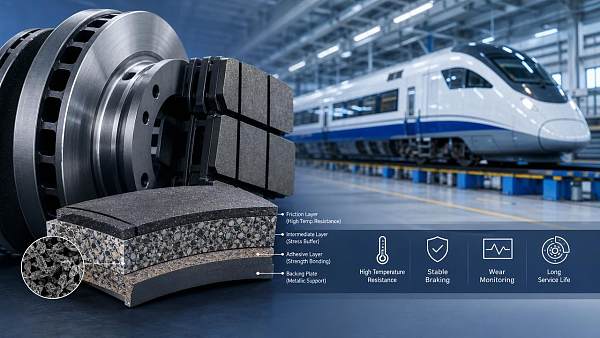
Composite brake pads are engineered blends of fibers, fillers, binders, friction modifiers, and reinforcing phases.
That composition gives designers more control over friction level, noise behavior, wear rate, and thermal response.
This is a notable shift from older material choices with narrower tuning windows.
More recent demand is also less forgiving.
Braking materials must now support predictable stopping under automation, digital monitoring, and stricter lifecycle accountability.
Composite brake pads can help meet that need, but only when the formulation matches the duty profile.
A pad optimized for low noise may not resist high thermal fade.
A pad built for aggressive friction may accelerate wheel or disc wear if contact films destabilize.
So the evaluation focus has moved from material category to behavior under stress history.
The fade mechanism is more about thermal chemistry than simple overheating
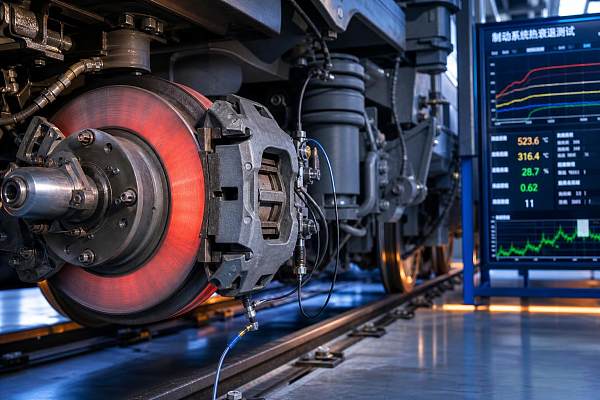
Heat fade happens when friction performance drops as interface temperature rises.
In composite brake pads, this often starts with changes inside the friction layer itself.
Binders can soften or decompose.
Friction modifiers may lose effectiveness.
Transfer films can become unstable, uneven, or glazed.
Once that happens, the contact surface stops behaving consistently across the braking event.
A useful way to view this is through three coupled changes:
- Mechanical change, where pad stiffness and surface conformity shift under heat.
- Chemical change, where resin systems and additives react or degrade.
- Interfacial change, where the friction film no longer forms evenly.
These mechanisms explain why two pads with similar room-temperature friction can behave very differently during repeated emergency stops.
More importantly, fade recovery also varies.
Some composite brake pads regain friction quickly after cooling.
Others show cumulative damage, making each later stop less predictable.
Wear behavior is shifting from a cost metric to a system stability metric
Wear used to be discussed mainly through replacement intervals.
That view is now too narrow for high-duty braking systems.
Wear changes the pad geometry, the contact pressure map, and the heat distribution pattern.
Those changes directly feed back into fade risk.
Composite brake pads can produce controlled wear when the material sheds evenly and maintains a stable friction layer.
Problems emerge when wear becomes localized.
Hot spots, edge loading, cracking, and glazing can follow.
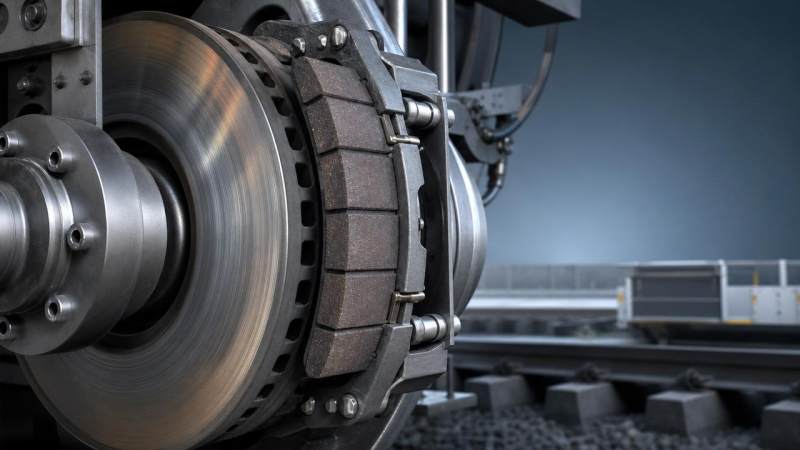
In rail transit braking systems, that means more than pad consumption.
It can alter stopping consistency, increase wheel damage exposure, and complicate predictive maintenance models.
From recent field expectations, the preferred composite brake pads are not simply low-wear materials.
They are materials with stable, interpretable wear patterns.
What often drives wear acceleration
Why application context now matters more than lab averages
One clear industry signal is that average friction coefficients alone no longer support confident selection.
Composite brake pads behave differently in metro cycles, heavy-haul freight, high-speed rail, and port-linked transport systems.
The same nominal pad can look acceptable in a bench sequence and still underperform in route-specific thermal patterns.
This is where GTOT’s cross-sector perspective becomes useful.
Land and sea systems increasingly share the same operating pressure.
Higher throughput, reduced downtime tolerance, and stricter energy discipline all push materials toward tighter reliability margins.
In practice, composite brake pads should be judged against duty-specific questions:
- How quickly does friction decline above critical interface temperatures?
- How repeatable is recovery after short cooling intervals?
- Does wear remain uniform across the pad face and service life?
- What happens to the mating surface after extended operation?
- Can the material support digital maintenance thresholds with stable degradation patterns?
Those questions usually reveal more than a single catalogue specification.
The biggest impact is showing up in evaluation logic
More organizations are moving from part-level judgment to system-level judgment.
That changes how composite brake pads should be assessed.
A pad with slightly higher unit cost may reduce thermal fade events, wheel maintenance, and unplanned service interruptions.
In lifecycle terms, that can be the lower-risk choice.
This broader logic is now common in sectors where safety and uptime are tightly coupled.
Railway control systems already operate under SIL4 thinking.
Braking materials are increasingly evaluated with a similar mindset: predictable behavior matters more than peak claims.
That also explains why composite brake pads are being reviewed alongside sensor data, brake control tuning, and route severity mapping.
The material is no longer treated as an isolated consumable.
It is part of a monitored performance chain.
What deserves closer attention during technical review
A stronger review process should focus on evidence that reflects real thermal and wear behavior.
The most useful checkpoints are usually these:
- Fade onset temperature and friction retention during repeated braking sequences.
- Recovery performance after partial cooling, not only full reset conditions.
- Wear uniformity, debris character, and pad surface integrity.
- Compatibility with wheel or disc metallurgy and surface finish.
- Data correlation between bench testing and in-service route behavior.
- Sensitivity to humidity, contamination, and seasonal operating changes.
More advanced evaluations also compare material performance across both fresh and end-of-life pad conditions.
That is increasingly important because some composite brake pads look stable early, then degrade rapidly near wear limits.
Where the next decisions are likely to move
The direction is becoming clearer.
Composite brake pads will be judged less by generic friction claims and more by transparent thermal behavior over time.
Materials that support stable digital diagnostics will gain preference.
So will formulations that balance low fade, controlled wear, and counterface protection together.
There is also a broader industrial backdrop.
As transport infrastructure modernizes and supply chains demand more uptime, hidden material instability becomes harder to absorb operationally.
That makes composite brake pads a strategic materials topic, not just a maintenance line item.
A practical next step is to map braking duty cycles against thermal fade evidence, wear pattern data, and mating-surface outcomes.
Then compare composite brake pads on system behavior, not isolated specification sheets.
That approach usually produces clearer decisions, lower lifecycle uncertainty, and safer long-run performance.
Recommended News
 Jun 18, 2026Thermal Fade Performance: When Brake Stability Starts to DropThermal fade performance reveals when brake stability begins to decline under repeated heat loads. Learn the warning signs, evaluation points, and smarter rail braking decisions.
 Jun 05, 2026How Composite Brake Pads Affect Heat Fade and WearComposite brake pads affect more than stopping power—learn how they influence heat fade, wear stability, lifecycle cost, and safer braking performance in demanding rail and heavy transport.
 Jun 05, 2026Composite Brake Pads: Cost vs Service Life in Rail FleetsComposite brake pads in rail fleets are not just about price. Learn how service life, friction stability, wheel wear, and route conditions shape the best-value choice.
 Jun 01, 2026Composite Brake Pads: Key Wear and Noise ChecksComposite brake pads require precise wear and noise checks. Learn how QC and safety teams spot risks early, reduce downtime, and improve rail braking reliability.
 May 29, 2026Composite Brake Pads: Wear, Noise, and SafetyComposite brake pads affect rail safety, wear control, and noise performance. Learn key inspection points and scenario-based maintenance tips.
 May 22, 2026Composite Brake Pads: Key Checks Before SelectionComposite brake pads selection starts with friction stability, fade resistance, compliance, and lifecycle cost. Discover the key checks to choose safer, longer-lasting rail braking solutions.
 May 16, 2026Composite Brake Pads: Wear, Noise, and Lifecycle Cost ComparedComposite brake pads compared for wear, noise, thermal stability, and lifecycle cost across rail applications. See how to reduce downtime, improve reliability, and choose the right fit.