



Search News
Industry Portal
Popular Tags
How shipboard cryogenic systems prevent LNG boil-off gas losses
Author
Time
Click Count
How Shipboard Cryogenic Systems Prevent LNG Boil-Off Gas Losses
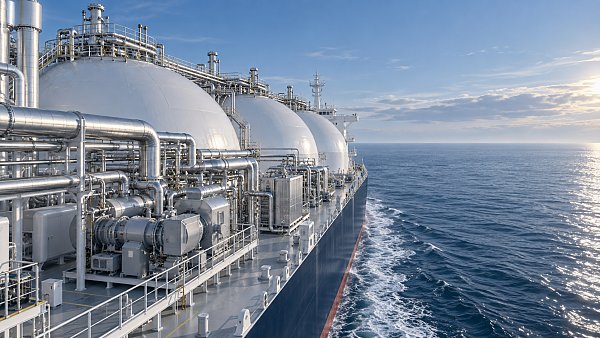
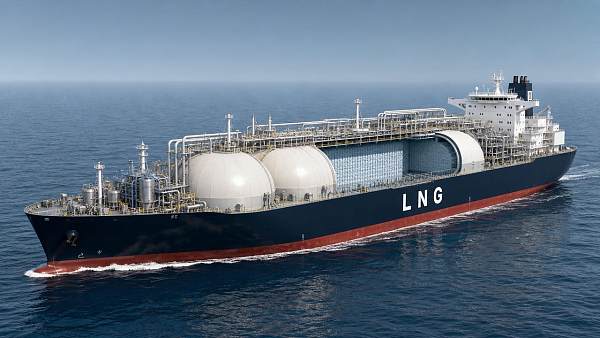
LNG cargo is carried at roughly minus 163°C, close to its atmospheric-pressure boiling point. That fact shapes nearly every design decision on an LNG carrier. Heat entering the cargo containment system cannot simply be ignored: it vaporizes a portion of the liquid cargo into boil-off gas (BOG), raises tank pressure, and creates a continuous operational question for the vessel—how should that vapor be used, recovered, stored, or safely disposed of?
For a technical evaluator, the relevant issue is not whether a vessel produces boil-off gas. All conventional LNG carriers do. The real question is whether the shipboard cryogenic systems control BOG predictably across laden voyages, ballast passages, slow steaming, port stays, partial loading conditions, and abnormal equipment states. A low headline boil-off rate is useful, but it is not a complete assessment of cargo retention or operational resilience.
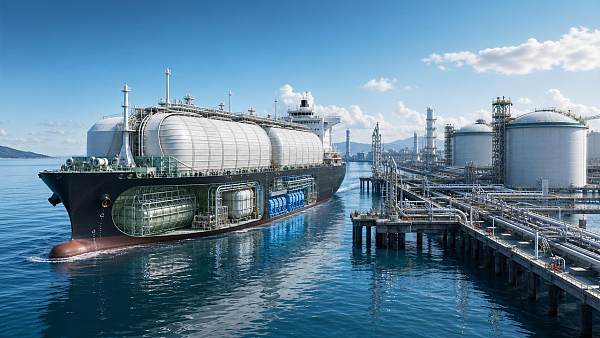
Modern LNG carriers treat BOG as both a cargo-management issue and an energy stream. Insulation limits its formation. Containment design manages the thermal and mechanical environment. Compressors, recondenser arrangements, reliquefaction plants, gas combustion units, and dual-fuel machinery determine what happens after vapor is generated. These systems need to be evaluated as one operating chain rather than as separate equipment packages.
Boil-Off Begins with Heat Leakage, but It Does Not End There
Even a well-insulated cargo tank receives heat from the surrounding hull structure, ambient air, seawater, piping penetrations, tank supports, and equipment interfaces. The rate is affected by vessel age, insulation condition, cargo level, weather exposure, loading temperature, and voyage duration. In practice, thermal performance is rarely as simple as a design calculation on a drawing.
A membrane tank and an independent tank may manage insulation, thermal contraction, and structural loads differently, but both depend on a carefully controlled barrier system. In membrane containment systems, the integrity of insulation panels, secondary barriers, corner details, and penetrations deserves close attention because small local defects can become disproportionately significant over a vessel’s operating life. For independent tank designs, support arrangements, insulation continuity, and interfaces between tank and hull structure are equally relevant.
Evaluators should be cautious when comparing nominal daily boil-off figures across ships without checking the reference conditions. The stated value may be tied to a defined cargo condition, ambient temperature assumption, voyage profile, or tank-pressure range. A number is only meaningful when the assumptions behind it are visible. More importantly, the vessel must maintain acceptable pressure behavior when the operating profile departs from those assumptions.
Thermal ingress also interacts with LNG composition. Cargoes do not all behave identically. Differences in nitrogen content and hydrocarbon composition can influence vapor behavior and the management of tank pressure. This is one reason cargo-system controls cannot be assessed only from insulation specifications. The control philosophy must accommodate realistic variation in cargo and voyage conditions.
Containment and Insulation: The First Line of Cargo Retention
The most efficient BOG is the gas that never has to be handled. High-performance insulation reduces the thermal load entering the cargo space, but shipboard cryogenic systems are exposed to forces that static onshore storage tanks do not experience: hull flexing, vibration, sloshing, wave-induced acceleration, and repeated cooldown and warm-up cycles.
That is why insulation should not be treated as passive material alone. It is part of a shipboard structural-thermal system. Technical reviews should examine how insulation performance is protected by installation quality, moisture control, barrier integrity, inspection access, and repair methods. A system that is efficient on paper but difficult to inspect or restore after localized damage can produce unfavorable lifecycle risk.
Tank pressure is another practical indicator. Cargo containment systems are designed to operate within specified pressure limits, while BOG handling equipment keeps the pressure within the intended operating band. A ship with tight pressure control has more flexibility during changing engine loads and port delays. A ship that approaches pressure limits quickly may be forced into less efficient operating decisions, including increased gas consumption or use of a gas combustion unit when other options are unavailable.
What Happens to BOG After It Is Generated
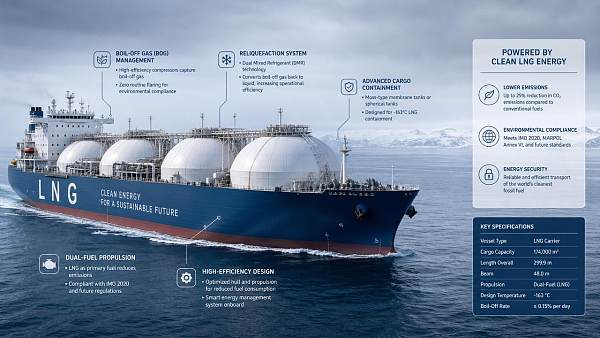
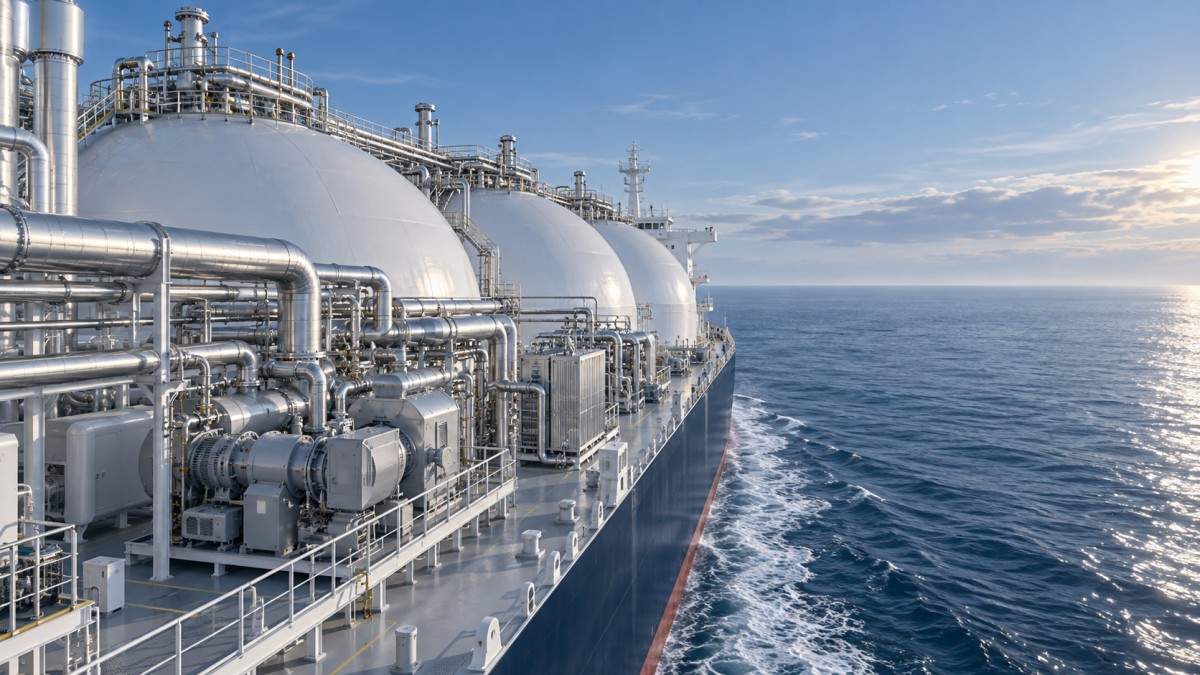
Once BOG enters the vapor-handling system, the vessel’s cargo-management philosophy becomes visible. Traditional steam-turbine LNG carriers commonly used boil-off gas as a primary fuel source. Modern vessels may use low-pressure or high-pressure dual-fuel engines, while some designs include onboard reliquefaction capability. Each approach can limit cargo losses, but each has different technical constraints.
Using BOG as fuel can be attractive because it converts an unavoidable vapor stream into propulsion energy. Yet the match between available BOG and engine fuel demand is not always perfect. At higher loads, the vessel may need supplementary fuel. At low loads, in port, or during slow steaming, gas generation may exceed what the propulsion plant can consume. The system therefore requires compression, conditioning, pressure control, and a credible excess-gas route.
Reliquefaction systems take a different path. They cool and return vapor to liquid cargo, helping preserve delivered LNG volume and providing operational flexibility where fuel demand is low. The trade-off is complexity. Reliquefaction introduces additional rotating equipment, refrigerant or process loops depending on the design, electrical demand, control integration, maintenance requirements, and potential downtime exposure. It should not automatically be considered superior simply because it returns gas to the tanks. The correct choice depends on charter profile, expected port time, propulsion arrangement, energy pricing assumptions, and owner maintenance capability.
A gas combustion unit (GCU) is normally retained as a controlled safety and operational outlet for surplus vapor. It is not a preferred routine method of cargo management where more efficient options are available, but it is essential when tank pressure must be controlled during upset conditions, machinery limitations, or prolonged low-demand periods. In evaluation, the question is not merely whether a GCU is installed. It is whether its capacity, control response, safety interlocks, and integration with cargo-tank pressure management are appropriate for the vessel’s realistic operating envelope.
Dual-Fuel Propulsion Changes the BOG Balance
Dual-fuel propulsion has made LNG carriers more flexible, but it has also made BOG management more dependent on automation and control discipline. Engines require gas at defined pressure, temperature, and quality conditions. The fuel gas supply system must therefore coordinate vapor withdrawal, compression or pumping arrangements, heating where required, pressure regulation, safety shutdown logic, and combustion demand.
The most important technical distinction is often between a system designed around expected average demand and one that remains stable under transitions. Engine load changes, changeover between fuel modes, compressor trips, port maneuvering, and reduced-speed operation can all create short-term imbalances. A good control strategy anticipates these shifts rather than reacting after cargo pressure has already risen.
Technical evaluators should ask for operating narratives, not only process flow diagrams. How does the system behave if a main BOG compressor becomes unavailable? What happens when engines reduce load rapidly? Is there enough vapor-handling redundancy to avoid avoidable GCU use? Can the plant maintain safe tank pressure during a temporary propulsion blackout? These are the questions that expose whether an integration concept is operationally mature.
Key Evaluation Criteria Beyond a Design Boil-Off Rate
A disciplined review of shipboard cryogenic systems should connect thermal design, machinery performance, and operating procedures. The following checks are more revealing than a single efficiency claim:
- Containment condition monitoring: Verify how temperatures, pressures, insulation spaces, barrier conditions, and tank-related alarms are monitored and trended over time.
- BOG handling capacity: Review compressor duty, redundancy philosophy, turndown capability, and the response to one-equipment-out conditions.
- Reliquefaction availability: Assess realistic operating availability, electrical demand, maintenance access, and the operational consequence of a plant outage.
- Fuel gas integration: Confirm compatibility between BOG supply characteristics and the selected dual-fuel engine or propulsion configuration.
- Pressure-control logic: Examine set points, alarm hierarchy, automatic sequencing, GCU activation philosophy, and manual intervention requirements.
- Lifecycle serviceability: Consider spare parts, specialist support, crew competence requirements, diagnostic tools, and access for maintenance at sea or during drydock.
International requirements for gas carriers are typically considered alongside the IMO International Gas Carrier Code, flag-state requirements, class rules, terminal interfaces, and company operating procedures. However, compliance alone does not establish that a BOG-management system is well matched to a particular trade. A vessel may meet the applicable requirements while still carrying avoidable operational inefficiency if its machinery selection or control philosophy does not suit its intended deployment.
The Often-Missed Risks: Partial Loads, Waiting Time, and Human Interfaces
The challenging periods are often not the headline ocean passage. A long terminal wait, partial cargo condition, changing ambient weather, or unplanned propulsion restriction can be more demanding for cargo pressure control than a stable full-speed voyage. Partial loading may alter heat-transfer behavior and sloshing exposure. Extended waiting periods reduce propulsion fuel demand while vapor generation continues. In those conditions, the interaction between reliquefaction capacity, tank-pressure margin, and GCU readiness becomes critical.
Crew workload also matters. Cryogenic cargo operations involve safeguards and automation, but operators still need to understand the system’s priorities during deviations. A confusing interface, poorly rationalized alarm set, or operating manual that does not reflect actual control behavior can turn a manageable event into unnecessary cargo consumption. Commissioning records, simulator training scope, alarm philosophy, and maintenance documentation should be part of a serious assessment.
From GTOT’s broader view of advanced ocean-going vessels, LNG cargo handling belongs in the same decision category as propulsion control, smart-vessel data architecture, and structural condition monitoring: it is an interface problem. The best results come when tank behavior, machinery health data, route planning, weather exposure, and fuel demand are interpreted together rather than by separate onboard systems with limited communication.
A Better Way to Judge Cargo-Retention Performance
When assessing an LNG carrier, start with the complete thermal and operational balance. How much heat is expected to enter the containment system? How will the resulting vapor be handled at normal sea speed, during slow steaming, at berth, and after a key equipment failure? What is the preferred use of BOG, and what is the fallback route? The answers should be consistent across design documentation, automation narratives, machinery capacities, and operating procedures.
A robust shipboard cryogenic system does not promise that no LNG will vaporize. It ensures that vaporization remains controlled, measurable, and economically manageable without compromising tank pressure, propulsion reliability, or safety margins. For technical evaluators, that is the practical definition of preventing boil-off gas losses: not eliminating physics, but designing the vessel so that the cargo, containment system, and energy plant remain in balance throughout the voyage.
Recommended News
 Sep 18, 2026How shipboard cryogenic systems prevent LNG boil-off gas lossesShipboard cryogenic systems reduce LNG boil-off gas losses through insulation, pressure control, fuel integration, reliquefaction, and reliable BOG handling.
 Jun 11, 2026LNG Carriers Technology Advancements: What Improves Cost and Boil-Off ControlLNG carriers technology advancements now drive cargo retention, fuel efficiency, and boil-off control. Explore how smarter containment, propulsion, and digital monitoring improve vessel economics.
 May 27, 2026LNG Carriers Technology Advancements That Improve Boil-Off ControlLNG carriers technology advancements improve boil-off control through better insulation, reliquefaction, and smart propulsion integration—learn which solutions boost efficiency and vessel value.
 May 19, 2026LNG Carriers Technology Advancements Improving Boil-Off Gas ControlLNG carriers technology advancements improve boil-off gas control with smarter containment, reliquefaction, and digital monitoring—boosting cargo efficiency, safety, and fleet performance.
 May 07, 2026When LNG Carriers Need Reliquefaction UpgradesLNG carriers need reliquefaction upgrades when boil-off losses, fuel inefficiency, and charter pressure cut value. Learn the key technical and commercial signs to assess retrofit ROI.