



Search News
Industry Portal
Popular Tags
How thermal fade performance disc brakes hold up in repeated high-load stops
Author
Time
Click Count
For technical evaluators, the real question is not whether a disc brake can produce high stopping force once. Almost any properly sized system can do that on paper. The harder question is how thermal fade performance disc brakes behave when the stop cycle repeats, axle loads stay high, and there is not enough cooling time between events. That is where design margins become visible.
In rail transit, heavy rolling stock, and other high-inertia applications, repeated high-load braking is less about peak friction and more about friction stability under heat. A brake that feels strong in the first stop but loses consistency by the fourth or fifth stop is not just underperforming. It changes stopping distance predictability, pad wear behavior, rotor stress, and the logic envelope for electronic brake control.
This is one reason the topic keeps appearing in advanced transport analysis. Platforms such as GTOT, which track the intersection of rail braking systems, traction control, and broader land-sea heavy equipment intelligence, often look at thermal fade not as an isolated component issue but as part of a larger operating system. That framing matters, because fade rarely comes from one part alone.
What thermal fade really means in repeated stopping cycles
Thermal fade is the loss or instability of braking effectiveness as temperature rises in the friction interface and surrounding hardware. In practical terms, the pad and disc heat up, the friction coefficient may drop or become erratic, and the system needs more pressure or more time to achieve the same deceleration. The effect can be gradual, or it can show up as a sudden loss of confidence after several heavy stops.
That sounds straightforward, but evaluators usually need to separate several overlapping mechanisms:
- Friction material fade, where pad chemistry changes with temperature and the effective coefficient falls.
- Disc surface effects, including hot spotting, glazing, oxidation, or transfer layer instability.
- Hydraulic or actuation-side thermal sensitivity, where response consistency changes even if the friction couple itself remains acceptable.
- Structural distortion, where thermal gradients alter contact pressure distribution across the pad face.
In repeated high-load stops, these mechanisms do not arrive one by one. They stack. A system may begin with mild friction loss, then develop uneven pad contact as the disc temperature field becomes less uniform, and finally enter a regime where recovery between stops is incomplete. Once that happens, each new stop starts from a worse thermal baseline.
Why repeated high-load stops are so punishing
A single emergency stop converts kinetic energy into heat in a very short time. Repeated high-load stops add two complications. First, heat input can exceed the disc’s ability to reject heat to air, wheel, hub, and adjacent structure. Second, the temperature distribution is rarely uniform. The outer radius, inner radius, leading edge, and trailing edge of the pad may all see different thermal histories.
In heavy rail and metro braking evaluation, this becomes especially relevant where service braking, gradient control, low adhesion correction, and emergency reserve functions all coexist. A brake may spend long periods operating moderately, then suddenly face clustered high-energy stops in dense traffic, downhill sections, or degraded regenerative braking conditions. If the disc brake is carrying more of the energy than originally assumed in nominal duty calculations, fade exposure goes up quickly.
This is also why bench results should always be read alongside duty-cycle assumptions. A good fade curve in a controlled test does not automatically guarantee the same behavior in a vehicle with different mass distribution, airflow, wheel enclosure geometry, or control strategy.
What evaluators should look at beyond headline stopping power
When reviewing thermal fade performance disc brakes, the most useful question is often: what stays stable as temperature rises? Not just what peaks.
Three indicators tend to be more informative than a single stopping-distance figure.
Friction coefficient stability across temperature bands
A pad material that delivers strong cold friction but falls sharply at elevated temperature may still look attractive in a short test. In repeated-service reality, a flatter and more predictable friction-temperature curve is usually more valuable than a higher initial number. Technical teams should ask for temperature-dependent friction behavior, not just nominal friction classification.
Recovery behavior after cooling intervals
Some systems fade under load but recover cleanly after a defined cooling period. Others do not fully return to baseline because the pad surface has glazed, the transfer film has changed, or the disc has developed local thermal damage. This recovery pattern matters for route profiles with stop clusters followed by open running.
Spread, not only average performance
Average deceleration can hide unstable brake feel. Evaluators should care about variation from stop to stop, axle to axle, and side to side. Thermal fade is not only a reduction problem; it is a consistency problem. For electronically managed systems, inconsistent torque generation can complicate control tuning and wheel-slide protection performance.
Material choice: where many fade debates actually begin
A lot of procurement discussions reduce fade to “better disc” or “better pad,” but the interaction matters more than either part in isolation. Composite friction materials can be tuned for wear, noise, dust, friction level, or high-temperature stability, and those objectives do not always align. A formulation optimized for one duty can disappoint in another.
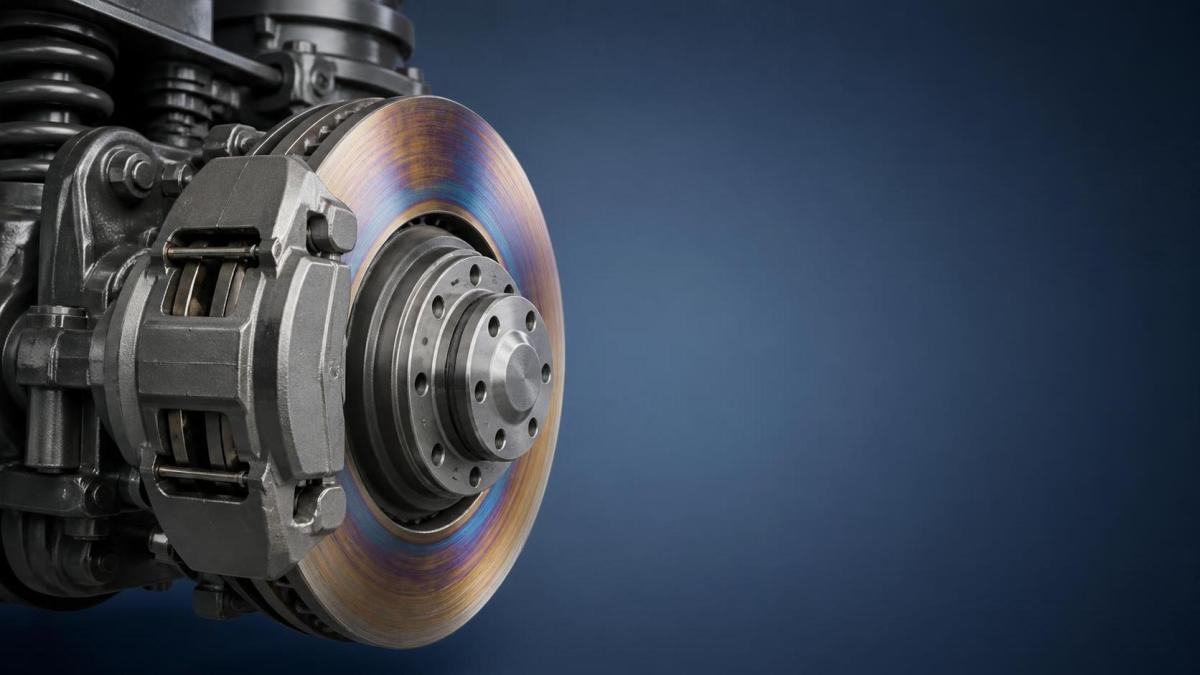
The same goes for disc material and geometry. Ventilation path, thermal mass, surface hardness, and crack resistance all influence how the system tolerates repeated energy input. Higher thermal mass may delay temperature rise, but if cooling is poor, that benefit can flatten out over repeated cycles. More aggressive ventilation may improve cooling but can introduce structural trade-offs or packaging constraints.
GTOT’s coverage of composite brake pad thermal fade has pointed attention to this exact issue in rail applications: friction material is never just a consumable line item. It is part of a thermal system linked to traction strategy, braking allocation, route conditions, and maintenance practice.
Common evaluation mistakes in technical reviews
One recurring mistake is to accept a supplier’s fade statement without checking the test boundary conditions. Was the test based on repeated decelerations from the same speed? What was the initial disc temperature for each cycle? Was cooling forced or natural? Was the pad new, bedded, or partially worn? Without that context, “good fade resistance” says very little.
Another mistake is treating wear and fade as separate decisions. In service, a material with low wear but unstable high-temperature friction can create more operational risk than a somewhat faster-wearing but thermally consistent alternative. Maintenance teams often discover this the hard way when replacement intervals look acceptable yet brake feel deteriorates under demanding duty.
There is also a control-system blind spot. Modern rail braking is blended. Regenerative braking may handle a substantial share of energy under normal conditions, but evaluators should always ask what happens when regen availability drops, adhesion changes, or onboard logic shifts more load to friction braking. That fallback state can be the real fade test, not the nominal one.
How standards and test protocols should be read
There is no single universal fade number that settles the question across all sectors. Rail, commercial vehicle, and industrial braking environments use different test philosophies, performance thresholds, and acceptance logic. So the right approach is not to search for one magic metric. It is to verify whether the protocol matches the actual duty profile closely enough.
In practice, technical evaluators should confirm:
- Whether test cycles reflect service, emergency, or mixed braking conditions.
- Whether repeated stops are sequenced tightly enough to produce realistic heat accumulation.
- Whether acceptance is based on average output or minimum retained performance.
- Whether post-test inspection includes cracking, pad surface condition, and thermal distortion checks.
This sounds procedural, but it often decides whether a paper-compliant brake will actually behave acceptably on a high-duty route or heavy-load service pattern.
A practical comparison framework
What holds up well, and what usually does not
In broad terms, disc brake systems hold up well in repeated high-load stops when three things are aligned: the friction pair is thermally stable, the disc can absorb and reject heat without severe local gradients, and the brake control strategy does not push the friction system beyond its assumed energy share too often.
They tend to struggle when selection is driven by nominal friction alone, when route or duty assumptions are optimistic, or when cooling and enclosure effects are underestimated. The weak point is often not a dramatic total brake failure. It is a narrowing safety margin: longer or less repeatable stops, more aggressive wear, more inspection findings, and more sensitivity during abnormal operating conditions.
That distinction matters in technical evaluation. A system can remain formally functional and still be operationally uncomfortable.
If you are comparing options, ask for the thermal story, not just the catalog story: repeated-stop test logic, retained performance at heat, recovery behavior, and inspection outcomes after the duty cycle. For high-speed rail, metro fleets, and other heavy transport systems where braking sits inside a tightly controlled safety architecture, that is usually where the meaningful differences appear.
Recommended News
 Aug 25, 2026How thermal fade performance disc brakes hold up in repeated high-load stopsThermal fade performance disc brakes in repeated high-load stops: learn what affects heat stability, recovery, and braking consistency for safer, smarter system evaluation.
 Jul 16, 2026How to Evaluate Foundation Brakes for Rail Vehicles by Safety, Wear, and Lifecycle CostFoundation brakes for rail vehicles: learn how to compare safety, wear patterns, and lifecycle cost to choose brake systems that improve reliability, availability, and long-term value.
 Jul 11, 2026Rail Brake Linings: Common Wear Issues and How to Prevent Early FailureRail brake linings wear issues often start with heat, misalignment, or contamination. Learn the warning signs, root causes, and practical steps to prevent early failure.
 Jul 10, 2026How to Evaluate a Rail Brake Components Manufacturer for Lifecycle CostRail brake components manufacturer selection should focus on lifecycle cost, safety compliance, reliability data, and support. Learn how to compare suppliers for lower risk and better fleet uptime.
 May 16, 2026Absolute Safety Benchmarks for Modern Rail Brake System ReviewsAbsolute safety defines every modern rail brake system review. Explore benchmarks for braking force, fail-safe design, thermal stability, and diagnostics to assess real-world reliability.