



Search News
Industry Portal
Popular Tags
What Drives LNG Carrier Costs in Newbuild Projects
Author
Time
Click Count
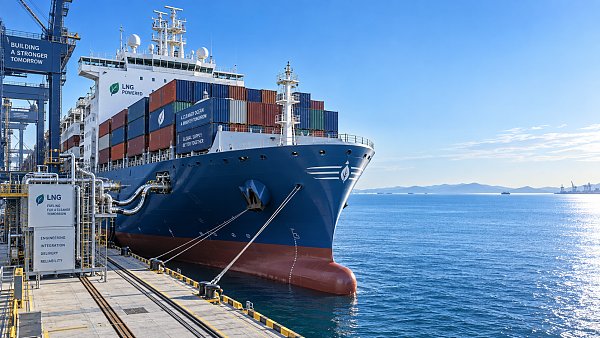
For financial decision-makers evaluating newbuild programs, understanding what drives LNG carriers costs is essential to balancing capital discipline with long-term asset value. From containment systems and dual-fuel propulsion to shipyard capacity, regulation, and delivery timing, LNG carriers involve a complex cost structure that directly shapes project returns, financing confidence, and competitive positioning in the global energy transport market.
Why are LNG carriers so expensive compared with many other vessel types?
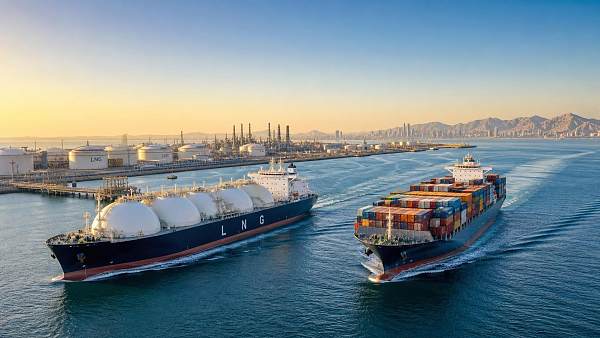
The short answer is that LNG carriers are not standard cargo ships. They are highly specialized floating energy transport assets built to handle liquefied natural gas at approximately minus 163 degrees Celsius. That single operating requirement changes almost every major cost category in a newbuild project. Hull design, insulation, cargo containment, gas handling systems, safety engineering, propulsion choices, boil-off gas management, crew considerations, and regulatory compliance all become more demanding than in conventional bulk, tanker, or container ship construction.
For a financial approver, the key point is that LNG carriers costs are not driven by steel tonnage alone. A large part of the budget sits in advanced systems, licensed technologies, specialist fabrication, and quality assurance. In practical terms, this means capex is more exposed to technology selection, yard experience, and supply chain bottlenecks than many non-cryogenic vessel classes.
There is also a market structure issue. Only a limited number of shipyards can build high-spec LNG carriers at scale and with acceptable delivery certainty. When global demand rises because of energy trade shifts, fleet renewal, or charter market strength, pricing power moves quickly toward those yards. This is why budget estimates for LNG carriers can move materially within a short period even when commodity inputs do not change at the same speed.
Which components usually contribute the most to LNG carriers costs?
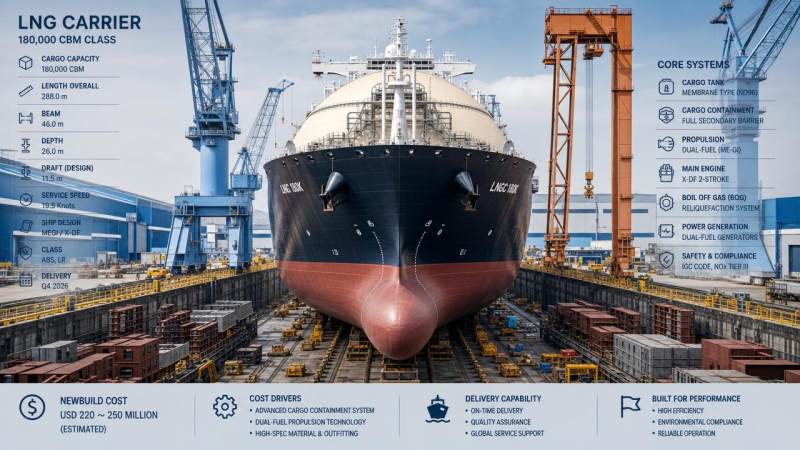
For most newbuild programs, the biggest cost drivers can be grouped into five areas: cargo containment, propulsion and machinery, shipyard construction capacity, compliance and safety systems, and project delivery risk. Each of these categories has direct financial implications and indirect effects on operating economics, charter attractiveness, and residual value.
Cargo containment systems are often among the most important variables. Membrane systems and Moss-type tanks differ in engineering complexity, fabrication methods, cargo volume efficiency, and maintenance implications. Licensed membrane technologies, for example, can improve cargo utilization and commercial flexibility, but they also require specialist know-how, strict installation controls, and qualified suppliers. That combination pushes up cost but may support better long-term earnings depending on trade route and charter profile.
Propulsion is another major cost center. Modern LNG carriers increasingly use dual-fuel engines, advanced reliquefaction capability, and optimized boil-off gas handling to reduce fuel loss and improve environmental performance. These systems raise initial capex, yet they often enhance lifecycle economics by lowering fuel consumption, supporting compliance, and improving charterer preference. Financially, the decision should be tested not only on purchase price but on time-charter equivalent potential, emissions exposure, and future fuel flexibility.
The third factor is yard capability. A first-tier yard with an established LNG carrier record may quote a higher contract price than a less proven builder, but it can reduce costly uncertainty related to rework, slippage, performance guarantees, and final acceptance. For approval teams, lower execution risk often justifies a higher headline number if debt drawdown timing, charter delivery windows, and revenue commencement are critical.
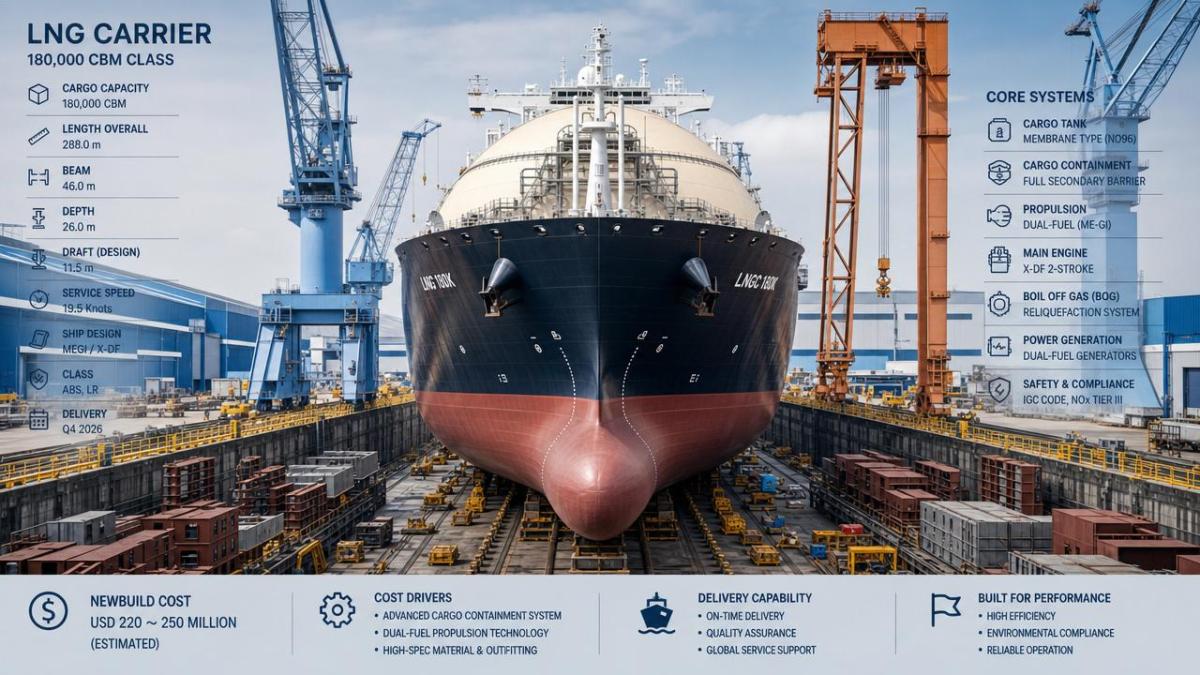
Quick reference: where the money usually goes
How do containment systems and propulsion choices change the investment case?
This is one of the most important questions for finance teams because it affects both acquisition cost and revenue quality. In LNG carriers, technology choices are not just engineering preferences. They define fuel efficiency, boil-off management, cargo retention, maintenance behavior, and charter market appeal.
A lower-cost technical specification may improve initial budget optics, but if it leads to inferior boil-off performance or less efficient fuel consumption, the vessel may earn lower charter rates or face narrower employment options. Conversely, a premium configuration may require stronger board justification today while delivering superior long-term competitiveness, especially in a market where charterers prefer efficient, regulation-ready tonnage.
When reviewing LNG carriers costs, financial decision-makers should compare at least three layers of value. First is direct build price. Second is operating cost over the financing horizon, including fuel, maintenance, and potential off-hire. Third is strategic asset value, which includes charterability, emissions resilience, and resale positioning. In many cases, the cheapest newbuild is not the lowest-risk asset.
This is where an intelligence-led approach matters. Platforms such as GTOT help teams connect vessel technology decisions with broader shipping cycles, component trends, and compliance trajectories. For LNG carriers, that means not evaluating propulsion or containment in isolation, but linking them to market timing, tender competitiveness, and the long-term direction of decarbonized maritime transport.
What external market factors can push LNG carriers costs up even if the design stays the same?
Many cost overruns or pricing surprises come from market conditions rather than from dramatic technical changes. Shipyard utilization is often the first trigger. When yards are full with LNG carrier orders, pricing rises because available slots become scarce. In hot cycles, buyers may also accept less favorable contract terms to secure earlier delivery, which effectively increases total economic cost even if the base contract value seems manageable.
Equipment supply chains matter as well. LNG carriers depend on specialized valves, cryogenic materials, insulation modules, automation systems, and engine packages from relatively concentrated supplier networks. If one of those areas experiences a bottleneck, the result may be escalation, delayed integration, or higher contingency requirements. Finance teams should therefore review supplier concentration risk, not just headline shipyard quotations.
Regulation is another external variable. Environmental rules, methane emissions scrutiny, safety updates, and fuel-intensity requirements can all reshape specification expectations. Even before a rule becomes mandatory, charterers and lenders may begin pricing future compliance into today’s decisions. That is why LNG carriers costs should be assessed against probable regulatory trajectories, not only current minimum standards.
Currency movements, interest rates, and export credit conditions also influence final economics. A vessel ordered in one interest-rate environment can look very different by the time milestone payments accelerate. For approval committees, this means the “cost” of LNG carriers is partly a financing structure question. Hedging strategy, payment schedule, refund guarantees, and debt covenant flexibility all deserve board-level attention.
What are the most common mistakes financial approvers make when reviewing LNG carrier newbuild budgets?
A frequent mistake is focusing too heavily on contract price while underestimating schedule risk. In LNG shipping, late delivery can destroy value if it misses a charter commitment, a seasonal market window, or a strategic fleet entry plan. A cheaper yard that cannot reliably deliver on time may become the more expensive option after accounting for lost revenue and financing carry.
Another mistake is treating contingency as a generic line item. With LNG carriers, contingency should be structured around identifiable risks such as technology integration, owner-furnished equipment delays, material inflation, testing complexity, and regulatory changes. Precision matters. A vague contingency budget may look prudent, but it does not help management understand where exposure truly sits.
Some teams also overlook the relationship between technical specification and future liquidity. If the vessel is built with a less favored propulsion setup or lacks the efficiency profile preferred by top charterers, refinancing and resale options may weaken. In other words, LNG carriers costs must be evaluated together with asset marketability. A ship is not only a transport unit; it is also a long-duration financial instrument.
Finally, there is often insufficient cross-functional review. Shipbuilding decisions can become siloed between technical, commercial, and finance departments. The strongest approval processes combine all three perspectives: whether the vessel can be built well, whether it can be employed profitably, and whether the capital structure remains robust under downside scenarios.
Common review errors and better questions to ask
How should financial decision-makers evaluate whether LNG carriers costs are justified?
A disciplined review should start with market logic, not ship specification alone. Ask whether the intended trade route, charter structure, and fleet strategy support a newbuild rather than secondhand acquisition or delayed ordering. If the commercial case is weak, even a technically attractive vessel may not justify investment.
Next, examine the cost stack in layers: base ship price, owner extras, financing cost during construction, contingency, and post-delivery optimization. Then test the project across multiple scenarios, including late delivery, lower charter rates, higher financing costs, and tighter emissions rules. This sensitivity analysis often reveals whether current LNG carriers costs are manageable or overly dependent on optimistic assumptions.
It is also useful to divide value drivers into protectable and non-protectable categories. Protectable value includes better efficiency, stronger yard guarantees, superior technical configuration, and charter-backed revenue visibility. Non-protectable value includes market optimism that depends mainly on future spot strength. Boards and lenders generally respond better when a larger share of the business case sits in protectable value.
For companies operating in a broader transport and equipment ecosystem, such as the audience served by GTOT, this evaluation should also connect with strategic intelligence. The same discipline used to assess rail control systems, braking reliability, or smart vessel digitalization applies here: identify the mission-critical subsystem, map the technical dependency chain, and quantify how performance or delay affects asset value. In LNG carriers, that systems-thinking approach is especially important because seemingly small technology choices can have outsized financial consequences.
Before approving a newbuild, what questions should be clarified first?
Before a final go-ahead, financial approvers should request clear answers on several points. What exact containment and propulsion configuration is being proposed, and why is it commercially superior for the intended employment? Which shipyard is selected, what is its LNG carriers track record, and how credible is the delivery schedule? What supplier bottlenecks could affect milestone payments or commissioning? How much of the revenue case is backed by charter coverage or customer demand visibility? And how would the project perform if capital costs stay elevated longer than expected?
They should also confirm whether the vessel specification supports future compliance rather than minimum present compliance. In a market moving toward tighter decarbonization and performance transparency, future-ready design can protect both earnings and financing access. That does not mean buying every premium feature; it means understanding which features are truly strategic and which are optional.
If further validation is needed, the most productive next conversations usually focus on five areas: target trade and charter profile, technical specification rationale, shipyard execution evidence, financing and hedging structure, and downside-case resilience. Clarifying these questions early helps determine whether LNG carriers costs are simply high, or whether they are justified by durable commercial and strategic value.
Recommended News
 Sep 29, 2026What drives traction systems price differences between rail projects?Traction systems price differences explained: compare duty cycles, voltage compatibility, integration, localization, and lifecycle costs for smarter rail procurement.
 Sep 26, 2026What to assess before selecting an electric traction system manufacturerChoose an electric traction system manufacturer with confidence. Explore key criteria for performance, reliability, safety, integration, energy efficiency, and lifecycle support.
 Sep 25, 2026When do full digitalization systems justify the investment?Full digitalization systems: discover when rail and maritime operators can turn connected data into safer operations, higher availability, and measurable ROI.
 Sep 23, 2026What drives automatic train control systems cost on rail projects?Automatic train control systems cost depends on integration, migration, safety testing, communications, and lifecycle support. Explore the key budget drivers for rail projects.
 Sep 21, 2026How to assess an ocean going vessel builder’s delivery riskAssess an ocean going vessel builder’s delivery risk with proven checks for schedules, capacity, design maturity, critical equipment, quality, and project controls.
 Sep 20, 2026What drives rail safety technology costs over a project lifecycle?Rail safety technology cost goes beyond equipment—explore lifecycle drivers from integration and safety assurance to cybersecurity, commissioning, and obsolescence.
 Sep 16, 2026What to verify before choosing an advanced ocean-going vessels supplierAdvanced ocean-going vessels supplier checklist: verify design authority, build quality, digital systems, delivery reliability, and lifecycle support before you buy.
 Sep 15, 2026What rail safety technology best reduces level-crossing risks in Southeast Asia?Rail safety technology Southeast Asia: discover how fail-safe signalling, barriers, obstacle detection and remote monitoring reduce level-crossing risks.
 Sep 14, 2026How exporters can reduce customs delays in global trade logisticsGlobal trade logistics for exporters: reduce customs delays with accurate data, clearance-ready documents, early filing, and proactive exception management.
 Sep 13, 2026When do global transportation network systems reduce delivery delays?Global transportation network systems reduce delivery delays by improving rail-port-vessel coordination, real-time visibility, and proactive decisions across complex land-sea supply chains.
 Sep 09, 2026When should you choose a rail and maritime manufacturer with dual-sector capability?Rail and maritime manufacturer guide: learn when dual-sector capability reduces integration risk, improves lifecycle support, and strengthens rail-to-port operations.
 Sep 08, 2026What to verify before selecting a railway signalling equipment supplierRailway signalling equipment supplier checklist: verify safety evidence, integration, cybersecurity, delivery capability, and lifecycle support before award.
 Sep 07, 2026How to size a traction power transformer for railway load demandTraction power transformer sizing guide: model railway load demand, peak duty, voltage regulation, harmonics, and contingency capacity for reliable service.
 Sep 07, 2026How do customization options for industrial connectors affect lead times?Customization options for industrial connectors can impact lead times, cost, and compliance. Learn how to specify smarter for rail and marine projects.
 Sep 05, 2026What information should an industrial sourcing guide include?Industrial sourcing information procurement guide: evaluate suppliers, compliance, lifecycle costs, interfaces, and lead times for smarter rail and maritime purchasing decisions.
 Sep 01, 2026How to find reliable maritime tender information before biddingMaritime tender information: learn how to verify sources, define bid-ready scopes, check qualifications, and reduce risk before submitting competitive marine bids.
 Aug 30, 2026How to select railway automation equipment for depots with phased upgradesRailway automation equipment for depots: learn how to plan phased upgrades that improve safety, throughput, integration, and lifecycle control.
 Aug 27, 2026How industrial sourcing intelligence pricing data supports budget approvalIndustrial sourcing intelligence pricing data helps teams benchmark scope, assess supplier risk, and build defensible budget approvals for complex rail and maritime assets.
 Aug 26, 2026When does a marine fuel efficiency solution make financial sense in the Middle East?Marine fuel efficiency solution Middle East: learn when retrofit savings, compliance value, and vessel data align to deliver credible ROI and smarter shipping investment decisions.
 Aug 24, 2026When does maritime automation for tankers deliver a real payback?Maritime automation for tankers delivers real payback when it cuts fuel use, reduces cargo risk, and improves uptime. See how owners can time investment for stronger ROI.
 Aug 23, 2026When do maritime logistics systems in the Middle East justify the costMaritime logistics systems Middle East: discover when rising delays, manual coordination, and poor visibility make system investment the smarter move for regional operators.
 Aug 22, 2026What drives vessel navigation system price for commercial fleetsVessel navigation system price depends on integration, compliance, automation, and support—not just hardware. Learn what drives fleet costs and compare quotes with confidence.
 Aug 21, 2026How to assess shipbuilding maritime tenders before biddingShipbuilding maritime tenders require more than price checks. Learn how to assess technical scope, compliance, supply chain, and commercial risk before bidding with confidence.
 Aug 20, 2026When does working with an ocean-going vessels distributor reduce supply risk?Ocean-going vessels distributor: learn when this partner cuts supply risk through stronger compliance, faster response, and better sourcing resilience in complex maritime procurement.